

The last box on the drawing: ordering a Galaxy Horizon lift-up with the run, not after it
Reviewed September 2026 · Captivating Cabinets
Prices quoted in this article were read off the grid on the review date; the live price grid on this page governs.
Every kitchen drawing has one cabinet that waits for something else to be decided, and it is nearly always the one over the appliance. Until the refrigerator or the range is chosen, nobody can say how wide the opening is, so the bridge above it is left as a dotted box while the rest of the order goes in. With a painted finish that delay costs little. With Galaxy Horizon, a stain whose maker says two parts may not match exactly, it is the single most expensive habit in the order. Two lift-up bridges exist in this finish, GH W421224LU and GH W481224LU, at $689.00 and $747.50, and this page is mostly about when to buy one rather than whether to.
What the two boxes are for

Both boxes are 12 inches high and 24 inches deep, which is the depth of the appliance under them rather than the 12 inches of an ordinary upper. The door is a single wide panel that lifts upward on a soft-close mechanism, which is how the listing describes it; the maker of that mechanism and its exact travel are not published, so treat both as a question for us before ordering.
What decides between them is the opening, and the opening is decided by the appliance.
| Code | W × H × D | Typical opening it closes | Displayed price |
|---|---|---|---|
| GH W421224LU | 42″ × 12″ × 24″ | An opening built to 42 inches, most often a 42-inch built-in refrigerator | $689.00 |
| GH W481224LU | 48″ × 12″ × 24″ | An opening built to 48 inches, most often a 48-inch built-in or side-by-side refrigerator | $747.50 |
Below 42 inches the ordinary 24-inch-deep boxes cover the job with side-hinged doors, and they are on the refrigerator wall cabinet page. GH W361224, the 36-inch one, is $370.50. The lift-up is not a nicer version of that box. It is the answer to a wider opening, which is why the appliance has to come first.
Why this cabinet ends up on a second order
Walk through how it usually goes. The run is measured, the layout agreed, the uppers and bases go on the first order because the lead time matters. The refrigerator, meanwhile, is still being argued about: counter-depth or built-in, 36 or 42, and whether the one on sale this month has the ice maker. So the bridge gets left off "until we know", and it is ordered on its own once the appliance arrives.
With a paint, a box ordered a month later is sprayed from the same colour formula, and it will look like its neighbours. With a stain the colour is not only in the finish. It is also in the wood that takes it, and wood varies board to board. The Allure spec book carries a note against every stained finish, Horizon included: because of the nature of wood and the complex finishing process, variations in colour "are considered normal". The warranty says the same from the other side, that replacement cabinets "may not match display samples and/or existing cabinets". Our own panels guide makes the same point about parts ordered after the fact: lots vary subtly between production runs.
Now place that late box in the room. It hangs alone above the appliance, usually between two tall panels or two uppers, at eye level, and its long face is the widest single stained door in the kitchen. If any part of the order is going to look like it came from another batch, this is the one that will show it, and the variation is normal by the maker's own definition, so there is no claim to make afterwards.
A long, low door, and the grain in its panel

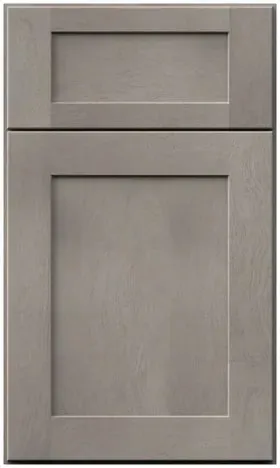
The Galaxy door is five pieces: a solid-wood frame of stiles and rails, and a recessed centre panel that Fabuwood's spec book describes as ⅜-inch "MDF/veneer", an MDF core with a wood veneer face. On a painted door that construction is invisible. On a stain the veneer is what you see, and its grain carries through the colour.
On nearly every other door in the run the centre panel is taller than it is wide. On these two it is the opposite: a strip roughly three and a half to four feet long and only a few inches high, at eye level, over the one appliance everyone walks up to. Whatever figure the veneer has is laid out along that strip, and a lively panel can read quite differently from the upright panels beside it.
Two things are not published: the wood species, and which way the veneer runs on a panel this wide. We will not guess at either. What you can do is look at the real thing. The door sample shows how the grain reads through this stain, and in Fabuwood's own photograph of the small sample the panel looks more figured than the frame around it. If the bridge is the focal point of the wall, ask us for a photograph of a Horizon lift-up door before you order, and we will request one from Fabuwood.
The bottom rail is where the wear goes
A side-hinged door is opened by its pull. A lift-up door is often opened by whatever part of the bottom edge a hand finds first, from underneath and slightly to one side, especially when that hand has just closed the refrigerator. Over years that edge takes more fingertips than any other stained surface on the wall.
Two things follow. Fit a pull, centred on the bottom rail, so hands have somewhere to go that is not the finish. And know how a stain is repaired, because it is not the way a paint is. Fabuwood's spec book rules out the aerosol: its finishes are too complex for spray cans to be offered on a stain. The repair is a small kit of fill stick, marker and scraper, sold for this finish at $62.40 (TOUCH UP KIT) on the loose parts page. A marker blends a worn edge well; it will not respray a panel.
For cleaning, Fabuwood asks for gentle products and a cloth that carries the cleaner, with nothing sprayed at the wood itself, and spills blotted up. On a bridge that mostly means fingerprints along the rail, which a damp cloth lifts.
Fillers and sides for a box that is twice as deep
Most bridges need at least one thin stained part beside them. The opening is rarely exactly 42.0 or 48.0 inches once the surround is built, and a filler takes up the difference. Wall fillers in this finish start at $26.00 for GH WF330; they come taller than this box and are cut down to its 12 inches on site, which is normal practice.
The same question applies to a side that shows. Where the bridge stands out past 12-inch uppers on either side, its end is visible, and the wall end skins in this finish (GH SK W30 to GH SK W42, $50.05 each) are sized for ordinary uppers. Ask us whether one covers 24 inches of depth before counting on it. Order every one of these thin parts with the box itself. A filler is a flat stained strip standing next to a framed door, and it is the easiest part in the kitchen to see a batch difference on. The decorative accessories page carries the skins, and the fillers are on the filler page.
Putting it on the first order
- Get the appliance model and its installation sheet, or commit to the opening width and buy to fit it.
- Measure the opening at the top and the bottom. Surrounds are rarely parallel, and the difference goes into the filler.
- Decide which sides of the bridge show, and ask whether the end skin covers 24 inches of depth.
- Put the bridge, its fillers and any skin on the same order as the run, so every stained part comes from one production.
- Order a door sample and hold it where the box will hang, under the light that reaches that wall.
We draw the opening and the box above it on a free 3D design. Expect a reply from a designer inside one business day, then the finished drawing and its quote in a day or two more. The boxes come built, door already hung, in about two weeks. The $35.00 door sample is on the samples page, the rest of the finish is on the collection page, and trade buyers order through Captivating Pro at trade pricing. If the appliance is still undecided the week you order, call us and we will help you settle the opening first.
Common questions
- Should I order the cabinet over the refrigerator after the fridge arrives?
- Not with a stained finish. Fabuwood notes that colour variation between stained parts is normal and that replacement cabinets may not match existing ones, so a bridge ordered weeks later is the part most likely to look different. Use the appliance's installation sheet, or fix the opening width, and order the bridge with the run.
- What sizes do lift-up wall cabinets come in for this finish?
- Two: GH W421224LU, 42 inches wide, and GH W481224LU, 48 inches wide. Both are 12 inches high and 24 inches deep, displayed at $689.00 and $747.50 on the review date.
- Does the grain show on a stained lift-up door?
- Yes. The Galaxy centre panel is MDF with a wood veneer face, and a stain lets that grain through. On a lift-up the panel is long and low, so its figure runs across a wide strip at eye level. The species and veneer direction are not published; ask us for a photograph of a real door if it matters to you.
- Can I touch up a stained cabinet with spray paint?
- No. Fabuwood's spec book says spray cans are not available for stained finishes. The touch-up kit (a stick, a marker and a scraper) is the repair, sold in this finish at $62.40, and it suits worn edges and small marks rather than whole panels.
- Do I need a filler next to a lift-up cabinet?
- Usually, because a built opening is rarely exactly 42 or 48 inches. Wall fillers come taller than the box and are cut to its height on site. Order them with the bridge so the thin stained strip and the door beside it come from the same production.
Keep reading
The guides behind the numbers on this page.
- Cabinet End Panels, Scribe Molding & Fillers Explained
Why panels and fillers ordered after the run can come from a different lot, and what each thin part does.
- Kitchen Cabinet Samples: How to Order & Evaluate
A long stained door is judged at eye level, in the light that falls on that wall; this is how.
- Important Kitchen Dimensions to Know Before Buying Cabinets
The appliance and opening measurements to have on paper before the first order goes in.
- Why Blum Soft-Close Hinges Are Worth the Investment
What the rest of the run hangs on, and how it differs from a door that lifts.
- Brown Kitchen Cabinets: Stains, Shades & Pairings
Why stains vary where paints do not, told from the brown end of the range.


