

Dozens of small stained pieces: the Galaxy Horizon wine lattice, and the six-inch question
Reviewed September 2026 · Captivating Cabinets
Prices quoted in this article were read off the grid on the review date; the live price grid on this page governs.
A door is a few large pieces of wood. A lattice is dozens of small ones, cut, crossed and finished together, and in a stain every one of those strips takes the colour a little differently. That is the first thing to know about the eight Galaxy Horizon wine racks, $273.00 to $620.75. The second is that four of them are six inches wide, which makes them an answer to a problem every layout has: the few inches left over at the end of a run.
Two shapes of rack
All eight are 12 inches deep with a diamond-pattern lattice, as the listings describe it. They come in two families that do quite different jobs:
| Code | W × H | Job | Displayed price |
|---|---|---|---|
| GH WC0630 | 6″ × 30″ | End-of-run column beside 30″ uppers | $273.00 |
| GH WC0636 | 6″ × 36″ | End-of-run column beside 36″ uppers | $305.50 |
| GH WC0639 | 6″ × 39″ | End-of-run column beside 39″ uppers | $318.50 |
| GH WC0642 | 6″ × 42″ | End-of-run column beside 42″ uppers | $341.25 |
| GH WR1515 | 15″ × 15″ | A small square feature bay | $321.75 |
| GH WR1818 | 18″ × 18″ | A larger square feature bay | $383.50 |
| GH WR3018 | 30″ × 18″ | A wide band, over a bar or a run | $575.25 |
| GH WR3618 | 36″ × 18″ | A wide band, over a bar or a run | $620.75 |
No listing publishes a bottle count. Count the openings in the product photograph, or ask us, before you plan a collection around one.
Why a lattice shows the stain's variation more than a door does
Fabuwood's spec book says it plainly for every stained finish: because of the nature of wood and the finishing process, variations in colour "are considered normal". On a door you see that as a slight difference between one door and the next. On a lattice you see it inside a single unit, because the unit is made of many short strips rather than a few large parts, crossing at dozens of points.
Under a paint, all of that vanishes into one colour. Under this stain it shows as a gentle patchwork of lighter and darker strips across the diamond. Most people who choose a stain like it, because it is what makes the rack read as wood rather than as a moulded grid. But if you want a lattice that reads as one even tone, a stain will not give you that, and it is better to know before ordering than after.
The lattice is also the part of a rack that takes knocks, from bottle shoulders sliding in and out of the diamonds. On a stain, the small dings those edges collect are marker work: the $62.40 TOUCH UP KIT on the loose parts carries the colour marker along with a fill stick and scraper, which is all a lattice edge needs.
Six inches left over: a filler, a pull-out or a column of bottles

Most runs end with a few inches that no standard box fills. At six inches there are three ways to close the gap in this finish, and the price spread between them is wide:
| Beside uppers of | Wall filler | 6″ wall pull-out | 6″ lattice column |
|---|---|---|---|
| 30″ | GH WF630 · $48.10 | GHZ SPO-WF630 · $438.75 | GH WC0630 · $273.00 |
| 36″ | GH WF636 · $65.00 | GHZ SPO-WF636 · $468.00 | GH WC0636 · $305.50 |
| 39″ | GH WF639 · $71.50 | GHZ SPO-WF639 · $471.25 | GH WC0639 · $318.50 |
| 42″ | GH WF642 · $78.00 | GHZ SPO-WF642 · $497.25 | GH WC0642 · $341.25 |
A filler is a flat strip. It costs least and stores nothing, and on a stain it is also the plainest piece of wood in the run, a six-inch-wide stripe of grain beside framed doors. Order it with the uppers so it comes from the same production.
The pull-out is a narrow sliding unit. It is the most expensive of the three and the most useful near the cooking, where oils and spices want to live. The listing does not detail its fittings, so ask what is inside before choosing it. It is on the cabinet accessories page.
The lattice column sits between the two in price and does something neither of the others does: it turns the leftover inches into a visible feature. Three or four bottles at the end of a run, or where the uppers stop against a window, reads as intended rather than as a gap someone had to fill. It suits a gap of six inches or a little more. Where there is an extra inch or two, a thin filler beside the column closes it, and should be ordered alongside.
Where a six-inch column looks intended
A lattice column is only a feature if it sits somewhere a feature makes sense. Three places where it does:
- At the open end of a run, where the uppers stop in the room rather than against a wall. The column closes the run with something to look at instead of a plain end.
- Beside a window, where the run meets the casing. A few bottles against the light from the glass read better than a strip of filler.
- Next to a tall cabinet or a refrigerator panel, where the height change already draws the eye.
The place it does not work is between two uppers in the middle of a run, where a six-inch lattice looks like a gap filled with trim. Fill that one with a filler or the pull-out, and keep the lattice for an end.
Dark bottles against a light stain
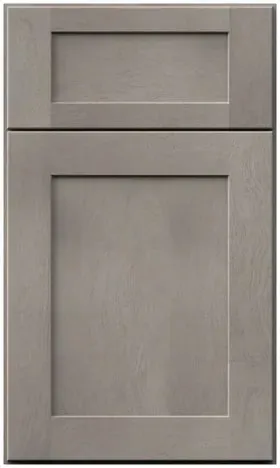
Fabuwood classes this finish as light in tone, and that changes how a rack reads once it is full. Wine bottles are mostly dark green or brown glass. Against a light grey-taupe lattice they read as a pattern of dark ovals, each one separated by a pale diamond, and the rack looks fuller than it is. On a dark stain such as Cobblestone the same bottles almost disappear into the frame, and what you see is the lattice.
So a half-full rack is less of a problem here than on a dark finish; a few bottles still read as a pattern. It also means clear-glass bottles and pale rosés are the ones that vanish, which is worth knowing if the rack is mostly for spirits or white wine.
If the rack is part of a bar rather than the kitchen, Fabuwood's own Horizon photographs pair this finish with copper accents, industrial touches and glass subway tile. Those are its choices, not ours, but they suit a bar wall well. Keep the rack off the wall behind the range and away from a sunny window: heat and light are bad for wine, and the warranty lists colour change from sunlight as not a defect, which matters for a many-pieced stained part that cannot be resprayed.
Ordering a rack
- Pick the shape by job: a 6″ column to close a run, a square for a feature bay, a wide band over a bar.
- Count the openings in the photograph, or ask, if capacity matters.
- Accept that the lattice will show strip-to-strip variation; that is the stain, not a fault.
- For a 6″ gap, compare the three options above and put whichever you choose on the same order as the uppers.
- Add a touch-up kit for the lattice edges.
A free 3D design shows exactly where a column or a band sits in the run, and whether the gap is really six inches. Replies come within a business day and the priced drawing soon after; the cabinets arrive assembled in about two weeks. Fillers are on the filler page, glass storage for stems on the stemware rack page, and the rest of this finish on the collection page. Contractors pricing a bar or a run of kitchens use Captivating Pro.
Common questions
- Will a stained wine rack be one even colour?
- Not exactly. A lattice is made of many short strips, and Fabuwood says colour variation in stained finishes is normal, so you will see gentle differences strip to strip. A painted finish hides that; a stain shows it.
- What can I put in a 6-inch gap between wall cabinets?
- In this finish: a wall filler ($48.10 to $78.00 depending on height), a 6-inch wall pull-out ($438.75 to $497.25), or a 6-inch lattice wine column ($273.00 to $341.25). Displayed prices on the review date.
- Is a 6-inch wine rack better than a filler?
- At the open end of a run or beside a window, usually yes: it turns a leftover gap into a feature for $224.90 to $263.25 more than a plain filler, depending on height. Between two uppers mid-run, a filler looks more natural.
- How many bottles does a lattice wine rack cabinet hold?
- The listings do not publish it. Count the openings in the product photograph, or ask us for the figure before ordering.
- Do wine bottles look good on light grey cabinets?
- Dark green and brown bottles read strongly against a light stain, so even a half-full rack looks deliberate. Clear bottles tend to disappear.
- Can a stained wine rack be touched up?
- Yes. Edge dings on the strips take a colour marker well; the finish kit for this colour is $62.40. An aerosol is not an option for a stain.
Keep reading
The guides behind the numbers on this page.
- Cabinet End Panels, Scribe Molding & Fillers Explained
The filler strip, and when a leftover gap is better closed with storage than with a plain piece.
- Space-Saving Cabinet Solutions That Actually Work
Narrow units and pull-outs that turn a few inches into storage.
- Brown Kitchen Cabinets: Stains, Shades & Pairings
Grain and colour variation in stained cabinets generally, which a lattice shows at close range.
- Wall & Tall Kitchen Cabinets: Sizes & Buying Guide
Standard upper heights, and which six-inch column matches each.


