

The box nobody remembers: getting every Galaxy Horizon single-door upper on the first order
Reviewed September 2026 · Captivating Cabinets
Prices quoted in this article were read off the grid on the review date; the live price grid on this page governs.
Ask anyone who has installed a kitchen which cabinet was missing on the day, and the answer is nearly always a narrow one. The 36-inch boxes get drawn first and counted twice; the 12-inch box beside the window, the 15-inch one next to the hood, the 9-inch strip at the end of the run are what the plan forgot or the wall revealed. On a painted door that is an irritation and a two-week wait. On Galaxy Horizon, a stain whose maker calls colour variation between doors normal, a box ordered months after the rest is the part most likely to look like it came from somewhere else. So this page is less about which narrow box to buy than about buying all of them, once.
Why the narrow upper is the one that turns up on a second order

There is a pattern to it. A layout starts with the big decisions: where the sink goes, how wide the range is, which wall gets the fridge. The wide two-door uppers follow those decisions almost automatically. What is left over is a set of short lengths of wall, and they are the parts people estimate rather than measure. Then the drywall goes up a little thicker than drawn, or the window casing is wider than the plan showed, or someone moves an outlet, and a box that was supposed to be 15 inches is now 12, or a gap nobody noticed appears beside the hood.
With most painted finishes the fix is simple: order the missing box, wait, hang it. The colour is a coating, and a later batch of the same paint lands close enough that nobody looks twice. A stain is different in kind. It soaks into the surface and lets the grain through, so each face frame and door carries its own figure and takes the colour a little differently. Fabuwood’s spec book puts a note against its stained finishes saying variations in colour are considered normal, and its warranty adds that replacement cabinets may not match display samples or existing cabinets. That is honest, and it is also the whole argument of this article: a narrow box ordered alone, later, is exactly the replacement-cabinet case the warranty is describing.
None of that means a late box will clash. Often it will be fine, especially up at eye level where it sits a door’s width from its neighbours. It means the odds are better if every upper on the wall comes off the same order, and the cheapest way to improve them is to find the narrow gaps now.
A walk along the wall before the quote is final
Do this with the plan in one hand and a tape in the other, ideally after the drywall is up and before the order is placed. Each item below is a place where a narrow single-door box tends to hide.
- Both sides of every window. Measure from the outside edge of the casing, not from the glass, and allow for the casing itself if new trim is going on. A window that sits off-centre on its wall leaves two different remainders, and each one wants its own answer.
- Both sides of the hood. A 30-inch range under a 36-inch hood is common, and the width left either side of the hood is rarely what the range width suggests. Measure to the hood you are actually buying.
- Beside the refrigerator. If the fridge sits in a surround of tall panels, the upper run stops at the panel, not at the fridge, and the last box before it is often narrow.
- Where the run meets a return wall. Walls are rarely square; measure at counter height and again at the ceiling, and take the smaller number.
- Around switches and outlets that land above the counter. A box cannot hang over a switch plate, and moving one after the fact costs more than a different width of cabinet.
- Under a soffit step or a beam. If the ceiling changes height partway along the wall, the box on either side of the step may need a different height from its neighbours.
Write the number for each one on the plan. Then compare it with the width grid: singles come 9, 12, 15, 18 and 21 inches wide, so any remainder resolves into one of those plus a filler. If you would rather we did the arithmetic, send the measurements and photos for a free 3D design; a designer replies within one business day and the drawing counts every box and every filler. Heights and the full size grid for uppers are in the wall and tall sizes guide.
The narrow sizes and what each one costs
Five widths, stocked at six heights except the 9-inch, which starts at 30 inches tall. Two heights cover most kitchens — 30 inches under an 84-inch line and 42 inches to an 8-foot ceiling — so those two columns are shown here at displayed prices on the review date. The full ladder, including the 15-, 18-, 36- and 39-inch heights, is on the product grid above.
| Width | 30″ tall | 42″ tall | Where it usually goes |
|---|---|---|---|
| 9″ | GH W0930 — $208.00 | GH W0942 — $282.75 | Spice or tray slot beside a range |
| 12″ | GH W1230 — $227.50 | GH W1242 — $302.25 | End of a run against a return wall |
| 15″ | GH W1530 — $234.00 | GH W1542 — $325.00 | Either side of a 36″ hood |
| 18″ | GH W1830 — $273.00 | GH W1842 — $354.25 | Beside a window, or over a dishwasher |
| 21″ | GH W2130 — $295.75 | GH W2142 — $416.00 | The widest single; past this it is two doors |
Two things stand out. The first is how little separates the narrow widths at 30 inches: the 12 and the 15 are six dollars fifty apart, so when a remainder sits between them the price should not decide it; the gap and the filler should. The second is the jump from 18 to 21 inches at 42 tall, $61.75, larger than any other step in that column. A 21-inch door is also the widest single door on the wall, and it swings a long way into the room. If a 21-inch gap can be split into an 18-inch box and a 3-inch filler without spoiling the layout, the smaller box is cheaper and the door is easier to live with.
Put the uncertainty in the filler, not the cabinet
Here is the practical trick, and it is cheap. A cabinet cannot be cut to fit on site; a filler can. A wall filler is a flat strip of finished face material that an installer rips down to the exact width the wall leaves, so it is the part of the run designed to absorb error. That makes fillers the right place to keep your tolerance, and on a stain it makes them the right thing to over-order, because a spare filler from the same shipment is already the same colour as everything around it.
The strips are inexpensive. At 3 inches wide: GH WF330 is $26.00, GH WF336 $34.45 and GH WF342 $41.60. At 6 inches: GH WF630 is $48.10, GH WF636 $65.00, GH WF639 $71.50 and GH WF642 $78.00. One spare at each height you are using costs less than a single narrow box, and it covers the most common late surprise — a gap an inch or two wider than drawn — with material from the same run. The difference between a strip, a skin and a panel is explained in the fillers and end panels guide, and every filler in this finish is on the filler page.
The converse matters too. If a remainder is borderline between a narrow box and a wide filler, take the box and shrink the filler, not the other way round. A 6-inch filler that has to become a 9-inch one cannot, but a 9-inch box with a 1-inch strip beside it is a normal detail that no one notices.
The box beside the window ages on its own schedule
Narrow boxes gather around windows, and that puts them in the brightest spot on the wall. Fabuwood’s warranty is plain that colour change from sunlight and UV exposure is not a defect, and that finishes may darken or lighten over time. It does not say by how much, and we have no Horizon-specific fading reports to quote. What it does mean is that a box in direct afternoon sun is not guaranteed to keep pace with the one in the shade two feet away.
Two sensible responses, neither expensive. Put a blind or a sheer on a window that throws hard light across the uppers for part of the day. And when you check the door sample at home, hold it on that wall at different times of day, not only on the counter. One homeowner who installed this finish in 2022 described it on Houzz as looking cold or dull on a cloudy day and warm on a sunny one; the swing the window causes is part of what you are buying, and it is worth seeing before you commit. How to judge a sample under your own light is covered in the sample guide.
Knocks at shoulder height, and what a touch-up kit does

A narrow upper next to a window or a hood takes more knocks than the wide ones: a pan handle on the way to the range, a blind cord, a ladder on the way to the curtain rail. The corners of the door and the face-frame edge are where it shows.
This is one place a stain behaves differently from a paint, and it is worth knowing before anything happens. Fabuwood’s spec book states that paint spray cans are not available for stained finishes. What exists instead is a touch-up kit, sold for this finish at $62.40, which Fabuwood describes as a stick, a marker and a scraper. The fill stick goes into a dent or chip, the scraper levels it, and the marker colours it in so the grain line carries across. It hides a small mark well at arm’s length. It does not refinish a scuffed door, and it will not undo sun change. Order the kit with the cabinets so it is in the drawer the day it is needed, and keep it with the rest of the loose parts. General cleaning and care is in the cabinet care guide.
Putting the narrow boxes on the quote
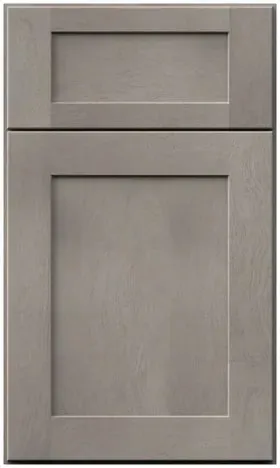
Every narrow box is still a real Allure cabinet: a ½-inch veneered plywood box with a natural finished interior, a solid wood face frame, and a five-piece door with a ⅜-inch recessed centre panel that Fabuwood specifies as MDF with a veneer face, which is why the grain shows through the stain on the panel as well as the frame. The hinges are Blum soft-close with quick release. Hand is written on the order line in words — “hinges on the left as I face it” — rather than coded into the part number.
Alongside the boxes: a finished skin for any side the room can see, GH SK W30, GH SK W36, GH SK W39 or GH SK W42 at $50.05 each (listed on the cabinet skin page); crown if the run stops short of the ceiling, from GH CM-1 at $117.00 (see the crown molding page); the fillers above; and the touch-up kit. Boxes ship pre-assembled with the doors hung, in about 2 weeks. If you are buying for a job, trade pricing runs through Captivating Pro, one program with no tiers and no logins. The rest of the uppers in this finish are on the wall cabinet page, and everything else on the collection page.
Common questions
- If I order another stained cabinet later, will it match?
- It may be close, but it is not guaranteed. Fabuwood notes that colour variation is normal on stained finishes and that replacement cabinets may not match existing ones. The safest plan is to find every narrow gap before ordering and put all the uppers on one order, with a spare filler at each height.
- What sizes do single-door wall cabinets come in?
- Widths of 9, 12, 15, 18 and 21 inches. The 12- to 21-inch widths come 15, 18, 30, 36, 39 and 42 inches tall; the 9-inch box starts at 30 inches. Anything wider than 21 inches is a two-door cabinet.
- Should I use a filler or a narrow cabinet at the end of a run?
- Keep the cabinet as large as the gap allows and let the filler take the remainder, because a filler is trimmed on site and a cabinet is not. Under about six inches, a filler alone is the usual answer; from nine inches up, a 9-inch box is available.
- Will a stained cabinet next to a window fade?
- Fabuwood’s warranty treats colour change from sunlight and UV as normal ageing rather than a defect, and says finishes may lighten or darken over time. It does not give a rate. A blind on a window that throws hard light across the uppers is the simple precaution.
- How do you touch up a stained kitchen cabinet?
- With a touch-up kit rather than a spray can. Fabuwood does not offer spray cans for stained finishes; the kit for this finish is $62.40 and contains a fill stick, a marker and a scraper for small chips and scratches.
- How much does a 12-inch wall cabinet cost in this finish?
- From $172.25 for the 15-inch-tall GH W1215 to $302.25 for the 42-inch-tall GH W1242 at displayed prices, with the common 30-inch GH W1230 at $227.50.
Keep reading
The guides behind the numbers on this page.
- Cabinet End Panels, Scribe Molding & Fillers Explained
Why the filler is the part built to be cut, and how much of it to plan.
- Kitchen Cabinet Samples: How to Order & Evaluate
Checking a stained sample on the wall it will live on, at more than one time of day.
- Wall & Tall Kitchen Cabinets: Sizes & Buying Guide
The full grid of upper widths and heights, including the ones not shown here.
- How to Clean and Care for Your Kitchen Cabinets
Day-to-day cleaning that keeps a stained face from needing the kit at all.
- Important Kitchen Dimensions to Know Before Buying Cabinets
The measurements to take before the narrow gaps are counted.
- How Free 3D Kitchen Design Works
Send a sketch and a few photos; the drawing that comes back counts every part.


