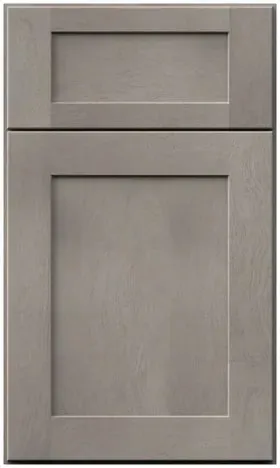


An inside you have not seen yet: buying an open Galaxy Horizon upper without a sample of its interior
Reviewed September 2026 · Captivating Cabinets
Prices quoted in this article were read off the grid on the review date; the live price grid on this page governs.
Every surface you will see in a kitchen can be judged before you buy it, except one. The door sample tells you how the face will look; a photograph of the run tells you the rest. What neither tells you is how the inside of an open box looks when it has been stained to match, and on the twenty no-door Galaxy Horizon uppers, $328.25 to $741.00, the inside is the product. This page is honest about what we know, what we do not, and how to find out before the order goes in.
What the listing says, and what it leaves out

The listing is clear on the principle. These are open-front wall cabinets from the Matching Interior series, "no doors, with the interior finished to match the exterior in Galaxy Horizon". An ordinary Allure box is finished inside in natural wood veneer. These are not; the sides, back and shelves carry the same finish as the frame.
What the listing does not do is show it, and with a stain that matters more than with a paint. A painted interior is the same opaque colour as the painted face, and you can picture it accurately. A stained interior is a stain on a different piece of wood. The face frame is solid wood and the door panel is veneered MDF, while the box is ½-inch veneered plywood. Different surfaces can take the same stain in slightly different ways, which is general finishing experience rather than anything Fabuwood publishes for this finish. So the recess may read a touch lighter or darker than the frame around it, and its grain may be busier or quieter. Or it may be a very close match. We do not know, and we will not describe a surface we have not seen.
"We will just take the doors off later" is a different cabinet
People often plan to buy the doored box and remove the doors if they decide they want it open. It is worth knowing why that gives you something else.
- The inside of a doored box is natural wood veneer, not the finish. Take the doors away and you have a wood-lined hole in a grey-taupe run.
- The hinge plates are screwed to the frame. Take them off with the doors and their screw holes remain; an open box never had them.
- Swapping to a proper open box later means ordering a single stained cabinet months after the run. Fabuwood's own warranty wording says replacement cabinets may not match the existing ones, and a lone open box is one of the most visible places in the room.
So if you are undecided, decide now. Order the open box with the run, or order the doored box and accept that it will stay doored. For a halfway option, the glass doors page covers fronts that show the contents but still close. The Galaxy glass lines describe themselves as an open frame that accepts glass, so confirm exactly what arrives, and what the interior behind it looks like, before ordering.
Plates slide, and a stain scratches differently

Inside a closed cabinet nobody notices the shelf. In an open box the shelf is on display and in use at once, with stacks of plates dragged out and slid back several times a day. The front edge and the floor of the bottom shelf take most of it.
How that wear looks depends on the finish. On a paint, a deep chip shows a different colour underneath. On a stain the colour sits in the wood under a clear topcoat, so wear tends to show as a dull or lighter track where the topcoat has thinned, rather than as a chip. That is general finishing behaviour rather than a published figure for this finish. It is less dramatic than a painted chip and harder to hide from close up.
Two habits help. Put small felt pads under heavy ceramics, and lift stacks rather than dragging them. For the marks that come anyway, there is no aerosol to reach for; Fabuwood does not make one for stains. Its kit (a filler stick, a colour marker and a small scraper) costs $62.40 as TOUCH UP KIT on the loose parts page. Buy one with the order. It is cheaper to have it on the shelf than to wait for it once you need it.
Where one open box belongs in a stained run
In a run of stained doors each door reads as a panel of grain inside a frame, repeated along the wall. An open box breaks that rhythm, and where it breaks it decides whether the gap looks planned. Three placements almost always work:
- At the end of a run, where the uppers stop against a window or a return wall. The open box finishes the run instead of interrupting it.
- As a matched pair either side of a hood or a window, so the break is symmetrical and clearly meant.
- Over a working station, a coffee corner or a baking counter, where what sits on the shelf is used there and the opening has a job.
The placement to avoid is a single open box somewhere in the middle of a long closed run, with doors on both sides and no reason for it to be there. It reads as a missing door. Remember too that the recess sits in its own shadow. An owner of this finish reports it looking cooler and duller on overcast days, and the inside of an open box is the part of the run that sees the least direct light. Put it where some light reaches it, or light it: the puck sets and strips are on the cabinet lighting page.
Ordering one
- Ask for a daylight photograph of a real Horizon matching-interior box, before you order.
- Choose the width with the premium table above in mind; 24 inches is the cheapest to open.
- Commit now: open or doored, not "doored for now".
- Put a touch-up kit and any skins for exposed sides on the same order.
The run, with the open bay placed and lit, comes back on a free 3D design. You hear from a designer by the next business day and have the priced plan within 24–48 hours, and the boxes ship assembled in about two weeks. The collection page has the rest of the finish, trade buyers use Captivating Pro, and if you want us to chase that interior photograph now, call us.
Common questions
- What does a stained matching interior look like?
- The listing says the interior is finished to match the exterior in this finish, but it does not show it. The box is veneered plywood while the frame is solid wood, and different woods can take a stain slightly differently. Ask us for a daylight photograph of a real cabinet before ordering.
- Why does an open cabinet cost more than one with doors?
- Because finishing the whole inside costs more than the door it replaces. At 36 inches high the open box costs $55.25 more than the doored one at 24 inches wide and $104.00 more at 18 inches, displayed prices on the review date.
- Can I remove the doors from a regular wall cabinet instead?
- You can, but the inside of a doored box is natural wood veneer, not the finish, and the hinge screw holes stay behind. It gives you a wood-lined box in a stained run, not a matching-interior cabinet.
- How do I fix a scratch on a stained open shelf?
- Use the finish kit sold for this colour at $62.40, which pairs a colour marker with a fill stick and scraper. There is no spray can for a stain. Felt pads under heavy dishes prevent most of the wear.
- Which open wall cabinet width is the best value?
- At 36 inches high the 24-inch width carries the smallest premium over its doored twin, 13%. The 15 and 18-inch widths cost about a third more than their doored versions.
Keep reading
The guides behind the numbers on this page.
- Plywood vs MDF vs Particle Board Cabinets
What the box is made of, and why a veneered plywood interior is a different surface from a solid frame.
- Kitchen Cabinet Samples: How to Order & Evaluate
What a door sample tells you, and the surfaces, like an interior, that it cannot.
- How to Clean and Care for Your Kitchen Cabinets
Dusting and wiping a shelf that is always on show, without wearing the topcoat.
- Kitchen Cabinet Terminology: Terms & Abbreviations
NDW, matching interior, face frame: the words on this page, defined.
- Brown Kitchen Cabinets: Stains, Shades & Pairings
Stain against paint in general, which is the question behind this page.


