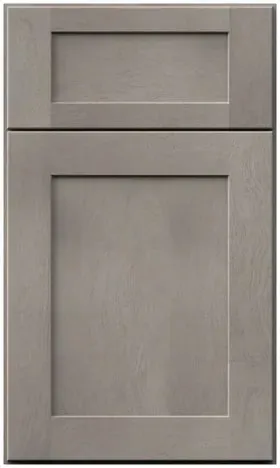


Galaxy Horizon fillers: settle every size before the first order ships
Reviewed September 2026 · Captivating Cabinets
Prices quoted in this article were read off the grid on the review date; the live price grid on this page governs.
A filler is a strip of finished wood that closes the gap between stock cabinet widths and the real wall. On a painted kitchen, forgetting one is an annoyance and a second delivery. On the Galaxy Horizon stain it is a little more than that, because a stain lets the wood show through, and a strip made in a later finishing run is the part most likely to look a shade off beside the door it touches. So this page is less about what a filler is and more about when its size can be known, so that every one of them ships in the first order.
Why fillers are the part that ends up in a second box
Look at how a kitchen order actually gets finalised. The cabinets are chosen off a plan drawn to round numbers. The fillers are whatever is left over, and what is left over depends on things that are often not true yet when the plan is drawn: the dishwasher model, the window trim, the finished wall. So fillers get pencilled in, the order is released, and on install day someone with a tape discovers that the three-inch strip should have been six, or that a return nobody drew needs one too.
With a paint that means a reorder and a wait. With a stain there is a second issue. Fabuwood’s specification book says plainly that, because of the nature of wood and the multi-step process used to make its stained finishes, colour variation is normal. Its warranty adds that a replacement part may not match cabinets already installed. Neither sentence is a defect notice; both are simply how stains work. But put them together and the risk lands in one predictable place: a filler from a later run, fixed tight against a door from the first run, where the eye compares the two across a hairline joint.
None of that means a late filler will look wrong. Most of the time it will be close enough that nobody notices. It means the cheapest protection available is to settle the sizes early, and the rest of this page is how.
Six facts that fix a filler size, and when each one is known
Each of these changes the width or height of at least one strip. The column that matters is the second one: the point in the project when the fact stops being a guess.
- The appliance models, not the categories. A 30-inch range from one maker and a 30-inch range from another want different clearances either side. Pick the exact model and send its installation sheet; the filler beside it comes off that sheet.
- The window and door casings. Trim is often chosen after cabinets, and a wider casing eats the inch you were counting on. Measure to the finished casing, or tell us the profile you intend to buy.
- The walls as built. Plaster and drywall corners are rarely square. Once the walls are up, measure each run at the floor, at counter height and at the top of the uppers; the smallest number is the one the order needs.
- The backsplash. A full-height stone slab behind the counter can be three-quarters of an inch or more thick, and it pushes the wall filler out by that much. Tile is thinner. Decide which before the wall run is finalised.
- The pulls. At an inside corner the filler has to clear the projection of the handle on the run next to it. A long bar pull asks for more room than a knob, so the hardware choice belongs before the order, not after.
- The ceiling. Tall fillers come at 96 and 120 inches and overlay fillers stop at 96, so the finished ceiling height and the crown plan decide which part a pantry or oven tower needs.
Every one of those can be known before the cabinets are released. That is the whole trick: the order waits for the walls, the model numbers and the hardware, rather than the fillers waiting for the install. Our free 3D design asks for all six, and a designer replies within one business day, with the full drawing and quote back in 24 to 48 hours.
The 24 parts, sorted by the height they have to match
A filler can be ripped narrower on site. It cannot be made taller. So the useful way to read this list is by height first, then by whether you want a plain strip (WF, BF, TF) or an overlay filler (OLF), which the store lists separately and prices higher.
| Height it matches | Plain strip | Overlay filler |
|---|---|---|
| Base cabinets | GH BF3 $26.00 · GH BF6 $43.55 | none listed |
| 30″ uppers | GH WF330 $26.00 · GH WF630 $48.10 | GH OLF330 $71.50 · GH OLF630 $113.75 |
| 36″ uppers | GH WF336 $34.45 · GH WF636 $65.00 | GH OLF336 $84.50 · GH OLF636 $146.25 |
| 39″ uppers | GH WF639 $71.50 (no 3″ plain part listed) | GH OLF339 $87.75 · GH OLF639 $156.00 |
| 42″ uppers | GH WF342 $41.60 · GH WF642 $78.00 | GH OLF342 $94.25 · GH OLF642 $172.25 |
| 84″ to 96″ talls | GH TF396 $84.50 · GH TF696 $152.75 | GH OLF384 $208.00 · OLF390 $221.00 · OLF393 $221.00 · OLF396 $230.75 |
| 120″ talls | GH TF3120 $156.00 | none listed |
Two gaps in that grid are worth knowing before you plan around them. There is no plain 3-inch strip at 39 inches: if your uppers are 39 inches tall and the gap is three, the choices are GH WF639 ripped down or the overlay GH OLF339 at $87.75. And there is no overlay part at base height or at 120 inches, so those runs take the plain strip.
The product listings do not say how an overlay filler is built, or which way the grain runs on any of these parts. If the face or the grain direction matters to how you intend to cut one, ask before the order is released and we will confirm it with Fabuwood rather than guess. The fillers, scribe and end panels guide covers what each family is for in general terms.
A filler at a window return catches light the doors do not

Where a run stops at a window, the filler sits in the one spot that gets light from the side, across its surface, while the doors a foot away are lit from the front. On a paint that makes little difference. On a stain with visible grain, light that crosses a surface raises the texture and can lift or deepen the tone. People who live with this finish describe it as reading cooler and duller on overcast days and warmer in sun, and a filler beside the glass sees the most extreme version of that.
Two things follow. Keep window-return fillers as narrow as the casing allows, because a narrow strip in cross light reads as a line and a wide one reads as a panel. And if one filler in the kitchen has to come from a later order, do not put it here. Put the later part where the light is even — under the uppers, in a corner, beside the fridge — and move a first-order strip to the window.
If a second order cannot be avoided
Sometimes it cannot. A strip gets mis-cut, an appliance is changed after delivery, or a wall turns out worse than any measurement suggested. Here is how we handle it so the join is as quiet as it can be.
- Order the moment the need is known, not when the rest of the install is finished. Galaxy ships in about two weeks, so a reorder placed on day one of the install can arrive before the counters are templated.
- Tell us exactly which door the new part will sit beside, and send a daylight photo of that door. It does not change how the part is made, but it lets us flag anything unusual before it ships.
- When it arrives, hold it uncut against the installed doors in two places: by the window and in the darkest corner. Decide where it goes after that comparison, not before.
- Swap positions if it helps. A first-order filler in a hidden spot — behind the fridge, at the end of a run nobody faces — can move to the visible gap, and the new part takes its place.
Putting them on the first release
In practice the rule is short: no cabinet order goes out until the six facts above are known, and every filler the drawing shows goes out with it, plus one spare at each height you are using. A spare 3-inch base strip is $26.00. A spare is not about waste; it is about making sure that if a strip is ruined, its replacement comes from the same run as its neighbours.
If a gap beside the range is going to hold something rather than just close a space, that is a different product and a different decision: the filler pull-outs run from GHZ SPO-BF3 at $334.75 up to the slim GHZ SSPO-BF1-1/2 at $1,313.00 and live on the cabinet accessories page. They are planned into the base run, so they belong on the same first order.
Everything here ships pre-assembled with the cabinets. The fillers are here, the rest of the trim is on the decorative accessories page, and the cabinets they sit between are on the collection page. Contractors placing repeat orders can get trade pricing through Captivating Pro, one program with trade pricing and no tiers.
Common questions
- Will a filler I order later match the cabinets I already have?
- Probably closely, but not guaranteed. Fabuwood states that colour variation is normal in its stained finishes and that replacement parts may not match cabinets already installed. That is why we settle filler sizes before the first order, and why a later part is best placed where the light is even rather than beside a window.
- Why is there no 3-inch plain wall filler at 39 inches?
- It is not on the live list for this finish. At 39 inches you can rip GH WF639 ($71.50) down to width, or use the overlay part GH OLF339 at $87.75. The other upper heights (30, 36 and 42 inches) have both a 3-inch and a 6-inch plain strip.
- Can I buy a raw strip and stain it to match?
- We would not. Fabuwood does not publish the wood species behind this finish, and the stain is a multi-step factory process, so a locally stained strip starts from an unknown and aims at a moving target. A factory filler is $26.00 to $156.00 for the plain parts.
- Which way does the grain run on a filler?
- The product listings do not say. If you plan to cut a 6-inch part down or use a strip in an unusual orientation, ask us before the order is released and we will confirm it with Fabuwood.
- What should I do if a filler gets scuffed during install?
- Use the touch-up kit, not paint. Fabuwood repairs stained finishes with a touch-up kit rather than a spray can; the Horizon kit is on the loose parts page at $62.40. Order it with the cabinets so it is on site when the fillers go in.
- Do I need an overlay filler or a plain one?
- A plain strip closes the gap for the least money. The overlay versions cost more ($71.50 to $230.75) and are listed as a different part; if how the face looks in a prominent spot matters, ask us what an overlay filler looks like in this finish before choosing it.
Keep reading
The guides behind the numbers on this page.
- End Panels, Scribe Molding and Fillers Explained
What each of the three gap-closing parts is for, before you size any of them.
- Important Kitchen Dimensions Before Buying Cabinets
How to measure a finished wall so the filler sizes are right first time.
- Wall and Tall Cabinet Sizes
The upper heights a wall filler has to match, including 39 inches.
- Gray Kitchen Cabinets: Finding the Right Shade
Why this grey-taupe reads warmer in sun and cooler on a grey day.
- How to Clean and Care for Kitchen Cabinets
Keeping a stained finish, fillers included, looking the way it arrived.


