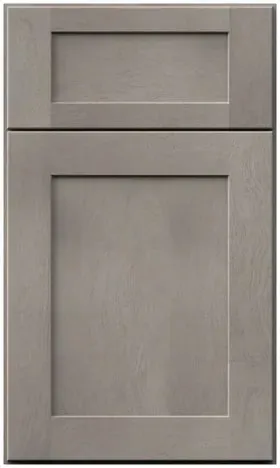


Galaxy Horizon cabinet skins: a flat stained side beside a five-piece door
Reviewed September 2026 · Captivating Cabinets
Prices quoted in this article were read off the grid on the review date; the live price grid on this page governs.
A cabinet skin is a thin finished sheet fixed over the exposed side of a box, and the Galaxy Horizon list has nine of them, one for each kind of end. On a paint, a skin and a door are the same opaque colour and the only question is fit. On a stain the question is how a flat face sits next to a door that is itself made of two different surfaces — a solid wood frame and a veneered centre panel — because the corner where they meet is exactly where the eye compares them. The answer shapes which ends get the most attention and how the skins in one delivery are shared out.
The nine skins, and the end each one covers
| SKU | Covers | Price |
|---|---|---|
| GH SK W30 / W36 / W39 / W42 | Wall cabinet ends at 30, 36, 39 and 42″ high | $50.05 each |
| GH SK MC | Microwave cabinet end | $50.05 |
| GH SK BASE | Base cabinet end | $62.40 |
| GH SK T12D | Tall cabinet end, 12″ deep | $126.75 |
| GH SK TALL | Tall cabinet end | $169.00 |
| GH SK WD | Wall-with-drawers cabinet end | $169.00 |
The four wall heights all cost the same, so there is no saving in choosing a shorter upper for its skin. The two tall skins differ by depth: T12D for a 12-inch-deep tall unit and TALL for a full-depth pantry or oven tower. The listings do not publish a thickness, a core material or the direction of the grain on any of them. If any of that decides how you will fit one, ask before ordering.
Skins are the cheap way to finish an end. The base end panel, GH BEP at $149.50, is the heavier alternative for a base end; it has its own page.
What a skin sits beside: a door made of two surfaces

Fabuwood’s specification book describes the Galaxy door exactly. The frame — the vertical stiles and horizontal rails — is solid wood, three-quarters of an inch thick and two and a half inches wide, joined with mortise and tenon. The recessed centre panel is three-eighths of an inch thick and described as MDF/veneer: a fibreboard core with a wood veneer face. That veneer face is why grain shows through the stain on the panel, and not just on the frame.
So a single door already presents two surfaces to the stain: solid wood on the frame and a veneer on the panel. In Fabuwood’s own photograph of the Horizon sample door, the grain on the panel looks wavier and more figured than the straighter grain of the stiles. That is our observation of their photo, not a published fact, but it matches how the materials behave.
Fabuwood does not publish the wood species of the frame or the veneer, and it does not publish what the skins are made of. What it does say is that, because of the nature of wood and its multi-step finishing process, colour variation in its stained finishes is normal. A flat skin is a third surface next to the other two. It will not be identical to either; the aim is that it reads as part of the same family.
Judge a skin against the stile, not the centre panel
Look at where a skin actually meets a door. At the end of a run the skin covers the box side, and the first thing next to it — at the corner, a finger’s width away — is the outer stile of the end door. The centre panel is a couple of inches further in and recessed. When the eye compares the side of a cabinet with its front, it is comparing the skin with that stile.
That changes how to evaluate a match. When you hold a door sample against a skin, compare the skin with the sample’s frame, not with its panel. When you judge an installed end, stand back far enough to see the corner, not the middle of the door. And when someone says the side does not match the door, ask which part of the door they mean; the panel and the stile of the same door can already read slightly differently.
Where the flat-beside-framed contrast shows most
- Wall ends at eye level. The corner of a wall run is seen from standing height, often lit by the window or by the under-cabinet lights spilling round the end. This is where a skin is looked at most closely.
- Tall ends. A full-height skin beside a pantry or oven tower is a long, uninterrupted flat face next to a column of stiles, seen from the whole room.
- The microwave cabinet end. Often at the end of an upper run near the range, where it catches cooking light and steam.
- Base ends, least of all. The countertop overhang shades the top of a base skin and the eye rarely lingers below counter height.
That order is also the order in which to spend attention on delivery day, below. The skin panels and gables guide covers the general case for skins versus thicker panels.
Delivery day: sort like-for-like skins before any go up
Most kitchens order several skins of the same code: three or four wall skins at the same height, two base skins. Because parts in a stained finish vary a little, the skins in one box are not necessarily interchangeable in how they look, even though they are interchangeable in fit. That gives you a free choice most people never use.
- Unpack every skin before installing any. Leave the protective wrap on the faces you are not inspecting.
- In daylight, stand each skin in turn against the door it could sit beside, at the corner, and look at it against the stile.
- Give the closest matches to the most visible ends: the wall end at the doorway first, then any tall end, then the rest.
- Send the least close match to the least visible end: behind the fridge, in a corner, or under the counter overhang.
- Mark the back of each skin with where it is going before the installer starts, so the sorting survives the day.
If one skin reads clearly outside the range of the rest, photograph it in daylight beside a door and send us the photo before it is fixed. A part in the box is far easier to deal with than a part on the wall.
A worked example. An L-shaped kitchen with 36-inch uppers has three exposed wall ends: one at the doorway, one beside the window over the sink, one tucked against the fridge. The order carries three GH SK W36 skins at $50.05. Stood against the end doors on delivery day, two read as near twins of the stiles and one sits a touch warmer. The twins go to the doorway and the window, where the corners are seen in good light; the warmer one goes beside the fridge, where the appliance shades it and nobody stands to look. Same parts, same price, a better kitchen.
The same sorting works for base skins, fillers of one code and the two tall skins if a plan uses more than one. It is the stained-finish version of what a good installer already does with a batch of solid-wood trim: look at every piece before deciding where it goes.
Counting and ordering skins with the boxes
Order every skin on the same release as the cabinets it covers, and include one for any end that might become exposed if the plan changes — a skin is $50.05 at wall height. They ship pre-assembled with the rest of the order in about two weeks. A free 3D design marks every exposed end on the drawing, which is the most reliable way to count them.
The skins are here, the full trim range is on the decorative accessories page, and the cabinets are on the collection page. Trade buyers can use Captivating Pro for trade pricing on repeat orders.
Common questions
- Will a cabinet end skin match my stained doors exactly?
- Not exactly, and neither will two parts of the same door. Fabuwood states that colour variation is normal in its stained finishes, and the Galaxy door itself combines a solid wood frame with an MDF/veneer centre panel. A skin from the same order should read as part of the same family; judge it against the door’s stile at the corner.
- What is the Galaxy door made of?
- Fabuwood’s spec book lists solid wood stiles and rails, 3/4 inch thick and 2-1/2 inches wide with mortise-and-tenon joints, around a 3/8-inch recessed MDF/veneer centre panel. Fabuwood does not publish the wood species.
- How much are the wall cabinet end skins?
- GH SK W30, W36, W39 and W42 are all $50.05, as is the microwave skin GH SK MC. The base skin is $62.40, the 12-inch-deep tall skin $126.75, and the full tall and wall-with-drawers skins $169.00.
- Can I swap skins between locations?
- Yes, where they share a code. Sorting them on delivery day and giving the closest matches to the most visible ends is one of the easiest ways to improve how a stained kitchen looks.
- Which way does the grain run on a cabinet skin?
- The listings do not say, and they do not publish the skin’s thickness or core either. If grain direction matters for how you plan to fit a skin, ask before ordering and we will confirm it with Fabuwood.
- Skin or end panel for a base end?
- A skin (GH SK BASE, $62.40) is the economical cover for an exposed base side. The base end panel (GH BEP, $149.50) is the heavier part; ask us what it looks like before choosing, since the listing does not show its face.
Keep reading
The guides behind the numbers on this page.
- Cabinet Skin Panels and Gables
When a skin is enough and when a thicker panel earns its price.
- HDF Cabinet Doors: What High-Density Fiberboard Is
How fibreboard cores behave, relevant to the veneered centre panel.
- Parts of a Kitchen Cabinet, Every Component Named
Stiles, rails, panels and gables, named properly.
- Kitchen Cabinet Samples: How to Order and Evaluate
Reading a stained sample frame and panel separately.


