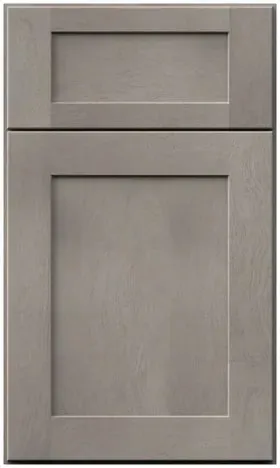


Galaxy Horizon drawer panels: narrow faces in the hand zone, and how a stain wears there
Reviewed September 2026 · Captivating Cabinets
Prices quoted in this article were read off the grid on the review date; the live price grid on this page governs.
The two Galaxy Horizon drawer panels are narrow finished faces, one and a half and three inches wide, that close a gap where a plain filler would look unfinished. They almost always end up at hip height, beside a drawer bank or an appliance, which is the part of a kitchen that gets bumped by hips, pot handles and dishwasher racks every day. That makes them a good place to talk about something every buyer of a stained finish should know before install: how a stain wears, and how it is repaired.
Two narrow faces, and what the titles do and do not say
| SKU | Width in the title | Price |
|---|---|---|
| GH DWR1-1/2 | 1-1/2″ | $123.50 |
| GH DWR3 | 3″ | $130.00 |
Neither is a drawer front in the usual sense; nothing on this page is wide enough to face a drawer box. They sit in the same code family as GH DWR6, which the store titles as a 6-inch dishwasher panel at $201.50 and which has its own page. Read together, the three look like a series of narrow finished faces for gaps around drawers and appliances.
The listings do not give a height, a thickness or a construction for either part. Tell us the opening and what sits either side of it, and we will confirm what the code ships as before the order goes out. A drawer front for a cabinet from another brand is a different job altogether and starts with photos.
Why a narrow face beside a drawer bank takes the knocks
Think about the band of a kitchen between the floor and the counter, and specifically the strips of it next to things that move. A drawer bank is opened and pushed shut with a hip dozens of times a day. A dishwasher door drops open and its racks roll out past whatever is beside it. A peninsula end is where people walk around the run and catch it with a bag or a chair. The narrow faces on this page get placed in exactly those spots, because those are the spots where a gap is left over.
They also tend to sit at an outside edge, where the corner is exposed, rather than tucked into a run. A corner takes a knock that a flat face in the middle of a run never would. None of this is a reason to avoid the part. It is a reason to know, before it goes in, what a scratch on it will look like and what you will do about it.
There is also a practical reason these faces get repaired more often than they are replaced. At $123.50 and $130.00 they are not expensive parts, but a replacement is a second order, a second finishing run and a face that may land a shade apart from the drawer fronts it was meant to line up with. A marked narrow face that has been touched up well usually looks better than a pristine new one that reads a little different. That is the case for knowing the repair routine below before you need it.
How a stain wears compared with a paint

In general terms, a painted cabinet has an opaque colour coat, and a chip through it exposes whatever is underneath: primer, MDF or wood, usually a different colour and a clean-edged spot. A stained cabinet has colour in and on the wood, sealed under a clear topcoat. A light scuff often only marks that topcoat and shows as a dull or slightly pale patch rather than a change in colour. A deeper scratch that cuts through the colour shows the wood below, which is typically lighter than the stain.
Fabuwood does not publish the wood species behind this finish, so we cannot tell you exactly how pale a deep scratch will look on it. What we can say is that a mid-light grey-taupe sits closer to the colour of bare wood than a dark stain does, so a scratch on it should stand out less than the same scratch on the Cobblestone door in the photo. That is our reading, not a published figure.
Fabuwood’s care guidance is short and worth following on these faces in particular: when something wet lands on the finish, blot it rather than wiping; use only mild cleaners; and never spray a cleaner directly onto the wood. Its warranty also excludes colour change caused by certain household cleaners, which is one more reason a narrow panel next to the dishwasher should get a damp cloth and nothing stronger. Our cabinet care guide covers the routine.
The touch-up kit, and a repair order that works
Fabuwood’s spec book says that paint spray cans are not available for its stained finishes. What exists instead is a touch-up kit, which Fabuwood describes as a stick, a marker and a scraper, offered for its stock Signature and Designer colours. Horizon is one of the Signature stains, and the kit is on our list as the Horizon Touch Up Kit at $62.40 on the loose parts page. Buy it with the cabinets, not after the first scratch.
The sequence below is our general practice for stained cabinets; follow any instructions that come in the kit first.
- Clean the spot with a damp cloth and a drop of mild soap, then let it dry completely.
- Test the marker inside a door or on the back of an offcut before it touches a visible face, and let it dry to see the true colour.
- For a chip, press the fill stick into it, then level it with the scraper so it sits flush rather than proud.
- For a scratch, use the marker in short strokes following the grain, and wipe off the excess before it sets so the colour stays in the scratch.
- Stop early. Several light passes blend better than one heavy one, and a repair that is a shade light is less visible than one that is a shade dark.
Do not sand a stained face to "even it out". Sanding removes the topcoat and some of the colour with it, and turns a small mark into a patch that the kit cannot fix.
Choosing a narrow face for a spot that gets knocked
Price the three options for a three-inch gap against how likely the part is to be damaged. The plain base filler, GH BF3, is $26.00. The overlay filler at 30 inches, GH OLF330, is $71.50. The finished drawer panel, GH DWR3, is $130.00. In a protected spot, pay for the face that looks best. In a spot where a dishwasher rack or a rolling bin will hit it for years, the extra money buys a nicer face that will be touched up more often, and a plain strip is cheaper to replace from the same order if you keep a spare.
Where the narrow face has to line up visually with the drawer fronts beside it, a finished panel is usually the right call. Where it is a gap between a drawer bank and a wall, most people should take the filler. The full grid of fillers is here.
Ordering, and what to keep in the drawer afterwards
Order these with the cabinets they sit beside, so they come from the same finishing run as the drawer fronts they are meant to line up with. Galaxy ships pre-assembled in about two weeks. Send the opening size and a note on what is either side of it and we will confirm the part; a free 3D design shows it in place before you commit.
After install, keep three things in a kitchen drawer: the touch-up kit, a soft cloth, and a note of which parts came in which order. The last one sounds fussy until the day a panel is damaged and you need to know whether its neighbours are from the same run. The rest of the trim for this finish is on the decorative accessories page, and the cabinets are on the collection page.
Common questions
- Do stained cabinets show scratches more than painted ones?
- They show them differently. A light scuff on a stain usually marks only the clear topcoat, and a deeper scratch shows the wood, which is normally lighter than the stain. On a mid-light grey-taupe that contrast should be smaller than on a dark stain, though Fabuwood does not publish the wood species, so we cannot give an exact answer.
- How do I touch up a scratch on a stained cabinet?
- With the manufacturer’s touch-up kit, not paint. Fabuwood’s kit is a stick, a marker and a scraper; fill chips with the stick, level with the scraper, and use the marker along the grain for scratches. Test inside a door first. The Horizon kit is $62.40 on our loose parts page.
- Is there a spray can for Horizon?
- No. Fabuwood states that spray cans are not available for its stained finishes. Stains are repaired with the touch-up kit.
- Is a drawer panel the same as a drawer front?
- Not on this page. GH DWR1-1/2 and GH DWR3 are 1-1/2 and 3 inches wide, which is far narrower than any drawer. They close narrow gaps with a finished face. Tell us the opening and we will confirm exactly what ships.
- Should I replace a scratched drawer panel or touch it up?
- Usually touch it up. A replacement is a later part from a different finishing run, and Fabuwood notes that later parts may not match installed cabinets. A well-done repair with the touch-up kit tends to read better than a new face that sits a shade apart.
- What cleaner is safe on a stained panel next to the dishwasher?
- A damp cloth with a little mild soap, then dry it. Fabuwood says to blot rather than wipe when the finish is wet, to use mild cleaners only, and never to spray cleaner straight onto the wood. Its warranty excludes colour change from certain household cleaners.
Keep reading
The guides behind the numbers on this page.
- How to Clean and Care for Kitchen Cabinets
The everyday routine that keeps a stained face from needing the kit at all.
- Matte Cabinet Finishes: Pros, Cons and Care
Why the sheen of a finish decides how scuffs show.
- End Panels, Scribe Molding and Fillers Explained
Where a narrow finished face ends and a filler begins.
- Parts of a Kitchen Cabinet, Every Component Named
The names for the rails, stiles and fronts this page talks about.


