

Where the plank lands and how its top face wears: floating shelves for a Galaxy Horizon kitchen
Reviewed September 2026 · Captivating Cabinets
Prices quoted in this article were read off the grid on the review date; the live price grid on this page governs.
A shelf is the one piece of cabinetry you hang at a height you invent. Every box in the kitchen gets its height from the counter, the ceiling or the appliance beside it, and the plank gets nothing, which is why so many look a couple of inches off. This page is about pinning that height to something already in the room, then about the surface on top, which you use every day: a stained plank in a Galaxy Horizon kitchen wears, fades and gets touched up like a stain rather than a paint, and it is worth knowing how before it goes up.
Four lines already on the wall that a shelf can borrow
A floating plank looks right when one of its two edges coincides with a line the eye already follows. It looks wrong, even when nobody can say why, when it sits an inch and a half above one line and three below another. So the first decision is which line it is joining.
- The underside of the wall cabinets. The commonest and the safest choice: the shelf continues the bottom edge of the upper run across a gap, a window return or a stretch of open wall. If the uppers are hung at the usual 54 inches, so is the underside of the plank.
- The top of the backsplash tile. Where the tile stops short of the uppers, or runs on a wall with no uppers at all, setting the underside of the shelf on the last course reads as though the tile was built to receive it. It usually means the shelf sits lower than the cabinets, which is fine as long as it does so on purpose.
- The head of the window. Beside a window with no uppers, the head casing is the strongest horizontal in the wall. A shelf in line with it, or with the top of the casing trim, turns window and shelf into one composition.
- The bottom edge of the range hood. Shelves either side of a chimney hood look designed when their undersides match the hood’s lower edge, and like leftovers when they float somewhere near it.
Two shelves, not one, give you a second choice: the top plank can borrow the line and the lower one sits a regular step beneath it, or the lower one takes the tile line and the upper one takes the cabinet line. Stacking three or more usually works better as an open box than as planks, because the grid is carrying the spacing for you; that option is on the open shelf, matching interior page. The heights behind all of this, from counter to upper to ceiling, are in the wall and tall cabinet guide.
Standard, Timber or Walnut next to a run that is already stained

Every lit shelf comes in three surfaces: Standard, Timber and Walnut. The titles do not define Standard. If it means the shelf is finished to match the cabinets, which is the natural reading, then on this collection it is a separately made stained plank that will sit beside doors made in another part of the same order. Fabuwood’s own spec book says colour variation is normal on its stained finishes, so treat a Standard shelf as a close relative of the doors, not a twin, and ask us to confirm what Standard is on a Horizon order before relying on it.
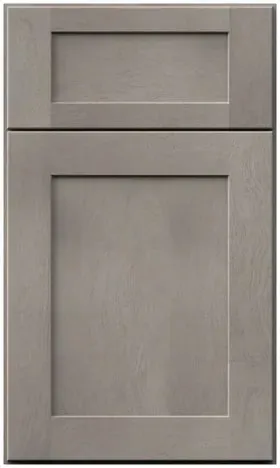
Timber and Walnut are wood-tone surfaces. On a painted kitchen, a wood plank is the one place you see grain at all. Here the doors already show grain through a light grey-taupe, so a wood shelf becomes a second grain next to the first, and the useful question is value rather than warmth. A plank that is nearly the tone of the doors looks like a mismatch; one that is plainly darker looks like a decision. In our experience Walnut is the one that reads as deliberate against a light stain, and Timber needs to be seen in the room before you commit. Fabuwood’s own Horizon kitchens lean on wood accents in the farmhouse and open-shelf settings, so wood on this collection is not a stretch.
| Width | Standard or Timber | Walnut | Walnut costs more by | SKU |
|---|---|---|---|---|
| 24″ | $487.50 | $585.00 | $97.50 | GH LED FLS24 |
| 30″ | $539.50 | $646.75 | $107.25 | GH LED FLS30 |
| 36″ | $617.50 | $715.00 | $97.50 | GH LED FLS36 |
| 42″ | $656.50 | $780.00 | $123.50 | GH LED FLS42 |
| 48″ | $698.75 | $845.00 | $146.25 | GH LED FLS48 |
| 54″ | $861.25 | $968.50 | $107.25 | GH LED FLS54 |
| 60″ | $1,027.00 | $1,098.50 | $71.50 | GH LED FLS60 |
The Walnut premium does not move in step with width. It peaks at 48 inches, $146.25 over Standard, and is smallest at 60, where it is $71.50. If you have settled on Walnut and the wall could take either a 54 or a 60, the longer plank closes the gap to Standard more than any other width does.
The top face is a working surface, and a stain wears like one
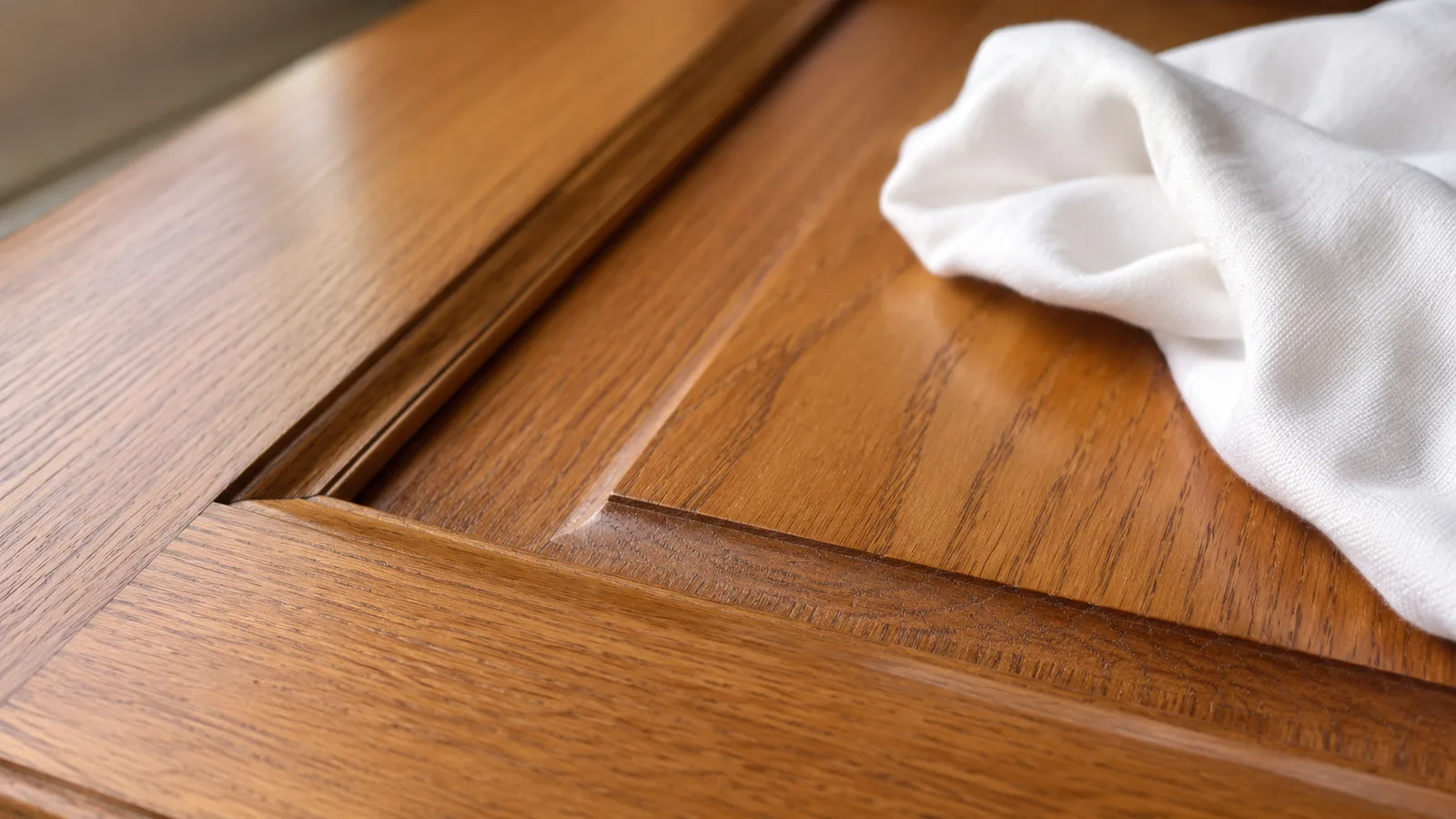
A door is touched at its edge. A shelf is used on its face: plates slide off it, jars get dragged across it, a mug goes down wet. That makes the top of the plank the most worked stained surface in the room after the drawer fronts, and it wears in a particular way. On a paint, a scratch shows the colour under the paint. On a stain, it shows lighter wood fibre under the colour, often as a thin pale line that follows the grain.
Repairs follow from that. Fabuwood’s spec book says paint spray cans are not available for stained finishes, and the touch-up kit it lists is a stick, a marker and a scraper. Put simply: a marker for a fine scratch, a fill stick for a dent, and the scraper to level the fill. None of it restores a large worn area, so the real protection is cheap and boring. Felt pads under stoneware, a tray for anything that sweats, and no sliding a stack of plates off the front edge.
Cleaning is where stains are least forgiving. Fabuwood’s care page asks for mild cleaners, for water to be blotted rather than wiped when it lands, and for cleaner never to be sprayed straight onto the wood. On a shelf over a sink or a coffee machine, that means a cloth dampened first and then used, not a spray bottle aimed at the plank. The cabinet cleaning guide covers the rest.
A shelf in the path of the sun
Floating shelves go where cabinets will not: beside windows, on the return by a glazed door, across a wall that gets the afternoon. That puts their top faces in direct light more than any door in the kitchen, because a horizontal surface catches sun that a vertical door only sees at an angle.
Fabuwood’s warranty is plain about this. Colour change from exposure to UV light and sunlight is not treated as a defect, and it notes that colours may darken or lighten over time. On a stained plank the likely result is gradual rather than dramatic, but an object that never moves will, over years, leave its outline on the wood around it. Two habits deal with it: move what sits on a sunny shelf every few months, and put a blind or a UV film on the window that throws a sunbeam straight across the plank.
Light also changes how the colour reads day to day. Homeowners describe this stain as looking cool and a little dull on an overcast day and warm in sun, and a shelf by a window sees both in one afternoon. That is the reason to hold a door sample against the exact spot at two different times of day before choosing between Standard and a wood surface.
The lit shelf needs power, and the power is its own order line
Every width above is a lit shelf, so each one needs a low-voltage feed arriving at the plank. What the titles do not say is whether a driver comes in the box. This collection sells one separately, GHZ LED DRIVER at $204.75, alongside a wireless switch, GHZ LED WLS SWITCH at $221.00, both on the cabinet accessories page. Ask us which of those a given shelf needs, and whether one driver can feed two shelves on the same wall, before the electrician quotes.
The wiring has to reach the shelf line before the wall is closed, and so does whatever fixing the bracket needs. The rated load and the bracket type are not published for these shelves either, so anything heavier than glassware waits on a written answer from us.
The unlit one: stainless steel, 36 inches
GH SSFLS36 is the only shelf here without lighting and without a wood face: stainless steel, one width, $510.25. It is the one to put within reach of the burners, where grease settles on anything horizontal and has to be washed off. Fabuwood’s own Horizon kitchens pair this stain with stainless appliances, so a steel shelf by the range sits comfortably with it. It also sidesteps every stain question on this page: nothing to match, nothing to fade.
Five answers to have before the shelf is ordered
- Which line the plank is joining: cabinet underside, tile top, window head or hood edge. Write the height on the drawing.
- What Standard means on this collection, if you are choosing it to match the doors.
- Whether the shelf ships with a driver, and how many shelves one driver can run.
- The rated load, in writing, if anything heavier than glasses is going up.
- How much sun the spot gets, and whether a blind or a film belongs on the same budget.
Every shelf, stained and steel, is listed with the rest of the collection on the Galaxy Horizon collection page and with the other trim on the decorative accessories page. For a whole wall, send it through the free 3D design service; a designer replies within one business day and the drawing and quote follow within 24 to 48 hours. Or call us on (609) 900-3358.
Common questions
- How high should a floating shelf be in a kitchen?
- Pick an existing line and join it: the underside of the wall cabinets (usually 54 inches off the floor), the top course of the backsplash tile, the head of a nearby window, or the lower edge of the range hood. A shelf that sits near a line but not on it looks like a mistake.
- Will a Standard floating shelf match my stained cabinets exactly?
- Do not count on exact. The titles do not define Standard, and Fabuwood says colour variation between stained parts is normal. Ask us to confirm what Standard is on your order, and if a near-match would bother you, choose a plank that is clearly different, such as Walnut.
- Does a walnut shelf go with gray cabinets?
- Against a light grey-taupe stain, a clearly darker wood plank tends to read as intended, while one close to the cabinet tone reads as a miss. On this collection Walnut costs $71.50 to $146.25 more than Standard, depending on width.
- How do I fix a scratch on a stained wood shelf?
- With a touch-up kit rather than paint. Fabuwood does not offer spray cans for stained finishes; its kit is a stick, a marker and a scraper. Use a marker on fine scratches and a fill stick on dents. Felt pads and a tray under wet items prevent most of it.
- Do wood shelves fade in the sun?
- They can change colour over time, and Fabuwood’s warranty does not treat colour change from sunlight or UV as a defect. Move objects on a sunny shelf every few months so they do not leave outlines, and shade a window that throws direct sun across the plank.
- Do LED floating shelves need a separate driver?
- The titles do not say one is included. This collection lists a driver at $204.75 and a wireless switch at $221.00 separately. Confirm with us what each shelf needs, and run the low-voltage feed before the wall is closed.
Keep reading
The guides behind the numbers on this page.
- Wall and Tall Kitchen Cabinet Sizes and Buying Guide
Where the underside of the uppers lands, which is the line most shelves should join.
- Cabinet Wood Species Compared
How grain and tone differ between woods, before you put a second one beside a stain.
- How to Clean and Care for Kitchen Cabinets
Blotting, mild cleaners, and why the spray bottle stays away from the wood.
- Kitchen Cabinet Samples: How to Order and Evaluate
Checking a sample in the morning and the evening before choosing a shelf surface.
- How to Match Cabinets, Countertops, Backsplash and Flooring
Where a wood shelf fits in a room that already has a stained run and a floor.
- Free 3D Kitchen Design
Send the room and every vertical and shelf line comes back drawn to the inch.


