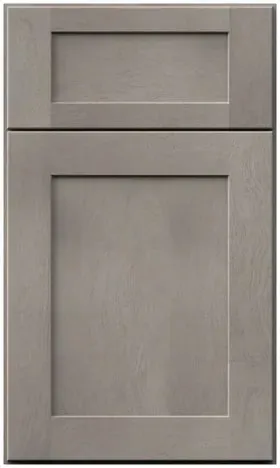


Galaxy Horizon end panels: mismatch or light? What to check before calling it a defect
Reviewed September 2026 · Captivating Cabinets
Prices quoted in this article were read off the grid on the review date; the live price grid on this page governs.
There is one decorative end panel on the Galaxy Horizon list: GH BEP, a base end panel at $149.50 for the exposed end of a base run or an island. It is a simple part. The reason it gets a long page is a question we are asked about ends more than any other part in a stained kitchen: why does the end look a different colour from the doors? Sometimes the answer is ordinary stain variation. More often it is the light, because an end panel faces a different way from every door in the run. Here is how to tell which, and how to place the end so the question rarely comes up.
One base end panel, and what it is for
GH BEP finishes the side of a base cabinet that would otherwise show its box: the end of a run that stops in open floor, the end of an island, the return of a peninsula. On this list it is the only part in its sub-type. Wall and tall ends in this finish are covered by skins — GH SK W30 to W42 at $50.05 each and GH SK TALL at $169.00 — which have their own page. The flat and shaker side panels in the SPF family are vanity parts and live with the vanity accessories.
The listing does not publish the panel’s dimensions or whether its face is flat or framed. The base skin, GH SK BASE, is $62.40, so the end panel at $149.50 is clearly a more substantial part; what exactly the extra buys should be confirmed before you choose between them. Ask and we will tell you what arrives.
The end is lit from the side, the doors from the front

Picture a base run along one wall with a window above the sink. Every door in that run faces the room. The window light and the ceiling lights reach the doors roughly face-on. The end panel, at ninety degrees to the doors, faces the doorway, the dining area or the living room. It gets light from a different window, or from none, and when light does reach it, it often arrives at a low angle across the surface rather than straight at it.
On a paint, that geometry changes how bright the end looks, and not much else. On a stain with the grain showing, light arriving at a low angle picks up the texture of the wood, and the colour itself is one that moves. Homeowners who have lived with it describe it as looking cold or dull on a cloudy day and warm on a sunny one. A kitchen designer whose showroom sells Fabuwood put it as reading warm or cool depending on what is around it. Put those two effects together and an end panel from the same order as the doors can look like a different shade at four in the afternoon.
Fabuwood also states that colour variation between parts is normal in its stained finishes, because of the nature of wood and its finishing process. So there are two honest causes of a difference, and they call for different responses. Light needs nothing but understanding. A real outlier part is something we want to hear about.
Five checks that separate light from a genuinely different panel

Run these before deciding anything. They take a day because the first one needs daylight at different hours.
- Look at it three times: morning, midday and evening. If the difference comes and goes, it is light.
- Turn off every artificial light and look again in daylight only, then do the reverse at night. Mixed bulbs with different colour temperatures can pull a warm-grey stain in two directions at once.
- Hold a door sample flat against a door front, then flat against the end panel. If the sample appears to change colour as you move it, the room is doing the changing.
- Hold a plain white card so it touches both the end and the nearest door, and photograph the corner in one frame. The card gives the camera a reference, and the photo lets you compare later.
- Stand where people actually stand: the doorway, the island stool, the sofa. A difference visible only with your nose at the corner is not the same problem as one visible from across the room.
If the panel still reads as clearly different in even daylight, in one photo, from where people stand, send us the photos and the order number. That is useful information, and the sooner we have it the more options there are.
Placing the end so the question rarely comes up
You cannot choose which way an end faces; the plan does that. You can choose what light reaches it.
- Island ends under pendants. The light falls from above and roughly evenly across the top of the island, the doors and the end, so the end is lit much like the doors. Keep the pendant bulbs the same colour temperature as the ceiling lights.
- Peninsula ends facing a dining table. These get the dining light, often a warmer bulb on a dimmer. Expect the end to read warmer there in the evening, and treat that as part of the design rather than a flaw.
- Run ends beside a window. These catch the strongest side light in the room. Consider whether a skin or a filler return is a better answer than a full panel, or at least avoid placing the one part from a later order here.
- Run ends at a doorway. Often lit from the next room. Seen by everyone who walks in, so it is the end most worth checking first, with a sample, in your own house’s light.
More on how this finish behaves under different light is in finding the right shade of grey.
If it really is a different panel
Say the checks point to the part rather than the light. It helps to know how that conversation goes, because stains are treated differently from paints. Fabuwood considers colour variation between stained parts normal, so a panel that is simply at one edge of the normal range is not, in itself, a defect. A panel that is plainly outside it — a different tone in even daylight, obvious from where people stand — is something we take up with Fabuwood with your photos.
While that is being looked at, there are practical options that cost nothing. If the kitchen has more than one exposed base end, the panels can swap places so the closer match faces the doorway. If the end sits in strong side light, a change of bulb or blind can bring it closer to the doors for most of the day. And if a replacement is agreed, it should be checked uncut against the run, in daylight, before it goes up, because a new part is also a later part.
What does not help is recolouring the end on site. The touch-up kit is made for chips and scratches, not for shifting the tone of a whole panel, and a panel worked over by hand usually reads worse than one that was a shade off.
What an exposed base end needs besides the panel
A finished end is more than one part. At the floor, the toe kick has to turn the corner: GH TK8 is $55.90 for 8 feet, with the cap at $7.80. Where the end meets an uneven floor or wall, a scribe covers the line: GH SM8-S at $39.00 or the decorative GH SM8-D at $41.60. On an island, the countertop overhang above the end sets how far the panel is seen, and the island clearance guide sets how much overhang you want.
All of it should come from the same order as the cabinets. That is not a sales line; it is the one step that removes a second finishing run from the equation before the light test ever needs to be run. The rest of the trim for this finish is on the decorative accessories page.
Common questions
- Why does my cabinet end panel look a different colour from the doors?
- Usually because it faces a different direction and gets different light, often from the side and at a low angle. This stain reads warmer in sun and cooler on overcast days, and it shifts with its surroundings. Run the light checks on this page before assuming the part is different.
- Is colour variation normal on stained cabinets?
- Fabuwood says yes. Its specification book states that, because of the nature of wood and the complex finishing process, colour variations in stained finishes are considered normal. That is also why we recommend ordering every end, filler and skin with the cabinets.
- What does GH BEP cost and what does it cover?
- It is $149.50 and it is a base end panel for the exposed end of a base run, island or peninsula. Its dimensions and face style are not published on the listing, so ask us to confirm what arrives.
- Is there a wall or tall end panel in this finish?
- Not in this sub-type. Exposed wall and tall sides are covered by skins: GH SK W30 to W42 at $50.05 each, GH SK TALL at $169.00 and GH SK T12D at $126.75.
- Can I tint an end panel to match the doors better?
- We advise against it. The touch-up kit is for chips and scratches, and Fabuwood does not make spray cans for its stained finishes. Recolouring a whole panel by hand usually makes it stand out more. Run the light checks first, then talk to us.
- How do I photograph a colour problem so you can judge it?
- In daylight with artificial lights off, with a white card touching both the end panel and the nearest door, and both faces in one frame. Add a second photo from where people normally stand.
Keep reading
The guides behind the numbers on this page.
- Gray Kitchen Cabinets: Finding the Right Shade
Why this stain reads warmer in sun and cooler on an overcast day.
- Kitchen Cabinet Samples: How to Order and Evaluate
The sample checks that make the light test on this page quick.
- Cabinet Skin Panels and Gables
The thinner alternative for an end that sits in strong side light.
- How Much Kitchen Island Clearance Do You Need
The overhang above an island end decides how much of the panel you see.


