

Galaxy Horizon corner molding: one edge, two faces, and two kinds of light
Reviewed September 2026 · Captivating Cabinets
Prices quoted in this article were read off the grid on the review date; the live price grid on this page governs.
Every outside corner of a kitchen shows you two faces at once, and they are almost never lit the same way. One faces the window and catches daylight; the other faces into the room and sits in its shade. On a stain that reads warmer in sun and cooler in shade, the two faces of the same corner can look like two slightly different colours, and the edge between them is where the eye compares them. Galaxy Horizon corner molding sits on that edge. This page is about where it is worth fitting, which of the three parts to use, and what it does to how a corner reads.
Why a corner looks like two colours

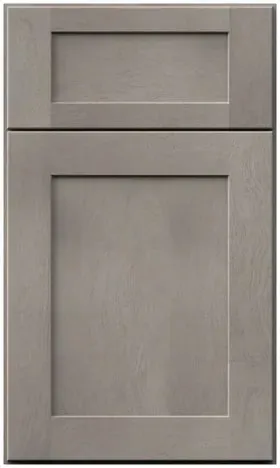
This is not a flaw in the finish; it is how a translucent finish over wood behaves. A homeowner on Houzz who has this stain in her kitchen put it simply: on a cloudy day the cabinets look "cold or dull", and on a sunny day they look warm. A kitchen designer in the same discussion said it can read warm or cool depending on the furnishings around it. Fabuwood itself describes the colour one way on its door page (a grey with "soft pink undertones") and another on its finish page ("misty greys and silvery undertones"). All of those are true, in different light.
At an outside corner you get both at once. The face turned to the window picks up warm daylight and shows the pink-taupe side of the colour; the face turned away picks up cooler, reflected light from the room and reads greyer. Grain adds to it, because light raking across one face picks out the figure while flat light on the other face mutes it.
A painted grey does this too, but less. Paint is opaque and has no grain, so both faces change in brightness more than in character. On a stain the difference is in warmth and texture as well, and it is most noticeable exactly where two faces meet.
What corner molding does at that edge
An outside corner molding is an L-shaped strip that wraps the corner where two finished faces meet: an end panel and a face frame, two panels at an island corner, or a skin and a door edge. It hides the raw joint, protects the edge, and gives the corner a single piece of wood with one grain running up it.
That last part is the useful one on a stain. Instead of two faces meeting at a hairline, where the eye flicks between warm and cool, the corner becomes a narrow vertical strip that belongs to both sides. It reads as a post rather than a seam, and a post catching the light on one side and falling into shadow on the other looks natural, the way the leg of a table does.
It is not a way to make the two faces match. Nothing does that except the light. What it does is give the change a place to happen that looks intended.
Three parts, and which edge each one is for
| Part | Code | Price | Best for |
|---|---|---|---|
| Outside corner molding, 8 ft | GH OCM8 | $62.40 | A crisp edge where a panel meets a face frame; the narrower wrap |
| Outside corner molding 1-1/4″, 8 ft | GH OCM8-1 1/4″ | $78.00 | A wider wrap, where the corner should read as a post |
| Inside corner molding, 8 ft | GH ICM8 | $59.80 | An internal corner where two panels meet at 90° going inwards |
The choice between the two outside profiles is mostly about how much you want the corner to read as a post. GH OCM8 is the quieter one, covering the joint and little more. GH OCM8-1 1/4″ covers more of each face and gives the corner a visible width. On an island that is meant to look like furniture, the wider one earns its extra $15.60; on a plain end of a base run, the narrower one is enough.
The live list gives the length, eight feet, but not the leg widths of the standard profile, so ask us for the section if the width matters for your drawing. Inside corner molding, GH ICM8, is for the reverse situation: two panels meeting in a re-entrant corner, such as where an island back panel meets an end panel set proud of it. It is seen less and is in shadow more, so its tone matters less.
Where it is worth fitting, by how the corner is lit
The honest way to decide which corners get molding is to look at the plan with the windows on it. A corner that has one face to the window and one away from it is where the two-light effect is strongest and where a molding helps most. A corner whose faces are both in the same light, such as two faces both in room shade, needs it only for protection or to cover a joint.
- Island corners. Islands stand in the room, and at least one corner faces the window. The most common place for the wider profile. The island clearance guide covers what surrounds them.
- Peninsula ends. The end of a peninsula usually faces the window or the dining space, so its two corners see very different light.
- The end of a base run beside a doorway. Seen from the doorway in the room’s light and from the window side in daylight.
- Tall cabinet ends. A pantry or oven tower end is a tall, flat face, and its outside corner runs the full height, so the change in light happens along seven or eight feet. A full stick covers it.
- Wall cabinet ends. Usually seen from one side only and at a steep angle, so worth fitting mainly where the end is exposed to a window.
Grain runs up the corner, like a stile
A corner molding is fitted vertically, so its grain runs up and down, the same way as the stiles of the doors beside it. That makes it look like part of the frame, which is what you want. Keep every corner strip running the same way, cut from the bottom of the stick upwards, so the figure rises consistently on every corner of an island.
On an island, cut all four corner strips from sticks that were sorted together in daylight. Stained parts vary slightly in colour, which Fabuwood calls normal, and the four corners of an island are seen together as you walk round it. The two corners on the window side are the most visible; put the closest-matched pieces there.
Where the corner strip meets the floor, the cut end of the stick shows end grain. Stop it on top of the toe kick or quarter round, so the end is covered, or sand it and colour it with the marker in the touch-up kit ($62.40) if it stands clear.
Corners on a two-tone kitchen
Fabuwood photographs this finish in two-tone kitchens more than most: with Frost, its white paint, and with Cobblestone, its dark grey-brown stain, which its blog says "pairs beautifully" with the lighter grey. In a two-tone plan the corner is also where one finish can meet the other, and the corner molding has to belong to one side.
The rule we use is that the corner takes the finish of the piece it wraps, not the piece next to it. A Horizon island in a Frost kitchen gets Horizon corner molding on all four corners, even where one face of the island sits a few feet from a white run, because the corner is part of the island. A Cobblestone island with Horizon perimeter cabinets gets Cobblestone corners, ordered from that collection.
Where two finishes meet at the same corner, such as a Horizon tall cabinet set against a Frost base run, do not wrap the corner at all. Stop each finish at its own edge and let the joint be a clean vertical line between them. A molding in either finish would look like it had strayed onto the wrong cabinet.
Test the sample on a corner, not a counter
Most people judge a door sample flat on a counter. For this page, judge it on its edge. Stand the door sample ($35.00) on the floor at the spot where an island corner will be, turn it so one face is to the window and the other to the room, and look at it in the morning, at midday and in the evening. You will see how far the colour moves between the two faces through the day.
If the difference is more than you want, the answer is in the lighting, not the molding. Warm-white lamps in the evening bring the shaded face closer to the sunlit one, and a sheer blind on a south-facing window softens the daylight side. The grey shades guide covers how undertones move with light.
The parts are priced on the corner molding page, and the end panels and cabinet skins they wrap are listed with the other decorative accessories. For a whole-kitchen check of which corners need it, the free 3D design marks them on the plan.
Common questions
- Why do my cabinet corners look like two different colours?
- Because the two faces of an outside corner are lit differently, one by the window and one by the room. A translucent stain reads warmer in direct daylight and cooler in shade, so the same finish looks different on each face. That is normal, and it is strongest where one face points at a window.
- What is outside corner molding for?
- It wraps the edge where two finished faces meet, such as an end panel and a face frame, covering the joint and protecting the corner. GH OCM8 is $62.40 and the wider GH OCM8-1 1/4″ is $78.00, both eight-foot lengths.
- Should I use the 1-1/4″ or the standard outside corner molding?
- The 1-1/4″ profile covers more of each face and makes the corner read as a post, which suits islands and furniture-style pieces. The standard GH OCM8 is quieter and enough for the end of a plain base run.
- Where does inside corner molding go?
- In a re-entrant corner where two panels meet going inwards, such as where an island back panel meets an end panel set proud of it. GH ICM8 is $59.80 for eight feet.
- Does a gray stain look warm or cool?
- Both, depending on the light. Homeowners with this finish report it looking cold on overcast days and warm in sun. Test the door sample on its edge at the place a corner will be, at several times of day.
Keep reading
The guides behind the numbers on this page.
- Gray Kitchen Cabinets: Finding the Right Shade
How undertones shift between warm and cool light.
- Cabinet Skin Panels and Gables
The finished faces that meet at an outside corner.
- Kitchen Cabinet Samples: How to Order and Evaluate
Why a sample should be judged where it will live, in that room’s light.
- Kitchen Cabinet Terminology Glossary
Stile, rail, skin and end panel defined, for reading a corner detail on a drawing.


