

The piece the next room sees first: square posts at a Galaxy Horizon island or peninsula end
Reviewed September 2026 · Captivating Cabinets
Prices quoted in this article were read off the grid on the review date; the live price grid on this page governs.
In an open plan, the end of the island or peninsula is the first piece of the kitchen anyone sees from the sofa or the dining table. It is also where a square post usually goes. That makes the post less a cabinet part than a handover: the point where fitted cabinetry meets loose furniture and wood floors. On a Galaxy Horizon island the stain helps with that job, because a stained post with the grain showing reads like a table leg in a way a painted one does not. This page is about placing the post for that view, and about what else the far side of the island needs to hold up to it.
Two square posts, and what their titles leave open
This page carries two parts. GH SP36, a 36-inch square post, is $425.75. GH SP3X3, a 3-by-3-inch square post, is $344.50. One title gives the height and not the section; the other gives the section and not the height. Ask us for the missing number on each before drawing either, because the post has to finish level with the underside of the counter and look right against the end panel beside it.
A third square part, the 36-inch square pilaster post GH SQP36 at $594.75, sits on the pilaster page because its title calls it a pilaster. It is the more detailed of the three, and it costs $169.00 more than SP36. If the post is standing at the threshold of a formal dining room, that detail may be worth it. If it is standing in a family room beside a sectional, the plainer post usually fits better.
Where the kitchen hands over to the next room

Walk into an open-plan room and note what you see of the kitchen from the far side. It is rarely a door. It is the end of the island, the back of the peninsula, a corner. Those are the faces that carry the kitchen into the living space, and they are the ones people treat as leftovers, finishing them with whatever panel came in the box.
A post at that corner gives the island an edge you can read from twenty feet away. It stops the run from simply ending and makes it finish. That matters most where the kitchen shares a floor with rooms full of furniture, because furniture has legs and edges and the island without a post is the one object in view that has neither. On a peninsula the post sits at the free end; on an island, at one or both of the corners facing the other room. Which corners depends on sightlines, not symmetry: a post nobody sees from the living room is money spent on the cook’s side.
A stained post reads as a leg; a painted one reads as trim
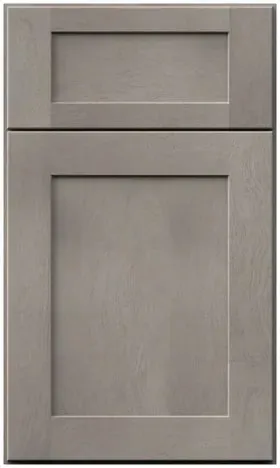
This is where the finish makes a difference you can see. On a painted island, a post is a smooth rectangle in the cabinet colour, and it reads as part of the cabinetry. On a stained island the grain carries up the post, as it would on the leg of a table, and the eye files it with the furniture across the room rather than with the doors behind it. Fabuwood itself describes this stain’s soft taupe tones and delicate woodgrain as suited to French country style, where a kitchen island is meant to look like a piece of furniture.
Detail behaves differently under a stain, too. In the grooves and steps of a profiled part, a stain can gather and read a shade darker than on the flat faces, which sharpens the detail; on a paint the same profile only shows as shadow. That is our general experience of stained trim rather than a Fabuwood statement, and it cuts both ways: one Houzz homeowner who looked at this stain for her island decided against it because she did not like what she saw as uneven tone. If the detailed square pilaster post is on your shortlist, look at a stained profiled part in person before choosing it.
That gives two practical rules. First, pick the post partly by the other room: next to a wood dining table or wood floors, the plainer post keeps the conversation between woods simple; in a room with turned or detailed furniture, the more detailed square pilaster post has something to answer. Second, check how the grain runs. The door stiles on this collection run vertically, and a post whose grain runs the same way reads as one continuous object; ask us to confirm how the posts are made if that matters to you, since the titles do not say.
Fabuwood’s own photographs of this stain show it with marble, black countertops, gold and copper accents, and with wood accents in farmhouse settings. The dining-side view is the place those choices meet. For putting the island, the floor and the counter into one palette, see matching cabinets, countertops, backsplash and flooring.
What the sofa side of the island has to have finished
A post only looks good if the panel beside it holds up to the same view. The back and ends of an island are raw cabinet sides unless something covers them, and from a living room they are more visible than the doors. The parts that do it on this collection: a base end skin, GH SK BASE, at $62.40, which laminates a thin finished face onto the side of a box; and a base end panel, GH BEP, at $149.50, a thicker finished panel that stands on its own. The difference and where each belongs are covered in cabinet skin panels and gables.
Two things are specific to a stain here. The first is that the post, the skins and the doors are separate stained parts, and Fabuwood notes that variation between stained parts is normal. Before they go on, stand the post against the panel it will sit beside and check them in the light the living room actually gets. The second is wear. The far side of an island is where stools are pushed in and feet rest, and on a stain a scuff shows as lighter wood rather than as a chip of colour. Fabuwood does not sell spray cans for its stains; the fix is a touch-up marker or fill stick, so it is worth leaving the stool footrests a few inches clear of the post.
Clear floor around the post, measured from the furniture
Posts are measured against the counter above them, but in an open plan the clearance that matters is the one to the nearest furniture. A dining chair pushed back from a table needs room to move, and the corner of an island with a 3-inch square post on it is harder to brush past than a flush panel. Keep the walkway between the post and the nearest chair or sofa arm to the same widths you would use between the island and a run of cabinets. The island clearance guide gives those widths, and the kitchen dimensions guide covers counter heights and overhangs.
Ordering square posts for the view from the next room
- Decide which island corners are seen from the other room and put posts only there.
- Ask us for the section of SP36 and the height of SP3X3, and check each against the counter.
- Add the end skins or end panels the far side needs, on the same order as the posts.
- On delivery, stand each post against its panel in daylight before fixing it.
- Keep footrests and stool bases clear of the post.
The island cabinets themselves are on the base cabinets page, and every trim part for the collection is on the decorative accessories page. If the island has to look right from two rooms at once, send us the plan through the free 3D design service and ask for a view from the living-room side as well as the kitchen.
Common questions
- Where should square posts go on a kitchen island?
- At the corners that are seen from the neighbouring room. In an open plan that is usually the end facing the dining or living area. A post that is only visible from the cook’s side of the island does little for the room.
- What is the difference between SP3X3 and SP36?
- GH SP3X3 is a 3-by-3-inch square post at $344.50; its height is not in the title. GH SP36 is a 36-inch square post at $425.75; its section is not in the title. Ask us for both missing figures before drawing either one.
- Does a stained post look different from a painted one?
- Yes. On a stain the grain runs up the post as it would on a table leg, so it reads as furniture. On a paint it reads as a smooth part of the cabinetry. That makes a stained post a natural bridge between an island and the wood furniture or floors of the next room.
- What should cover the back of an island that faces the living room?
- A finished end skin or end panel. On this collection a base end skin is $62.40 and a base end panel is $149.50. Order them with the posts, and check the tone of post and panel together in the living room’s light before fitting.
- How do I fix scuffs on a stained island post?
- With a touch-up marker or fill stick. Fabuwood does not offer spray cans for stained finishes, and its touch-up kit is a stick, a marker and a scraper. Keeping stool footrests clear of the post avoids most scuffs.
Keep reading
The guides behind the numbers on this page.
- Kitchen Island Clearance Guide
Walkway widths that apply between an island post and the nearest chair too.
- Cabinet Skin Panels and Gables
Finishing the far side of an island that another room looks at.
- Transitional Kitchen Cabinets Guide
How a stained island sits beside painted cabinets and furniture.
- How to Match Cabinets, Countertops, Backsplash and Flooring
Bringing the post, the counter and the floor into one palette.
- Brown Kitchen Cabinets: Stains, Shades and Pairings
How wood tones in one room speak to each other, from a stain-first point of view.
- Free 3D Kitchen Design
Send the room and every vertical and shelf line comes back drawn to the inch.


