

Galaxy Horizon beaded molding and the furniture test: making one piece read as something made, not installed
Reviewed September 2026 · Captivating Cabinets
Prices quoted in this article were read off the grid on the review date; the live price grid on this page governs.
A painted cabinet reads as a painted object; a stained one reads as wood. That one difference changes what Galaxy Horizon beaded molding is good for. On paint, a bead is mostly an ornament. On a stain it is the cheapest way to take a single piece of cabinetry, usually an island, and make it look like a piece of furniture that was brought into the room rather than a row of boxes fixed to the floor. That is the test this page applies to every place a bead might go: does it make the piece read as furniture? If yes, use it. If no, leave it off.
Why a bead does more on a stain than on a paint

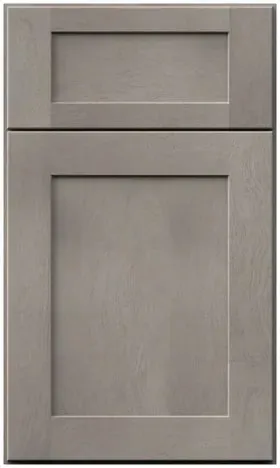
The Galaxy door is a five-piece frame with a recessed centre panel: solid wood stiles and rails round a ⅜″ panel that Fabuwood’s spec book describes as "MDF/veneer". On this finish that means you see grain in the frame and figure in the panel. Fabuwood’s own description of the colour for French country rooms mentions "soft taupe tones and delicate woodgrain", which is a fair summary of what a stain gives you that a paint does not.
Furniture is built the same way, a frame around a panel, and it announces itself through its edges: a bead round a table apron, a moulded frame on the side of a sideboard. Put a bead frame on the flat side of an island and the island borrows that language. It works on paint as well, but on a stain the wood tone has already done half the job, so the bead finishes the effect instead of trying to create it.
GH BM1 1/4 is $57.85: a one-and-a-quarter-inch strip with a bead along one edge, sold by the length for cutting and applying on site. The live list does not publish the stick length or what the strip is milled from, so ask us before calculating a quantity.
Four pieces that pass the test
- The island, on its seating side and ends. This is the main event. A finished panel on the back of an island is a big flat plane at knee height, seen by everyone who sits there. A bead frame set a few inches inside its edge turns it into a panelled side, the way a sideboard is panelled. The end panel page has the panels it goes on.
- A hutch or dresser wall. A section of the kitchen built as a unit, with a base, a counter and an upper with glass or open shelves, often on a dining wall. A bead round the base panels and along the underside of the upper ties it together as one piece.
- A bench or window seat. Built from base cabinets with a cushion on top, its front and ends are flat. A bead frame on the ends makes it read as a settle rather than a row of drawers.
- A freestanding-look vanity. A vanity with finished sides, set between two walls or on its own, reads more like a washstand with a bead frame on each side. The vanity range is where these start.
What those four have in common is that each is one piece, standing apart, that you would describe with a furniture word: island, hutch, bench, washstand. A bead helps something become that word. It cannot help a run of wall cabinets become anything but a run of wall cabinets.
Where it fails, and why
The test fails wherever the piece is built in rather than standing apart. A bead along the light rail under a wall run, round the edge of a filler, or along a toe kick makes nothing read as furniture; it just adds a line to a surface that was already a line. On a stain there is a second cost: every added strip is another piece with its own figure and tone sitting against the doors, and the more strips there are, the more chances there are for one to read slightly off.
It also fails on a piece that is already busy. An island with glass doors, open shelves and a waterfall end has no calm field for a bead frame to sit in. Leave the bead off and let the other elements carry it.
And it fails when the rest of the room is modern. A flat-panelled, handleless-look scheme with slab stone does not want a bead anywhere. If a crisp edge is still wanted on an island panel, GH BM3/4, the batten molding, is $44.20 and has a flat face with no bead. It frames a panel in the same way but reads contemporary.
Frame it the way the doors are framed
A bead frame on a panel is a rectangle of four strips mitred at the corners, like a picture frame. The detail that makes it read as furniture rather than as trim is proportion, and the Galaxy door gives you the proportion for free. Its stiles and rails are 2½″ wide. Set the bead frame so the margin between it and the panel edge echoes that width, about two and a half to three inches, and the island side looks like an oversized version of the doors beside it.
Then the grain. On the doors, the grain in the stiles runs vertically and the grain in the rails runs horizontally. Do the same in the bead frame: the vertical strips run with their grain up and down, the horizontal strips with their grain side to side. That happens automatically if each strip is cut from the length, which is the only way it can be cut, but it matters for the next point.
Cut all four strips of one frame from one stick, in sequence round the frame. The corners then meet pieces that grew next to each other, the tone matches as closely as it can, and the mitres read as one continuous moulding. Fabuwood notes that stained parts vary in colour, and a frame assembled from four different sticks is where that shows most, because the eye compares the four sides at once.
| Piece | Panel it sits on | Frames per piece | Approx. bead per frame |
|---|---|---|---|
| Island seating side | Back panel, ~34″ high | 1 per panel bay; long islands split into 2–3 bays | 8–10 ft per bay |
| Island end | End panel, ~34″ × ~24″ | 1 each end | ~8 ft |
| Hutch base ends | End panel, base height | 1 each end | ~8 ft |
| Bench ends | Low end panel | 1 each end | ~5–6 ft |
| Vanity sides | Finished side | 1 each exposed side | ~6–8 ft |
Those lengths are perimeters for planning, not a cut list; confirm the panel sizes on your drawing. Allow a little extra at each corner for the mitres, and add a spare stick so each frame can come from one length.
Long islands: split the side into bays
An eight- or ten-foot island back panel with one long bead frame round it looks stretched, like a picture frame on a wall. Furniture makers break a long side into bays, and so should you. Divide the side into two or three equal fields, with a bead frame in each and a vertical strip of plain panel between them, placed wherever the cabinets behind meet. The result reads like a sideboard with three doors’ worth of panels, which is exactly what the furniture test is after.
On a stain there is a bonus: each bay is its own small frame, so if one stick is fractionally off in tone, it goes into one bay instead of stretching the length of the island. The island clearance guide covers the seating side’s dimensions before you plan the bays.
Fixing it, and the cut ends
The bead is applied with glue and fine pins to a finished panel. The pins go in at a shallow angle through the flat part of the strip, not the bead, and the holes are filled with a colour-matched wax or the fill stick from the touch-up kit, $62.40 in this finish. Keep glue off the panel face: on a stain, squeeze-out wiped with a wet rag leaves a patch where the finish looks different, so let it gel and lift it off with a chisel.
The mitres are the only cut ends and they are closed into each other, so on a well-cut frame no end grain shows at all. Cut them with a fine-tooth blade and a backer so the bead’s crown does not splinter. Everything here is priced on the beaded molding page with the rest of the decorative accessories.
Common questions
- How do I make a kitchen island look like furniture?
- Finish the seating side and ends with panels, then apply a bead frame inside each panel edge so the sides read as panelled, the way a sideboard does. On a long island, split the side into two or three bays. GH BM1 1/4 is $57.85 in this finish.
- Where should beaded molding not be used?
- Along wall runs, light rails, fillers or toe kicks, where it only adds a line to something that is already a line, and on pieces already busy with glass or open shelving. In a modern scheme, use the flat GH BM3/4 batten at $44.20 or nothing.
- How wide should the margin be around a bead frame on a panel?
- About the width of the door stiles, which are 2½″ on the Galaxy door, so two and a half to three inches. The panel then reads as a larger version of the doors next to it.
- Does beaded molding match stained cabinets?
- It is supplied in the same finish, and Fabuwood notes that stained parts vary slightly in colour. Cut all four strips of one frame from one stick, in sequence, so the corners meet pieces that match as closely as possible.
- What is the difference between beaded and batten molding?
- Beaded molding has a rounded bead along one edge and reads traditional or French country. Batten molding, GH BM3/4, has a flat face and frames a panel in a contemporary way. Both are applied strips cut on site.
Keep reading
The guides behind the numbers on this page.
- Kitchen Island Clearance Guide
The seating-side dimensions to plan bead bays against.
- Cabinet Skin Panels and Gables
The finished sides a bead frame is applied to, and how they are fixed.
- Kitchen Cabinet Molding Types
Bead, batten and every other applied profile side by side.
- Brown Kitchen Cabinets: Stains, Shades and Pairings
What makes a stained kitchen read as wood, and how it pairs with painted pieces.
- 27 Kitchen Cabinet Ideas
Finished rooms with furniture-style islands for proportion reference.


