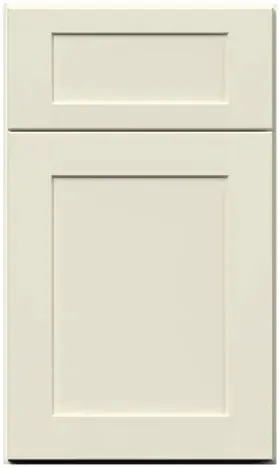


Galaxy Linen return angle base cabinets: the three pieces that face the room
Reviewed September 2026 · Captivating Cabinets
Most of a kitchen shows the room its doors. The end of a peninsula shows the room its side, its angle and its toe kick, which is why Galaxy Linen return angle base cabinets — GL BRA24, GL BTL12 and GL BTR12 — deserve more thought than a price band of $419.25 to $588.25 suggests. They are the parts a guest sees first and the cook sees least.
Return angle or base transition: which angled piece for which run
The three are not sizes of one thing. One is a 45-degree base cabinet with an angled face; the other two are handed transitions that step a run from one depth to another. Match the part to the job before looking at the price.
| The run has to… | Order | Size | Displayed price | Order with it |
|---|---|---|---|---|
| End at 45° where a peninsula meets the walkway, and still store something | GL BRA24 | 24″ W × 24″ D × 34½″ H | $588.25 | A finished side, plus toe kick for the extra miter |
| Step from a 24″-deep base run down to a 12″-deep run or a finished end, angle turning to the left | GL BTL12 | 12″ W × 24″ D × 34½″ H | $419.25 | A finished side if the step is exposed |
| The same step, angle turning to the right | GL BTR12 | 12″ W × 24″ D × 34½″ H | $419.25 | A finished side if the step is exposed |
The BRA24 is described by Fabuwood as an angled base return that wraps a corner with a clean angled face where a square one would be too tight — the angled end cabinet for a peninsula, in plain terms. The transitions are described as bridging a 24″-deep base run into a 12″-deep application on the left or the right side — think of a run that continues as shallow cabinets under a window, or dies into a wall at less than full depth. If your elevation has neither of those conditions, you do not need a base transition cabinet, however tidy it looks in the catalog.
What a wedge-shaped interior is good for
The BRA24 has a door and a shelf, and the shelf is a wedge: full 24″ depth against the wall, tapering toward the angled face. A stack of dinner plates is the wrong thing for it. The right things are tall and stand up — bottles, vases, a pitcher collection — or flat and lean along the long back wall: boards, trays, the serving pieces that come out when there are guests, which is fitting for a cabinet whose door opens toward the guests.
The shelf itself is a stocked part, GLN AS-BRA24 at $64.35 under loose parts, which is a small reassurance for a cabinet that will be leaned on, bumped by chairs and used as the end of a counter for twenty years.
The 12″ transitions hold very little and are not bought for storage. If a wall of yours needs one, judge it on whether the run lands cleanly; that is the whole job.
Beige cabinets with white trim: what shows at a peninsula end

A cabinet side is finished as an interior — natural wood veneer, made to be seen from inside the box. At a peninsula end that side faces the dining room, so it needs a finished end panel in the same paint. The product pages for these three carry a finished-side option at checkout, quoted on the product page at $96 per side; the alternative is a separate GL BEP base end panel at $149.50 or GL SK BASE end skin at $62.40 ordered with the cabinet. Either way, order it now: a panel from a later batch is the one that will not quite match, and it will sit in the most looked-at position in the house.
Then look at what the panel meets. Below it is the toe kick, beside it the baseboard, under it the floor. This finish is a true beige with a hint of greige, and it reads as beige — a color, not a white — precisely where it touches something white. A bright white baseboard running into a Linen end panel is the sharpest such joint in the kitchen. Against a warm wood floor or a cream trim it settles; against a cold white it announces itself. Neither is wrong, but one of them is a decision.
Handing, miters and the template: the short checklist

- Confirm the hand from the elevation, standing where the room looks at the run. Fabuwood describes the BTL12 as left-facing and the BTR12 as right-facing; the angle is cut at the factory and a wrong hand cannot be flipped. Send the drawing with a design request if there is any doubt.
- Order toe kick to turn the angle. Two miters replace one square corner, and the recess under a 45° face uses more of the 8-foot GL TK8 length than a straight end. Short toe kick at a peninsula end is a common site problem and a cheap one to avoid.
- Tell the countertop fabricator at template that the end is angled. A mitered return in stone is a different template, sometimes a seam, and always a different price from a square end; get it into the quote before the slab is cut.
- Check the walkway. The reason to angle the end is usually a pinch point; if the peninsula leaves less than 36″ to the wall or island opposite, the clearance guide has the numbers that decide whether a 45° cut buys enough back.
The rest of the odd base boxes in this finish
The other awkward shapes each have a page of their own. The blind corner bases are the budget way to turn a 90° corner and hide a strip of themselves doing it. The easy reach bases put a 45° door on a square box with fixed L-shaped shelves, and the lazy Susan bases put rotating trays in the same box. The drawer bench seats are 16⅜″-high open-top boxes for a banquette, and the specialty bases are the two microwave bays, with the knee drawer and file drawer base covered on the same page.
Common questions
- What is a base return angle cabinet?
- A 24″ × 24″ × 34½″ base with its face turned through 45°, used to wrap a corner or end a peninsula with an angled face where a square corner would be too tight. It has a door and a wedge-shaped shelf. In this finish it is GL BRA24 at $588.25.
- What is a base transition cabinet (BTL12 or BTR12) for?
- They are 12″-wide handed transitions that bridge a 24″-deep base run into a 12″-deep run or a finished end — left-facing and right-facing respectively, $419.25 each. They resolve a change of depth; they are not bought for storage.
- How do I get a finished end panel on a peninsula?
- Choose the finished-side option on the product page — $96 per side — or order a GL BEP base end panel ($149.50) or GL SK BASE end skin ($62.40) with the cabinet. Order it on the same purchase so the paint batch matches.
- Do beige cabinets look right with white trim and baseboards?
- They can, but it is a decision rather than a default. Linen is a genuine light beige and reads as a color wherever it meets something white, and a peninsula end panel meeting a bright white baseboard is the sharpest such joint in the room. Test the door sample against the trim, not just the wall; a warm white trim paint quiets it.
- Does a 45-degree end cabinet change the countertop cost?
- Usually. The fabricator has to template and cut a mitered return, and may need a seam. Raise it at template and get the figure into the quote before the slab is cut.
- Which way is left and which is right?
- Fabuwood describes the BTL12 as left-facing and the BTR12 as right-facing, read from the room looking at the run. The angle is cut at the factory, so if the elevation is ambiguous, send it to us before ordering rather than guessing.
Keep reading
The guides behind the numbers on this page.
- How to Match Kitchen Cabinets, Countertops, Backsplash and Flooring
The undertone test to run where the end panel meets the trim.
- Cabinet End Panels, Scribe Molding and Fillers Explained
Panel versus skin at an exposed run end, and which to order.
- Kitchen Island Clearance Guide
The walkway numbers that justify an angled peninsula end.
- Kitchen Layouts Guide
G-shaped and peninsula plans, where these pieces earn their keep.
- Cabinet Molding Types
Toe kick and base molding around a 45° face.
- Fabuwood Cabinet Colors
Why this beige reads as a color against white trim.
- Fabuwood Linen vs Dove
The off-white option if the baseboard joint decides it for you.


