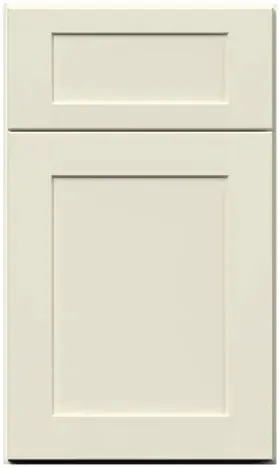
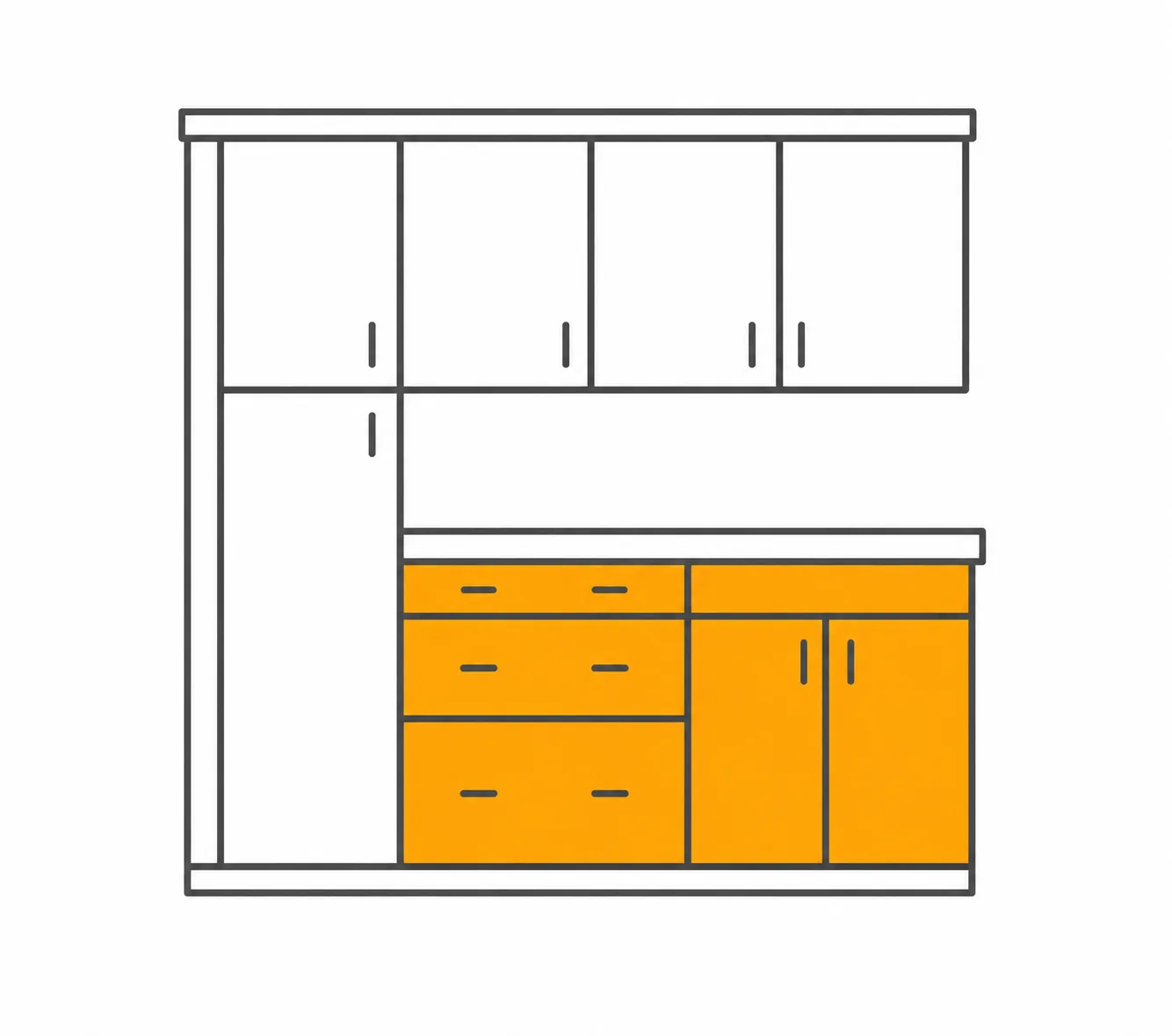


Three tiers, one box: what each drawer of a Galaxy Linen 3 drawer base cabinet is for
Reviewed September 2026 · Captivating Cabinets
Order this one by the tier, not the width. A Galaxy Linen 3 drawer base cabinet stacks a shallow drawer over two deep ones, and once you know what each of those heights will take, the nine widths from 12″ to 36″ pick themselves off an inventory of what you own rather than off the wall dimension. Below: the height arithmetic, the inventory, and what a run of these costs per foot against doors.
Drawer heights, tier by tier: the dimensions the spec sheet leaves out
Start from the box. Every Fabuwood base in the finish is 34½″ high with a 4½″ toe kick, so about 30″ of front is available for drawers. The published spec sheet does not give the individual front heights or the clear height inside each drawer, so the figures below are measured off our own display cabinets and rounded; if one particular item is the reason you are buying, confirm on a sample.
| Tier | Front, roughly | Clear inside, roughly | Belongs here | Does not |
|---|---|---|---|---|
| Top | 6″ | 4″ | Flatware in a tray, knives on a block, measuring spoons, foil and wrap boxes lying flat | Anything that stands up — a spice jar is borderline, a bottle is out |
| Middle | 12″ | 8–9″ | Dinner plates stacked, bowls, food containers with lids nested, dish towels | Skillets with the handle up, pots over about 8″ with the lid on |
| Bottom | 12″ | 8–9″ | Saucepans, a 5-quart Dutch oven lid-on, skillets flat, small appliances that lie down | Stockpots, the stand mixer, anything you would rather not lift from knee height |
The uneven split is the reason to buy this over the two-drawer bank: a real utensil tier without giving up the depth underneath. The cost is about two inches of clear height per deep drawer, which is the difference between a Dutch oven and a stockpot.
Choosing between the 18, 24 and 36 inch widths by what you own

Subtract about five inches from the nominal width for the inside of the drawer — the face frame and runners take the rest — then walk through what has to lie flat in each tier. A drawer is only a good drawer when nothing in it is stacked at an angle.
- Dinner plates, 10½″ to 11″ across, need about 12″ inside — an 18″ box minimum, GL DB18 at $646.75. In a 15″ box they tilt.
- A half-sheet pan, 18″ × 13″, lies flat with about 16″ inside. That is the 21″ box, GL DB21 at $672.75, or wider.
- Two rows of plates side by side want 20″ or more inside — the 27″ (GL DB27, $773.50) or 30″ (GL DB30, $845.00).
- A cutlery tray in the top tier is sized to the cabinet, and the smallest one made in this finish fits the 15″ box. Nothing is made for the 12″.
Then the wide-versus-pair question — most people arrive at it as “one 36 inch three-drawer base, or two 18s” — which the catalog answers with a number. One GL DB36 is $1,030.25; two GL DB18 come to $1,293.50. The single box is $263.25 cheaper and gives three drawers nearly 31″ inside; the pair gives six fronts, two zones, and a stile down the middle. Buy wide for plates and pots, buy the pair when prep and baking should stay apart.
Drawer base vs door base: the cost per foot of run
Buyers compare a drawer base to a door base at the same width and stop there. Cost per foot of run is the more useful figure, because that is how the wall gets priced, and it shows what the width-for-width comparison hides: the drawer premium shrinks as the box gets wider.
| Width | Three-drawer bank | Per foot | Door base | Per foot |
|---|---|---|---|---|
| 12″ | GL DB12 · $617.50 | $618 | GL B12 · $364.00 | $364 |
| 18″ | GL DB18 · $646.75 | $431 | GL B18 · $409.50 | $273 |
| 24″ | GL DB24 · $705.25 | $353 | GL B24 · $471.25 | $236 |
| 30″ | GL DB30 · $845.00 | $338 | GL B30 · $555.75 | $222 |
| 36″ | GL DB36 · $1,030.25 | $343 | GL B36 · $676.00 | $225 |
Read down the drawer column: a foot of 12″ bank costs nearly twice a foot of 30″ bank, because a narrow box carries the same three drawers, six runners and face frame across fewer inches. That is the honest case against the 12″ unit — not a bad cabinet, but the most expensive foot of base in the line, holding the least, and $253.50 more than the GL B12 door box that fills the same foot with a drawer over a shelf.
Read across: at 24″ and up, drawers run about $115 a foot over doors — roughly $940 on eight feet of wall. The single-door and double-door pages cover where a shelf does the job for less.
A twelve-foot wall, three ways
Four 36″ boxes make a twelve-foot run. The same wall, sink in the same place, drawer count varied, priced from the live list; counter, panels and sink are extra.
- All drawers except the sink: GL SB36 + GL DB36 + GL DB36 + GL DB36 — $3,581.50. Every foot that is not plumbing slides out.
- Mixed, the run we would draw: GL SB36 + GL DB36 + GL B36 + GL DB36 — $3,227.25. Drawers flank the sink and the prep zone; the door box at the far end takes the small appliances and the things you open monthly.
- All doors: GL SB36 + GL B36 + GL B36 + GL B36 — $2,518.75. The cheapest wall, and the one where the back foot of every cabinet goes unused.
The gap between the mixed run and the all-drawer run is $354.25, and between mixed and all-doors is $708.50. Put the second number next to a pot drawer under the cooktop at $835.25 and the shape of a sensible base budget appears: drawers where you stand, doors where you do not, one deep bank for the pots.
What that does to a whole-kitchen number is in our Fabuwood cost guide; the benchmark 10x10 layout quotes at $3,500.00 in this finish.
Inserts sized to these boxes

The codes say which box each tray fits; loose parts carry the GLN prefix in the same paint. Cutlery trays: GLN CD-15/18 ($201.50), GLN CD-21/24 ($273.00), GL CD-27/30 ($399.75) and GL CD-33/36 ($526.50). K-cup trays: GL KCUP-18 ($224.25) and GL KCUP-21/24 ($266.50). The DCD BLUM series, GLN DCD-15 through DCD-36 at $354.25 to $676.00, is a second shallow drawer on its own runners inside the top tier rather than a tray dropped in.
Fit one to the top tier and stop; a tray in a deep tier wastes height. The cabinet accessories page has the roll-outs that do the same job inside a door base, and the space-saving guide covers aftermarket layouts.
Writing the box list
Order matters more than widths. Fix the sink base first, because the plumbing does not move. Fix the cooktop or range cabinet second. Then place drawer banks on both sides of the cooktop and at the prep counter, door bases at the far ends and under anything tall, and close out the remainder with a 27″ or 33″ box before you reach for a filler.
One detail for a long, visible run of beige drawer fronts: the top tier here and the top drawer on a door base sit at similar heights, so the horizontal rail line carries across the wall, and in a cream-to-beige shaker like this one that continuous line is what makes the run read calm. Check it on the elevation drawing before ordering; a full-height door box breaks it, and sometimes that is the right call anyway.
Everything ships assembled in 7 days to 3 weeks. The base cabinet lineup has the corners and specialty boxes, and the design service will draw the elevation if you would rather not.
Common questions
- How tall is each drawer in a three-drawer base cabinet?
- A 34½″ box with a 4½″ toe kick leaves about 30″ of front, split roughly 6″ on top and 12″ for each drawer below, with around 4″ clear in the top tier and 8–9″ in the lower two. Those are our measurements, not a published spec — confirm on a sample if a specific item has to fit.
- What width drawer base do I need for dinner plates?
- At least 18″. Plates run 10½″ to 11″ across and the inside of a drawer is about five inches narrower than the cabinet, so an 18″ box gives roughly 13″ — enough for one stack with room to grip it. For two stacks side by side, go to 27″ or 30″.
- Is one 36-inch drawer base cheaper than two 18-inch ones?
- Yes, by $263.25 — GL DB36 is $1,030.25 against $1,293.50 for two GL DB18. The wide box gives three drawers nearly 31″ inside; the pair gives six fronts and two separate zones. Buy wide for plates and pots, buy the pair when you want prep and baking kept apart.
- How much more do drawers cost than doors per foot of run?
- At 24″ and wider, about $115 a foot: a 30″ drawer bank works out near $338 a foot against about $222 for a 30″ door base. The premium is steepest at narrow widths — the 12″ unit is $617.50 for a single foot.
- Which drawer takes a divider insert?
- The top one. It is the shallow tier and the only one a tray suits; the lower two are deep enough that a tray wastes height. Factory trays in this finish start at the 15″ box (GLN CD-15/18) and run up to the 36″ (GL CD-33/36). Nothing is made for the 12″.
- Do Fabuwood drawer base cabinets come with soft-close drawers?
- Yes, as standard. Every drawer in this finish runs on Blum Tandem plus Blumotion full-extension concealed glides — the soft close is in the runner, not an add-on — over ⅝″ dovetailed solid wood boxes, assembled at the factory. Nothing on the price list swaps them for a cheaper runner.
Keep reading
The guides behind the numbers on this page.
- Fabuwood Cabinets Price List (2026)
Every base SKU priced, if you want to run the per-foot math on a different wall.
- Fabuwood Cabinet Sizes and Specs: The Complete Dimension Guide
The 34½″ box and the width grid the tier arithmetic starts from.
- Types of Base Cabinets: Sizes and Standard Dimensions
Sink, corner and specialty bases that go on the list before the drawers do.
- How to Read Cabinet SKU Codes
DB, B, SB and the GLN loose-part prefix, decoded.
- How Much Do Fabuwood Cabinets Cost?
What the drawer premium does to a whole-kitchen quote.
- What Is a 10x10 Kitchen? Cabinet Costs and Packages
The benchmark layout this finish quotes at $3,500.00.
- Soft-Close vs Self-Closing Cabinet Drawers
What the Blumotion runner is doing under a loaded middle tier.


