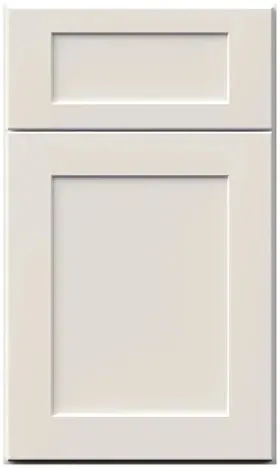


Galaxy Dove farm sink cabinets: a white apron beside an off-white door — too close, or the point?
Reviewed September 2026 · Captivating Cabinets
Choose an apron sink and you are choosing a nine- or ten-inch block of colour that sits at eye height halfway along the run, permanently. In most finishes that is a styling question. With a Fabuwood Galaxy Dove farm sink cabinet — GD FS30, FS33 or FS36, at $806.00, $815.75 and $825.50 — it is the whole decision, because the door is an off-white and the sink most people want is a bright white fireclay. This page is about that pairing, about which half of a two-tone kitchen the apron cabinet belongs to, and about the three things to confirm before the box is ordered.
What the apron cabinet gives up, and what it is built to carry
A standard base hides its top rail under the countertop. An apron-front box drops that front so the sink face sits in the opening, and the bowl rests on a support inside the cabinet instead of hanging from the stone. Everything else — the five-piece door with its ⅜″ MDF centre panel, the ½″ veneered plywood box, the veneered interior, the Blum soft-close hinges, the limited lifetime warranty — is what the sink base one page over has, which is why $806.00 to $825.50 sits so far above that page's $386.75 to $572.00: you are paying for a box engineered around a missing rail and a load it was never meant to carry.
Three widths — 30″, 33″ and 36″, all 34½″ high and 24″ deep — and the spread between the cheapest and dearest is $19.50, so width is never a budget decision here; the sink dictates it. Two figures the listing does not publish matter a great deal: the height of the opening, for a tall apron, and the load the support is rated for, for cast iron. We confirm both against the sink drawing before an order is released. Ask us to.
White fireclay next to an off-white door

Here is the honest version. A white fireclay apron is a brighter, cooler white than this door. Put the two side by side and the door reads warmer than it did on its own — which is precisely what buyers who picked this finish over a stark white were after: a white kitchen with the edge taken off. The gap is real but small. On a true beige the same sink reads as deliberate contrast; on this off-white it reads as the brightest point on a white wall. That is not a mismatch. It becomes one only when the sink is nearly the door's colour and not quite, and that near-miss is the trap on this page.
| The apron | Against the door | Our call |
|---|---|---|
| Bright white fireclay or cast iron | A step brighter and cooler; the door reads warmer beside it | The pairing most people are picturing. Tie it to a white or warm-white quartz so the sink is not the only bright white in the room |
| Biscuit, bisque or "linen" fireclay | Within a shade of the door — close, and not the same | Avoid unless the chip matches in your light. A near-miss reads as a paint error |
| Stainless | Neutral, leaning cool under cool bulbs | Safe in a bright room; check it under the strips you will actually run |
| Matte black or dark composite | A hard block of contrast | Works here, where it would fight a beige — the same logic as black pulls on this finish |
| Copper or bronze | Warm metal on a warm white | The easiest pairing of all, if you are willing to manage a patina |
| Grey composite or concrete | Cool and quiet | This finish takes grey where a beige cannot; keep the counter in the same family |
The thing that decides it cannot be seen on a screen. This door's warmth is faint enough that a photograph flattens it, so the sink brand's colour chip and a $25.00 door sample have to meet in your kitchen, under your bulbs. Warm LEDs at 2700–3000K keep a white apron and this door in the same family; a 4000K strip over the sink pushes the door grey and the sink blue-white, and the pairing that looked right at noon looks wrong at dinner.
Can a farmhouse sink go in the island? In a two-tone plan it often should
This finish is the easy half of a two-tone kitchen: an off-white perimeter over a Timber or Indigo island is a plan we draw constantly. The apron sink is what decides which half it belongs to. Put it on the window wall and the perimeter carries the water, the island stays dry, and you order this page — a GD FS box in the perimeter colour. Put it in the island, where the apron becomes the island's front and faces the room, and the box is ordered in the island colour, not in Dove; this page is then the wrong one and the same cabinet in the island finish is the right one.
Each has a cost. A sink in the island means plumbing to the island and a dishwasher beside it, which is the expensive version of two-tone; a sink on the wall keeps the island for seating and prep, which is the cheap one. And there is a look at stake. A white apron on a dark island is a strong photograph. A white apron on this off-white perimeter is the softer, whole-kitchen version of white. Decide which room you are building before the box is ordered — a free 3D layout shows both.
Three things to confirm before the box is ordered
In the order they cause trouble:
- The sink's outside width against the box. The allowance is about three inches over the sink — a 30″ apron sink in the 33″ box, a 33″ in the 36″ — and the 36″ box is the top of the range, so a sink sold as 36″ has no home in this line unless its maker's outside dimension says otherwise.
- The apron height against the opening. The opening is cut at the factory and the listing does not state it; an apron taller than it allows does not sit lower, it does not fit. Send the sink drawing and we check it.
- The weight, for fireclay or cast iron. The support inside the box carries no published rating, and a full cast-iron bowl weighs about as much as the person washing up in it. We confirm the rating with the manufacturer before releasing the order.
The sink also has to be on the job before the boxes go in: the installer lands it on the support, and the countertop is templated around the sink that is there rather than the one on the plan. If a big double bowl is forcing a 39″ or 42″ box that this line does not make, the alternatives are a deep undermount in a standard sink base or, for the tall uninterrupted face without the apron, a full-height door base.
If the apron sink loses the argument
Plenty of people arrive here for the fireclay look and leave with a deep stainless undermount once the near-match question settles the other way. That is a sink base, 21″ to 42″ at $386.75 to $572.00 in the same off-white, and the false front across its top is the panel this cabinet removes. A corner sink is different again — the diagonal sink base at $617.50, or the diagonal sink front for a cavity built on site — and neither comes in an apron version. The rest of the perimeter is in the Dove collection.
Common questions
- Does a white farmhouse sink go with off-white cabinets?
- Yes, with one caveat: the sink will be the brightest white on the wall and the door will read a touch warmer beside it, which is the effect most people chose this finish for. Pair it with a white or warm-white counter so the sink is not the only bright white in the room, and avoid biscuit or bisque fireclay, which lands too close to the door to look intentional.
- What size farm sink cabinet do I need for a 30 inch farmhouse sink?
- The 33″ box, GD FS33 at $815.75. The cabinet wants about three inches over the sink's outside width for the stiles and the support. Confirm against the sink maker's drawing, because two brands' "30-inch" sinks can differ by an inch outside.
- Can you put a farmhouse sink in a kitchen island?
- Yes, and in a two-tone plan it is common — but then the apron cabinet is ordered in the island colour, not the perimeter colour. If the island is Timber or Indigo under a Dove perimeter, the box on this page is the wrong finish for it.
- Stainless or fireclay farmhouse sink with warm white cabinets?
- Bright white fireclay gives the classic photograph and reads a step brighter than the door. Stainless is neutral and asks nothing of the door, but leans cool under 4000K light. Black composite is the surprise: it works on this off-white where it would fight a beige.
- How much does a Fabuwood Galaxy Dove farm sink cabinet cost?
- $806.00, $815.75 and $825.50 for the 30″, 33″ and 36″ boxes, each arriving built with its Blum soft-close hinges on. The sink is bought separately and must be delivered before installation day.
- Is the farm sink cabinet rated for a cast iron sink?
- The listing does not publish a rating, so for fireclay or cast iron we confirm the support with the manufacturer before releasing the order. Send the sink model with the order and we will do it before anything ships.
Keep reading
The guides behind the numbers on this page.
- Cabinet Samples: How to Order and Evaluate Before Buying
Judging a door sample against a sink colour chip in your own light.
- How to Match Cabinets, Countertops, Backsplash and Flooring
Tying a white sink, an off-white door and a counter into one family.
- White Kitchen Cabinets: Finding Your Perfect Shade
Bright white, warm white and off-white, and how each reads beside a fixture.
- Kitchen Island Clearance Guide
The room an island sink and the dishwasher beside it need.
- Types of Base Cabinets: Sizes and Standard Dimensions
Where the apron box sits among the other bases.
- Fabuwood Cabinet Sizes and Specs
The catalog tables behind the 30″, 33″ and 36″ widths.
- Cabinets for Remodelers
Sequencing a sink that has to arrive before the cabinets.
- How Much Do Fabuwood Cabinets Cost?
What an $800 specialty box does to a whole-kitchen number.


