

The door that goes up: what a lift-up bridge cabinet is really for
Reviewed September 2026 · Captivating Cabinets
A cabinet door has to go somewhere when it opens, and in most of a kitchen the somewhere is obvious: it swings into the room and nobody minds. Two places in a wall run it is not obvious. Over an appliance, where a swinging panel opens across the thing you are trying to reach. And across a span wide enough that a side-hinged door becomes an object in its own right. Both of those are what the two boxes on this page exist for. There are exactly two — GN W421224LU and GN W481224LU, $689.00 and $747.50 — and the first thing to get straight about them is their shape, because the code misleads almost everyone who reads it.
Two boxes, and the number in the middle that is not depth

Read GN W421224LU left to right and it is width, then height, then depth: 42 inches wide, 12 inches high, 24 inches deep. Not 12 deep. Twenty-four — twice the depth of an ordinary upper, the same depth as the boxes built to sit over a refrigerator. So this is not a cupboard. It is a bridge: a long, shallow-fronted, deep box that spans an appliance or an opening and puts a shelf of storage across the top of it.
That shape is the reason the door goes up. A 12-inch-high face 42 or 48 inches long cannot sensibly be hinged at the side — one door of that proportion is a flag, and a pair of them puts a joint down the middle of a run where nothing else has one.
| Code | Width × height × depth | Displayed price | Per inch of span |
|---|---|---|---|
| GN W421224LU | 42″ × 12″ × 24″ | $689.00 | $16.40 |
| GN W481224LU | 48″ × 12″ × 24″ | $747.50 | $15.57 |
Six more inches of span for $58.50, which makes the wider box the cheaper one per inch. That is unusual in this catalogue and it is worth knowing before you draw the opening: if the wall will give you 48 inches, the 48 is better value than the 42, not worse.
Above 36 inches there is no doored version of this box
This is the fact that settles most orders, and it is easy to miss because it lives in the absence of a product rather than the presence of one. The 24-inch-deep wall boxes with ordinary doors run 24, 30, 33 and 36 inches wide and stop. GN W361224 — 36″ × 12″ × 24″, the doored twin of what is on this page — is $370.50 and is the widest one built. There is no 42 and no 48.
So above 36 inches of span the choice is not lift-up against swing. It is one lift-up box against two boxes and a joint. And openings above 36 inches are common: a 42-inch built-in refrigerator, a side-by-side with panels, a 48-inch range, a bar or window opening drawn to the room rather than to the catalogue.
- Over a wide refrigerator. The 24-inch depth brings the box flush to the appliance instead of leaving a ledge on it, and an upward door does not open over the fridge door. Narrower cases are on the refrigerator wall cabinet page.
- Over a range and hood. A 12-inch face above a hood keeps the run continuous without hanging a cupboard where the heat goes.
- Across a window or a pass-through, where a swinging door would meet the casing or the head and stop halfway.
- Over a peninsula worked from both sides, where a door that swings is a door someone walks into.
Everywhere else, buy the doored box. A lift is a mechanism, and a mechanism you did not need is a mechanism that can still go wrong. The ordinary widths sit on the single-door and double-door pages.
What an upward door needs that a sideways one does not
A lift trades side clearance for clearance above and in front, and people plan the first and forget the second. The panel rotates up through roughly its own height before it parks, so a 12-inch door wants something like 12 inches of unobstructed space over the top of the box, and it wants nothing hanging in front of the box while it travels — no pendant, no shelf bracket, no range hood chimney sitting proud.
Run it against a real wall. Hang the box so its underside is at 84 inches and its top lands at 96, dead into an eight-foot ceiling, and there is nowhere for the door to go. Hang it lower, with the top at 84 or 90, and there is room above it and the door has somewhere to travel. The listing tells you it is a single wide door on a soft-close lift mechanism; it does not publish the make of the mechanism or its swing path. Measure the gap above the box and confirm the travel before the order goes in — that one call is the whole risk on this page.
The second consequence is the one nobody warns about: a lifted door stays lifted. That is the point — it frees both hands — but it also leaves a panel standing at head height, in the sightline of whoever is at the sink, until somebody closes it. Over a working counter in a galley that is a real objection. Over a refrigerator opened twice a day it is not.
Duty cycle: a hinge carries the door, a lift holds it
Worth separating the two jobs. A concealed hinge supports a door on a fixed axis and does its real work in the last few degrees of closing. A lift mechanism supports the door AND holds it against gravity for as long as it is open, on a spring or strut tensioned to that panel’s weight — which makes it the only part of a wall run with a genuine duty cycle.
What is on your side is the door itself. A 42 × 12 shaker panel is light by lift standards, far lighter than the tall glass-and-aluminium flaps these mechanisms usually carry. The rest of the run hangs on Blum Compact Clip hinges, which are not the part in question.
The rule that follows: put the lift over a bay you open a few times a day, not the one you open thirty times. The roasting tin, the spare stock of something, the appliance you use on a Sunday. Everyday cups and plates belong behind an ordinary door.
The money, and the side you can see
Set the lift-up against the widest doored box at the same depth and the premium is legible. GN W361224 spans 36 inches for $370.50; GN W421224LU spans 42 for $689.00. That is $318.50 for six more inches and an upward door, and almost none of it is width — it is the mechanism and the single-piece face.
One line people forget: if either end of the box is exposed, it needs a finished side. The wall end skins are $50.05 in every height (GN SK W30 through GN SK W42) under decorative accessories — confirm with us that the part covers 24 inches of depth rather than 12, because these boxes are twice as deep as an ordinary upper.
Forty-eight inches of one colour, unbroken
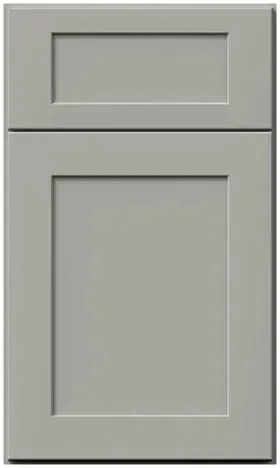
At 48 inches this box carries the widest single door face in the whole wall range — nothing else in the line presents that much uninterrupted painted surface in one piece at eye level. In a mid-tone grey it reads as a solid band across the top of the appliance, and whether that looks calm or heavy depends on what sits beside it. A light rail under the run (GN LRM, $149.50) or a strip of under-cabinet LED puts a bright line beneath the band and stops it reading as a slab. Left bare against a dark counter, it will read as one.
Before one goes on the order
Measure the opening top and bottom — appliance surrounds are rarely parallel. Measure the gap from the planned top of the box to the ceiling. Decide which ends are exposed, and confirm the mechanism and its travel with us rather than reading it off a photograph.
Send the elevation through a free 3D design and it comes back with the bridge drawn at a height that lets the door open and the run itemised. Boxes arrive pre-assembled with the door hung, in 7 days to 3 weeks. Contractors order through Captivating Pro; the rest of the range is on the collection page, and a $25.00 door sample is the cheapest way to judge a 48-inch face.
Common questions
- What is a lift up wall cabinet?
- A wall cabinet whose door lifts upward on a soft-close mechanism instead of swinging sideways on hinges. In this finish there are two: GN W421224LU and GN W481224LU, 42″ and 48″ wide, 12″ high and 24″ deep, at $689.00 and $747.50 displayed. Both are bridge boxes meant to span an appliance or an opening.
- Why is there no 42-inch wall cabinet with ordinary doors at this depth?
- The 24″-deep doored wall boxes run 24, 30, 33 and 36 inches wide and stop there; GN W361224 at $370.50 is the widest. A single side-hinged door much wider than that becomes unwieldy and a pair of short wide doors puts a joint in a run that has none. Above 36 inches the lift-up is the only single box.
- How much clearance does a lift-up cabinet door need above it?
- Plan for roughly the door’s own height of clear space above the box — about 12 inches here — plus nothing hanging in front of the face while the panel travels. A lift-up run dead into a ceiling has nowhere to put the door. The listing does not publish the exact travel, so confirm it before ordering.
- Do lift-up cabinet doors stay open on their own?
- Yes, and that is the point: the mechanism holds the panel up so both hands are free at the counter or the appliance below. It also means the door sits at head height until someone closes it, which matters if the run faces a working area rather than a refrigerator.
- Are lift-up doors soft close?
- The listings specify a soft-close lift mechanism on both boxes. The maker and the strut rating are not published on the page, so confirm them with us if the cabinet is going somewhere it will be opened many times a day.
- Is a lift-up better than a standard cabinet over a refrigerator?
- Only above 36 inches of span, or where a swinging door would open across the appliance door. Under 36 inches the doored 24″-deep boxes cost considerably less — $370.50 against $689.00 — and have no mechanism to maintain.
Keep reading
The guides behind the numbers on this page.
- Wall and Tall Kitchen Cabinet Sizes and Buying Guide
The height, width and depth ladder every code on these pages is cut from.
- How to Read Cabinet SKU Codes
Which digits are width, which are height and which are depth, before one goes on a quote.
- Why Blum Soft-Close Hinges Are Worth the Investment
What the rest of the run hangs on, and why the lift is the exception.
- Soft-Close vs Self-Closing Cabinet Drawers
Two mechanisms that sound identical and behave nothing alike.
- Kitchen Cabinet Molding Types
Crown, light rail and scribe, and which gap each one is for.
- Important Kitchen Dimensions Before Buying Cabinets
The clearances to take off the wall before an appliance bridge is drawn.
- Pre-Assembled Kitchen Cabinets: A Buying Guide
Why a box that arrives built is square, and what that is worth on an open unit.
- Gray Kitchen Cabinets: Finding the Right Shade
The full ladder of greys, and the undertone question answered without hedging.


