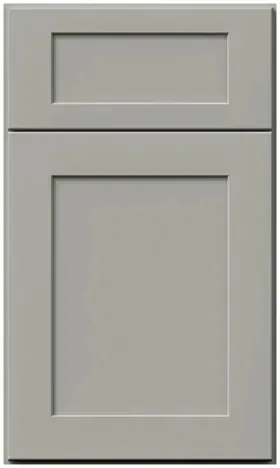


Drawers at the counter, a shelved cupboard above: why the four heights are what they are
Reviewed September 2026 · Captivating Cabinets
Prices quoted in this article were read off the grid on the review date; the live price grid on this page governs.
Four cabinets sit on this page and they are the strangest objects in the wall range: GN WD1848, WD1854, WD1857 and WD1860, 18 inches wide, 12 inches deep, and 48 to 60 inches tall, from $796.25 to $926.25. The name makes it sound like an upper built entirely of drawers. It is not. The drawers sit at the bottom, down at worktop level, and above them is a door-closed section fitted with adjustable shelves — the catalogue even sells extra shelves cut for this one box. The genuinely odd thing is the height, because an upper five feet tall is not hanging anywhere. That resolves the moment you do one piece of arithmetic, and the arithmetic tells you exactly where in the room this cabinet is supposed to stand.
Forty-eight, fifty-four, fifty-seven, sixty

Those four numbers look like a random slice of a height ladder. They are not. The standard wall run in this line comes 30, 36, 39 and 42 inches tall, and it hangs on a line 54 inches off the floor — a 34½-inch counter, a countertop, and the 18-inch backsplash gap above it. Add 18 to each of the four upper heights and you get 48, 54, 57 and 60.
Which means this box was drawn to stand on the counter, not to hang beside the uppers. Set it on a 36-inch finished counter height and its top lands dead flush with the run next to it, every time, at whichever of the four heights you picked. No scribe, no filler above, no step in the top line. That is the whole design, and once you see it the cabinet stops being strange.
| Code | Height | Standing on a 36″ counter, tops out at | Flush with | Displayed price |
|---|---|---|---|---|
| GN WD1848 | 48″ | 84″ | a 30″ upper — GN W1830 | $796.25 |
| GN WD1854 | 54″ | 90″ | a 36″ upper — GN W1836 | $877.50 |
| GN WD1857 | 57″ | 93″ | a 39″ upper — GN W1839 | $880.75 |
| GN WD1860 | 60″ | 96″ | a 42″ upper — GN W1842 | $926.25 |
Note the third row. Three extra inches of cabinet costs $3.25 — $877.50 to $880.75 — which is the smallest step anywhere in this finish. If your run is 39 inches and you were going to make do with the 54, do not; the 57 is effectively free. The jump from 57 to 60 is a different matter at $45.50, and that one is a real decision about the ceiling.
Twelve inches deep, in two zones: a drawer band and a shelf cupboard
The depth is the constraint both halves follow. A base drawer is 24 inches deep and swallows pans, lids and mixing bowls. The drawers here live in a 12-inch carcass, and once you subtract the box sides, the back and the runners the usable front-to-back space is closer to ten. Nothing tall, nothing round, nothing heavy goes in them — and because they sit right at the worktop, under your hands, that shallowness reads as convenience rather than as a shortfall.
Above the drawers the box changes character. It becomes a cupboard behind a door, still 12 inches deep, with shelves you can move. On the 48 that cupboard is modest; on the 60 it is most of the cabinet, and its top reaches 96 inches off the floor, well past anyone’s comfortable reach. So plan the tower by zone, working up from the counter:
- The drawer band, at worktop level: cutlery in a tray, coffee filters and capsules, measuring spoons, piping tips, folded napkins, chargers — small, flat, used every day, reached without stretching.
- The lower shelves, roughly shoulder to eye height: mugs, everyday glasses, tea tins, a single row of spice jars. A 12-inch shelf takes a dinner plate; it will not take a big serving platter.
- The top shelf on the 57 and the 60: the once-a-month layer — spare glassware, the cake stand, the holiday mugs. Put things there knowing the step stool comes out to reach them.
The shelves are the adjustable part, and the loose parts page sells extras made for the 18-inch WD box: AS-WD18 at $37.05, AS-WD18-1 at $37.70, and packs of two ($78.00) and three ($113.75). The listings do not say how many shelves arrive in each height, or whether the two single-shelf SKUs differ, so ask both before adding any. A tall cupboard full of short mugs is where one extra shelf pays for itself fastest.
Here is the price comparison that frames the decision, and it is almost funny. GN DB18-4, an 18-inch four-drawer base 24 inches deep, is $799.50. GN WD1848 is $796.25. The same money, to within $3.25, buys either a deep drawer bank under the counter or a tower of shallow drawers and shelves standing on top of it. They do not compete — one holds your pans and the other holds what you reach for at the counter — but if the budget only stretches to one and you have not yet solved pan storage, solve pan storage. The four-drawer bases are on their own page.
What it takes off the counter, in square inches
A tower standing on the worktop is occupying worktop. Eighteen inches wide by twelve deep is 216 square inches — a foot and a half of counter, gone for good, and on a standard 25-inch-deep run it takes very nearly half the depth for its whole width. That is fine against a wall you were never going to work on. It is not fine in the middle of the prep stretch, and it is a poor idea in a galley where the facing counter is close enough that a tower narrows the aisle at shoulder height.
The three placements that work are the three where the counter underneath was never really counter:
The coffee station
A machine, a grinder, and a tower beside it: beans, filters and capsules in the drawers at counter level, cups on the shelves behind the door above. The counter behind the machine was dead space anyway, and this is the one bay in a kitchen where that split earns its money every single morning.
The end of a baking run
Set at the end of the run rather than in it, so the mixer’s working space stays clear. Sheet pans and bowls live below in a base; the small, flat, fiddly half of baking lives in the tower’s drawers at the worktop, with measuring jugs and cake tins on the shelves over them.
A desk or homework counter
At 12 inches deep the tower fits walls that will not take a pantry, the low drawers take the small flat clutter a desk generates, and the cupboard above holds files and boxes out of sight. This is the version we draw most often outside the kitchen proper — see the base cabinet guide for the desk-height parts that go under it.
The end panel tells you what this really is
Look at what it costs to finish the side of one. A wall cabinet end skin is $50.05 in every height. The skin for this box, GN SK WD, is $169.00 — the same figure as GN SK TALL, the skin for a full-height pantry, and more than three times what an upper’s side costs. The catalogue files this under wall cabinets and prices its panel like a tall cabinet, because in every way that matters to a fabricator it is one.
Which means: if either side of the tower is visible, budget the $169.00 and put it on the same order so the paint comes out of one batch. A tower is nearly always visible on at least one side — it is a freestanding-looking object on a counter, and the side is at eye level. Both skins and every other finished part live under decorative accessories.
A column of colour that starts at the counter
Every other upper in the kitchen floats: there is a lit band of backsplash under it, and that band is what keeps a mid-tone run from feeling heavy. This box has no band. It stands on the worktop and runs five feet straight up, which makes it the only place in the room where the grey meets the counter surface directly and reads as a solid object rather than a plane.
That is either the effect you want — a piece of furniture anchoring the end of a run — or it is a block in the wrong place. The test is whether it stands at the end of a stretch or in the middle of one. At the end, against a wall or beside a window, it reads as deliberate. Mid-run, with counter either side of it, it reads as an obstruction. If you are unsure, hold a door sample at $35.00 against the counter you already own and look at the two surfaces touching.
Ordering one
Confirm your finished counter height before you pick a height — the arithmetic above assumes 36 inches, and a thicker slab or a taller base moves every number with it. Confirm the drawer-and-door split and the shelf count. Decide which sides show. Then check the top line against the run beside it on a drawing rather than on the wall.
A free 3D design will do all four of those and come back with the elevation drawn to scale. Boxes ship pre-assembled in about 2 weeks, drawers already on Tandem plus Blumotion full-extension runners with ⅝″ solid-wood dovetail boxes. The rest of the wall range is on the wall cabinet page and the whole finish on the collection page.
Common questions
- What is a wall cabinet with drawers?
- A narrow cabinet that stands on the counter instead of hanging above it, with drawers at the bottom and a door-closed section of adjustable shelves above them. In this finish it comes one width only — 18 inches — in four heights from 48 to 60 inches, all 12 inches deep, from $796.25 to $926.25 displayed.
- Why are these cabinets 48 to 60 inches tall?
- Because each height is a standard upper height plus the 18-inch backsplash gap. Standing on a 36-inch counter, the 48 tops out at 84″, the 54 at 90″, the 57 at 93″ and the 60 at 96″ — flush with a 30, 36, 39 or 42-inch upper hung on the usual 54-inch line.
- How deep are the drawers in a wall drawer cabinet?
- The box is 12 inches deep, so the usable drawer depth is closer to ten once the carcass and runners are subtracted. That suits cutlery, coffee, spice, baking small goods and linen. Pots, bowls and anything tall belong in a 24-inch-deep base drawer instead.
- Does a counter-standing drawer cabinet take up counter space?
- Yes — 18 by 12 inches of it, about 216 square inches, and roughly half the depth of a standard 25-inch counter for its full width. Put it at the end of a run or over counter you were never going to work on, not in the middle of a prep stretch.
- How many drawers does a WD cabinet have?
- The listing does not publish the count, the drawer heights or where the door section starts, and they may vary with height. What is clear is the layout — drawers low, shelves behind a door above — so confirm the exact split before you order.
- Can I add shelves to the cupboard section?
- Yes. Adjustable shelves made for the 18-inch WD box are sold on the loose-parts page: AS-WD18 at $37.05, AS-WD18-1 at $37.70, and packs of two ($78.00) and three ($113.75). Ask how many ship with your height before buying extras.
- Do I need a finished side panel for one?
- Almost certainly. The side of a counter-standing tower is at eye level. GN SK WD is $169.00 — the same as a pantry skin, not the $50.05 an ordinary upper’s side costs — and it should ride on the same order so the finish comes from one batch.
Keep reading
The guides behind the numbers on this page.
- Wall and Tall Kitchen Cabinet Sizes and Buying Guide
The height, width and depth ladder every code on these pages is cut from.
- Dovetail Drawers and Cabinet Quality
What a ⅝″ dovetail box and a Blumotion runner are actually buying you.
- How to Read Cabinet SKU Codes
Which digits are width, which are height and which are depth, before one goes on a quote.
- Cabinet End Panels, Scribe Molding and Fillers Explained
Why the side of this box is priced like a pantry’s.
- Space-Saving Cabinet Solutions
The inserts and narrow units that turn leftover inches into storage.
- Important Kitchen Dimensions Before Buying Cabinets
Counter height, backsplash gap and the 54-inch line the arithmetic above rests on.
- Fabuwood Cabinet Sizes and Specs
Every dimension the line is built to, in one grid.
- Gray Kitchen Cabinets: Finding the Right Shade
The full ladder of greys, and the undertone question answered without hedging.


