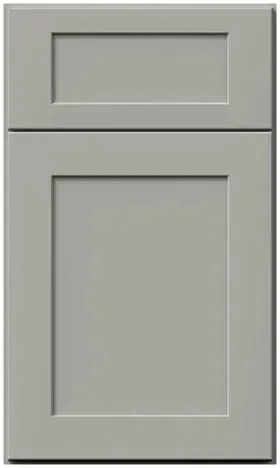


Six heights and one door: choosing a narrow wall cabinet for the gap it fills
Reviewed September 2026 · Captivating Cabinets
Nobody shops for a 15-inch-wide upper cabinet because they want one. They buy it because there are fifteen inches left between the hood and the wall, or because the soffit is at 84 inches and the run has to stop there, or because a window head cuts the wall down to a strip. A narrow single-door box is the part that makes an upper run fit a real room, and it comes in six heights and five widths, which sounds like thirty choices and is really two: how tall, and which way does the door swing. The first is arithmetic. The second is the one people get wrong, because a wall door swings at the height your face is.
The ladder starts at fifteen inches, and the cheap rung is in the middle

Six heights are stocked in the one-door widths: 15, 18, 30, 36, 39 and 42 inches. There is no 12-inch and no 24-inch box on this page — those two heights exist only in the wider two-door sizes over a fridge or a range, which is worth knowing before you draw a plan around a 12-inch-high 15-inch box that does not exist. The 9-inch width is narrower still: it starts at 30 inches tall and goes no shorter.
Here is the whole ladder at one width, so the steps are visible. A 15-inch box, all six heights, at displayed prices on the review date.
| Height | Code | Price | The job it is bought for |
|---|---|---|---|
| 15″ | GN W1515 | $182.00 | Over a doorway, or a strip above a window head |
| 18″ | GN W1518 | $227.50 | Beside a hood chimney, or under a low soffit |
| 30″ | GN W1530 | $234.00 | The default, topping out at 84″ with crown above |
| 36″ | GN W1536 | $282.75 | Tops at 90″, leaving six inches for a crown profile |
| 39″ | GN W1539 | $295.75 | Tops at 93″, a three-inch reveal to an 8-foot ceiling |
| 42″ | GN W1542 | $325.00 | Straight into a 96″ ceiling, no gap and no tolerance |
Read the third and fourth rows again. Eighteen inches of cabinet costs $227.50 and thirty inches costs $234.00 — twelve extra inches of box, a whole extra shelf bay, for six dollars and fifty cents. That is the single best-value step anywhere on the wall, and it is the reason we push back when somebody specifies a short box for a gap that could take a tall one. The steps above it behave normally: 30 to 36 is $48.75, 36 to 39 is $13.00, 39 to 42 is $29.25. End to end the ladder spans $143.00.
None of which decides anything on its own. The height is set by what sits above the gap, and that is the next section. Widths and heights across the whole wall grid are listed in the wall and tall sizes guide, and every box in this finish is priced on the wall cabinet page.
Four gaps, four answers
Almost every narrow upper we sell is doing one of four jobs. Work out which one yours is and the height chooses itself.
- Under a soffit. Measure from the counter to the underside of the soffit and subtract the backsplash gap you want — 18 inches is standard. A soffit at 84 inches over a 36-inch counter leaves 48 inches, minus 18, equals a 30-inch box. A soffit at 90 takes a 36. This is the one case where the number is not a judgement call at all, and the one case where getting it wrong is visible from the doorway.
- Above a window head. A window whose head is at 80 inches leaves 16 inches of wall to the ceiling on an 8-foot wall — enough for a 15-inch box and a scribe. This is where the two short heights earn their keep, and where a 12-inch-wide box at $302.25 in the 42-inch height would simply not fit.
- Flanking a hood or a chimney. The usual arrangement is a 36-inch hood with a narrow box either side running full height. Two 15-inch boxes at 36 inches tall are $282.75 each; two 12-inch boxes are $266.50 each. This is the one place a narrow pair reads as deliberate rather than leftover, because the eye sees a symmetrical frame around the range rather than two odd remainders — the shadow line down each stile is doing work in a mid-tone that it would not do in white.
- Closing out a run at the wall. The remainder after the full-size boxes is whatever it is: 9, 12, 15, 18 or 21 inches, plus a filler. Match the height to the boxes beside it, not to the gap.
A fifth case turns up often enough to name: the gap over a refrigerator. That is not this page. Those boxes are 24 inches deep rather than 12 so they sit flush with the appliance, and they are 30, 33 or 36 inches wide — see the refrigerator wall cabinets page. A narrow 12-inch box hung over a fridge leaves a two-foot ledge on top of the appliance and looks like an error, because it is one.
The arc a door draws, at the height your face is
Here is the part a plan view hides. These are full-overlay doors on Blum Compact Clip hinges that open 110 degrees, so a 21-inch door swings a 21-inch arc and ends up projecting roughly its own width into the room. On a base cabinet that happens at hip height, where it is a nuisance. On a wall cabinet it happens between 54 and 96 inches off the floor, which is to say between your chest and the ceiling, and the leading edge of a door hung on the wrong side arrives somewhere around your cheekbone.
So the hinge side is not a detail, and it is not in the part number either — hand is a build option, stated on the order line rather than typed into a code. The way we ask for it is plain English: face the cabinet from where you would stand to use it, and tell us which edge the hinges sit on. What follows is how to work out the answer.
- Hinge on the side you walk in from, so the door opens away from your approach rather than across it. The person reaching in is standing at the cabinet; the person getting hit is the one walking past.
- At the end of a run against a return wall, hinge on the wall side. A door hinged the other way swings out into open air and has nothing to stop it; hinged to the wall it opens into the corner and stays out of the lane.
- Beside a window, hinge away from the casing. A deep reveal or a plantation shutter will stop a door well short of 90 degrees, and a door that only opens halfway makes the whole cabinet awkward for twenty years.
- Flanking a hood or a range, mirror the pair with the hinges outboard. Both doors then open away from the cooking surface, and neither one hangs over a hot pan while you are reaching for oil.
- Next to an inside corner, check the corner cabinet first. Its door and the door of the first full box have to pass each other, and the reveal between them is what makes that possible — see the corner wall cabinets page for how the corner is resolved before the run beside it is set.
One more thing worth knowing rather than discovering: the hinge cups are bored into the door and the frame is drilled to match at the factory, so the swing is not a field change on a pre-assembled cabinet. The hinges themselves are six-way adjustable and quick-release, which means the door comes off in a second and goes back in line without tools — but it goes back on the side it was built for. Why those hinges are worth the price is set out in the Blum soft-close guide; door hand on the base run is covered on the single door base page.
Five widths, and when nine inches beats a filler
Across at 36 inches tall the widths run: GN W0936 at $243.75, GN W1236 at $266.50, GN W1536 at $282.75, GN W1836 at $318.50 and GN W2136 at $351.00. Twelve inches of extra width, 9 up to 21, costs $107.25. Twelve inches of extra height at one width costs about the same — $91.00 from GN W1530 to GN W1542 — which makes the narrow boxes unusual. On the wider two-door sizes height is the expensive dimension by a clear margin and width is nearly free; down here the two run neck and neck, so buy whichever one the wall will actually give you.
Which raises the question people actually ask on this page: at the end of a run, is the leftover space a small cabinet or a filler strip? The strips are cheap — a 3-inch wall filler is GN WF336 at $34.45, a 6-inch is GN WF636 at $65.00 — and there is no shame in one. The rule we use is six inches. Under six inches of remainder, fill it; a 6-inch cabinet does not exist on the wall grid in this finish anyway, and a 6-inch door is a door you will stop opening. At nine inches and up, buy the box: GN W0936 at $243.75 gets you a full-height shelved bay for the price of a good pan, and nine inches of wall is enough for tinned goods, spices, cutting boards on edge or a tray stack.
If the remainder lands at exactly three or six inches and you want it to work harder than a strip of wood, the filler can be a pull-out instead: GNK SPO-WF336 is $409.50 for a 3-inch by 36-inch wall unit and GNK SPO-WF636 is $468.00 for the 6-inch. That is a lot of money for a narrow gap, and it is the right money in exactly one situation — a spice pull-out immediately beside the range, where the alternative is a drawer four feet away. The pull-out accessory guide covers how they mount and what the box has to give them.
What goes on the order beside the box
Three parts are not in the cabinet price and belong on the same order rather than a second one. Crown, if the run stops short of the ceiling: profiles start at GN CM-1, $117.00, and run to GN CM-8 at $367.25, with the detail in the molding guide. Light rail, GN LRM at $149.50, which hides the LED strip under the run and is worth more on a mid-tone than on a white one because it puts light on the counter instead of on the doors. And a finished skin for any side the room can see: GN SK W30, GN SK W36, GN SK W39 and GN SK W42 are all $50.05.
Then measure the ceiling in all four corners before you commit to a height, because half an inch of fall across twelve feet changes the answer. Send us the wall and a free 3D design comes back with the run drawn, the swings arrowed and the fillers counted. Before any of it, spend $25.00 on a door sample and look at it at eye level under your own bulbs, because that is the height these doors live at. Boxes arrive pre-assembled with the doors hung, in 7 days to 3 weeks. Trade buyers go through Captivating Pro; the rest of the finish is on the collection page.
Common questions
- What heights do single-door wall cabinets come in?
- Fifteen, 18, 30, 36, 39 and 42 inches in the 12″ to 21″ widths; the 9″ width starts at 30 inches and goes no shorter. The 12-inch and 24-inch heights people expect to find exist only in the wider two-door sizes used over a fridge or a range.
- Which way should a kitchen wall cabinet door open?
- Away from the way you approach it. Hinge on the side you walk in from, hinge to the wall at the end of a run, hinge away from a window casing, and mirror a pair either side of a hood so both doors open away from the range. A wall door swings at face height, which is why it matters more up here than on a base cabinet.
- Can I change the hinge side after the cabinet arrives?
- No. The hinge cups are bored into the door and the frame is drilled to match before the cabinet ships, so the swing is fixed at build. The Blum hinges are six-way adjustable and the door lifts off without tools, but it goes back on the side it was built for. Specify the hand on the order line.
- How much is a 15-inch wall cabinet in this gray shaker?
- From $182.00 for the 15-inch-high GN W1515 to $325.00 for the 42-inch-high GN W1542 at displayed prices, with the 30-inch GN W1530 at $234.00 in the middle. The step from the 18-inch box to the 30-inch box costs six dollars fifty, which makes it the best-value rung on the ladder.
- Is a 9-inch cabinet better than a filler strip?
- At nine inches or more, buy the cabinet — GN W0936 is $243.75 and gives you a usable full-height bay. Under six inches, fill it: a 3-inch wall filler is $34.45 and a 6-inch is $65.00. Between the two, judge it on whether a narrow door in that position would actually be opened.
- What height wall cabinet fits under a soffit?
- Measure from the counter to the underside of the soffit and subtract the backsplash gap, usually 18 inches. A soffit at 84 inches over a standard 36-inch counter leaves a 30-inch box; at 90 inches it takes a 36. Measure the soffit at both ends of the run, because they are rarely level.
Keep reading
The guides behind the numbers on this page.
- Wall and Tall Kitchen Cabinet Sizes and Buying Guide
The full height and width grid, with the odd sizes set beside the common ones.
- Important Kitchen Dimensions Before Buying Cabinets
Backsplash gaps, soffit heights and the numbers a height decision hangs on.
- Why Blum Soft-Close Hinges Are Worth the Investment
What 110 degrees of opening and six-way adjustment actually buy you.
- How to Read Cabinet SKU Codes
Decoding W1536 — and the one thing the code will never tell you.
- Kitchen Cabinet Molding Types
Crown and light rail, and which profile suits the gap you have left.
- Gray Kitchen Cabinets: Finding the Right Shade
Where this mid-tone sits among the greys, and how it behaves under bulbs.
- Fabuwood Cabinet Sizes and Specs
Catalogue dimensions for every box on the wall grid.
- Free 3D Kitchen Design
What we need from you, and what comes back on the drawing.


