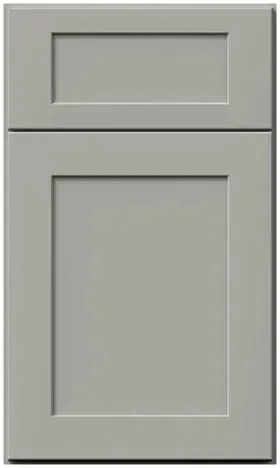


Ending an upper run gracefully: angled and open Galaxy Nickel wall ends
Reviewed September 2026 · Captivating Cabinets
Runs of cabinets end. On a plan that is a line stopping, and on a plan it looks like nothing at all. In the room it is a twelve-inch-deep box with a square corner hanging somewhere between five and eight feet off the floor, and if that corner happens to be at the mouth of a walkway or beside a doorway, it is the piece of your kitchen that people will meet with their forehead. Which is the whole case for this page, and the surprising part is what the fix costs: about two dollars more than doing nothing.
A twelve-inch corner at forehead height

The end of an upper run is a small design problem pretending to be a detail. Physically it is a right-angled corner projecting twelve inches from the wall, starting at 54 inches and finishing wherever the box tops out. At 66 inches it is at eye level for a lot of adults; at head height for children standing on the wrong side of a swinging door it is worse.
That is the safety half. The other half is visual: a run that stops dead, square, with a flat slab of colour on its end reads as an amputation. Somewhere in the room there is a doorway, a walkway or a change of direction that the cabinetry is acknowledging or not, and the end of the run is where it gets acknowledged. There are three ways to do it and they are much closer in price than anyone expects.
Three ways to finish it, with two dollars between two of them
Priced at 36 inches tall, which is the most common run height, at displayed prices on the review date.
| How the run ends | Parts | Total | What it looks like |
|---|---|---|---|
| Plain box, finished side | GN W1236 + GN SK W36 | $316.55 | A square end with a flat, finished face |
| An angled end | GN WAE1236 | $318.50 | The outer corner cut back at 45° with a narrow angled door |
| An open end, 12″ wide | GN OE1236 | $425.75 | A shelved bay with no door, open to the room |
| An open end, 6″ wide | GN OEL636 or GN OER636 | $425.75 | The same, in half the width, handed left or right |
One dollar and ninety-five cents. That is the entire premium for the angled end over an ordinary box with a skin on it, and it is the number that should end most of these conversations. For less than the price of a coffee the corner comes off the run, the transition into the walkway reads as intentional, and nobody meets it with their head. If the end of your run is anywhere near a lane people walk in, buy the angled box.
The open end costs $107.25 more than the angled one and is doing a different job. It is not a safety fix, it is a full stop with something to look at in it — a shelf for cookbooks, a plant, three good bowls. The break is worth naming for one specific reason on this finish: an open bay is a hole in a continuous plane, and what shows through it is the natural wood-veneer interior, so the interruption reads warm rather than dark. That is the difference between an open end that lifts the run and one that punches a shadow in it.
And note the last row, which is a genuine curiosity: the 6-inch open ends cost exactly what the 12-inch one does. At every height — $364.00 at 30 inches, $425.75 at 36, $429.00 at 39, $455.00 at 42 — the narrow unit and the wide one are the same money. So the 6-inch is the expensive one by any measure of what you get, and you buy it because six inches is what the wall left you, not because it is a bargain.
Which of these carries its side in the code, and which does not
A small trap, cheaply avoided. The 6-inch open ends are handed and say so: GN OEL636 is the left-hand unit and GN OER636 the right. Type the wrong letter and a cabinet built to sit at the left end of a run turns up for the right end, and it is not a cabinet that can be turned around.
The 12-inch open end, GN OE1236, carries no letter. Neither does the angled end, GN WAE1236. Which does not mean they are indifferent to position — it means the position is a build option that has to be written on the order line rather than typed into a code, exactly as a door hand is. Tell us which end of which run it goes on and which way the angle faces, in a sentence, and the drawing will come back with it marked.
Then the finished side, which is the requirement that catches people out because the cabinet looks complete without it. Any side of a cabinet the room can see gets a finished face. On an end box that is not optional and it is not expensive: GN SK W30, GN SK W36, GN SK W39 and GN SK W42 are all $50.05, whatever the height. Two cases are worth flagging. An open end has no door, so its outer side is on show from the moment it is hung — and so is its underside, if the run passes over a walkway where people look up. And a run that ends against nothing, in mid-wall, has a side that is visible from both approaches. The distinction between a skin, a panel and a filler is laid out in the end panels guide.
Where each one belongs
The positions come up again and again, and the right answer is fairly settled for each.
- At the mouth of a walkway or beside a doorway: the angled end, every time. This is the position it exists for, and the 45-degree cut turns a corner you collide with into one you brush past.
- Where a run ends in open wall, nothing beyond it: an open end if you want the run to trail off, a plain box with a skin if you want it to stop cleanly. Both are legitimate; the open one suits a room where the kitchen is part of a living space and the closed one suits a working kitchen.
- Where a run meets a window reveal: a plain box and a skin, scribed to the reveal. An angled end beside a window fights the vertical line of the casing and looks restless.
- At the end of a peninsula: an open end, and consider putting it on the side that faces the dining area rather than the kitchen, so the display faces the people sitting down. A wine rack does the same job with a different texture.
- Beside a tall cabinet or a fridge: a plain box and a skin. An angled end butting into a 24-inch-deep tall cabinet creates a junction that has no good resolution.
- Within a couple of feet of a cooktop: not an open end. Open shelving beside a range collects airborne grease onto everything standing on it, and the cleaning that follows is set out in the cabinet care guide.
One part worth knowing about because it is the cheapest line in the whole finish: the shelf for the angled end, GNK AS-WAE12, is $16.90. If the box arrives with one bay and you want two, that is the fix.
Matching the end to the run it finishes
Both families come in the same four heights as the rest of the wall grid, so the end matches whatever the run is doing. The angled ends run GN WAE1230 at $279.50, GN WAE1236 at $318.50, GN WAE1239 at $331.50 and GN WAE1242 at $364.00. The 12-inch open ends run GN OE1230 at $364.00, GN OE1236 at $425.75, GN OE1239 at $429.00 and GN OE1242 at $455.00, with the 6-inch left and right units priced identically at each height.
Match the height exactly. An end box a size down from the run beside it is the sort of thing that looks fine on a drawing and looks like a mistake in the room, and there is no crown profile that rescues it. If the run steps down deliberately — over a window, at a peninsula — step it at a cabinet junction with a full box, not at the end.
If you want more than one break in a long run rather than just a soft ending, the same logic extends inward: a no-door box or an open shelf box mid-run does the same thing in the middle, and the wall cabinet guide has the argument about how many breaks a run can take before it stops being a run.
Getting the ends onto the quote
Walk the plan and mark every point where a run stops — including the ones that stop against a tall cabinet, which still need a finished side even though nobody thinks of them as ends. Then for each one, write the position in a sentence and pick from the three options above.
Send it over for a free 3D design and the ends come back drawn, handed and counted, with the skins itemised rather than assumed. Everything arrives pre-assembled in 7 days to 3 weeks; the decorative parts including skins and fillers are on the decorative accessories page, and the rest of this finish is on the collection page. Contractors and builders go through Captivating Pro.
Common questions
- What is an angled wall end cabinet for?
- It cuts the outer corner of the last cabinet in a run back at forty-five degrees, so the end of the run is a chamfer rather than a square corner at head height. It belongs wherever an upper run ends at a walkway or a doorway. At 36 inches tall it is $318.50 — about two dollars more than a plain box with a finished skin.
- How do I finish the exposed end of a wall cabinet run?
- With a finished skin, at $50.05 in every wall height. Any cabinet side the room can see needs one, including the sides of open-end boxes and the undersides of cabinets over a walkway. Order it with the cabinets — a skin chased three weeks later holds up the installation.
- What is an open end wall cabinet?
- A shelved bay with no door at the end of a run, open to the room. It costs $425.75 at 36 inches tall against $318.50 for an angled end, and it is doing a different job — a visual full stop with something to look at rather than a safety fix. The interior is natural wood veneer, so the break reads warm against the cabinet colour.
- Why do the 6-inch and 12-inch open end cabinets cost the same?
- They do, at every height — $364.00 at 30 inches through $455.00 at 42. The narrow one is not a saving; you buy it because six inches is what the wall left you. If you have the space for the 12-inch unit, it is the better value of the two by a wide margin.
- Do wall end cabinets have a left and right version?
- The 6-inch open ends do and the code says so — GN OEL636 is left, GN OER636 is right. The 12-inch open end and the angled end carry no letter, which means the position is a build option written on the order line rather than typed into the code. State it in a sentence and check it on the drawing.
- Should I put open shelving at the end of a run near the range?
- No. Open shelving within a couple of feet of a cooktop collects airborne grease onto whatever is standing on it, and it has to be washed rather than wiped. Use a plain box with a finished side, or an angled end, and put the display somewhere the cooking cannot reach it.
Keep reading
The guides behind the numbers on this page.
- Cabinet End Panels, Scribe Molding and Fillers Explained
Skin, panel, filler and scribe — which part goes on which exposed side.
- Important Kitchen Dimensions Before Buying Cabinets
Walkway widths and the clearances an end of run has to respect.
- 27 Kitchen Cabinet Ideas
Runs that end well, in rooms worth looking at.
- How to Clean and Care for Kitchen Cabinets
What open shelving near a range actually asks of you.
- Wall and Tall Kitchen Cabinet Sizes and Buying Guide
Matching an end box to the height of the run it finishes.
- Small Kitchen Design and Layout Ideas
Where a softened end matters most: rooms you have to walk through.
- Gray Kitchen Cabinets: Finding the Right Shade
How an open bay reads against a continuous run of this mid-tone.
- Free 3D Kitchen Design
What we need from you, and what comes back on the drawing.


