

Six inches high: the tray cabinet, and the bakeware that will not fit in it
Reviewed September 2026 · Captivating Cabinets
Two cabinets sit under this heading and the category name misleads badly. "Wall organizer" suggests a message centre — mail, keys, a pinboard, the kind of thing a builder shows in a marketing photograph. It is not that. GN W0306 and GN W0366, $273.00 and $305.50, are 30 and 36 inches wide, 12 inches deep and six inches tall, fitted with vertical dividers, and their listings say exactly what they are for: cutting boards, baking sheets, trays, serving platters and other flat things that fall over in an ordinary cupboard. It is a bakeware divider in a very short box, and everything worth knowing about it follows from those six inches.
What the two boxes actually are

| Code | Width × height × depth | Fitted with | Displayed price |
|---|---|---|---|
| GN W0306 | 30″ × 6″ × 12″ | Built-in vertical dividers | $273.00 |
| GN W0366 | 36″ × 6″ × 12″ | Built-in vertical dividers | $305.50 |
Six more inches of width for $32.50, which is the cheapest width step anywhere in the wall range, so if the bay above your run is 36 inches, take the 36. There is no 15, no 18 and no 24; two widths exist and both happen to be the two commonest cabinet widths in a kitchen, which is not a coincidence — see the next section.
One thing the listings do not publish: the number of dividers, or the width of each slot. That is the number you need, and it is not on the page. Read it off the product photograph or ask us before ordering, because a box with four wide bays and a box with eight narrow ones are very different cabinets at the same price.
Why a six-inch cabinet exists at all
Run the standard arithmetic and the answer appears. A counter at 34½ inches, a countertop, an 18-inch backsplash gap, and the wall run hangs on a line 54 inches off the floor. A 36-inch upper on that line tops out at 90 inches. An eight-foot ceiling is 96. The gap left over is six inches — exactly the height of this box.
So the usual answer to that gap is crown, and the crown page starts at $117.00 for GN CM-1 and runs to $367.25 for GN CM-8. The organizer is the other answer: instead of closing the gap with a profile, it fills the gap with storage, in the same finish, in the same plane as the run. At $273.00 for 30 inches it is more expensive than a stick of the cheapest crown, and it covers one bay rather than the whole elevation — so this is not really crown-versus-organizer. It is a question of whether one particular bay above the run should be a cabinet.
The other places six inches turns up:
- Above a 36-inch upper on an 8-foot ceiling, as above — the textbook position.
- Above a 30-inch upper, which leaves 12 inches; an organizer plus a 6-inch reveal, or a deeper crown, closes it.
- Over a range where the hood takes the wall and a full-depth box is unwelcome, but a shallow band above the hood chimney keeps the top line unbroken.
- Under a soffit that drops six inches lower than the run wants to be.
The rest of the gap-closing parts — crown, light rail (GN LRM, $149.50), scribe (GN SM8-S, $39.00) — are on the crown molding and decorative accessories pages, and the profiles are compared in our cabinet molding guide.
Measure your bakeware before you buy this
This is the section that will save somebody a return, so it is blunt. Six inches high and twelve inches deep is a small opening, and a lot of standard kitchen flatware does not fit inside it in any orientation.
The numbers to hold against it:
| Item | Typical size | Verdict |
|---|---|---|
| Half-sheet pan | 18″ × 13″ | Will not fit — both dimensions exceed the 12″ depth and the 6″ height |
| Quarter-sheet pan | 13″ × 9½″ | Only if the slot is wide enough to take 13″ across the width |
| Cooling rack | 16½″ × 11½″ | Marginal — the 11½″ dimension clears the depth, the 16½″ does not clear the height |
| Small cutting board | 8″ × 12″ | Fits, lying flat, if a slot is wide enough |
| Large cutting board | 12″ × 18″ | Will not fit |
| Muffin tin | 13″ × 10″ | Marginal — check against the exact slot width |
| Serving platter, oval | up to 16″ long | Will not fit if the long dimension exceeds 12″ |
Which is to say: this box takes the small, flat, awkward half of the collection — the boards you use daily, the quarter sheets, the trivets, the placemats, a couple of small platters. It does not take the half-sheet pan that most people are actually trying to solve for. Go and measure your three biggest flat things before this goes on an order. That is five minutes of work against $273.00.
A six-inch band reads as a line, not a cabinet
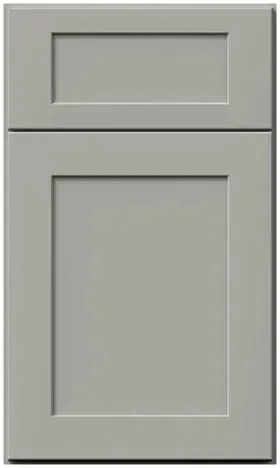
The appearance argument is short and it is the one place the colour changes the decision here. At six inches tall, sitting under a ceiling or a soffit, this box does not read as a cabinet. It reads as a horizontal band at the top of the run — and in a mid-tone grey, tucked into the shadow the ceiling casts, it reads as a shadow line rather than as an object. That is flattering. It closes the top of the elevation cleanly without adding a profile, and it keeps the run’s top edge straight in a way crown never quite does on a ceiling that is not level.
The corollary: do not treat it as a feature. Nothing hangs off it, it takes no hardware worth looking at, and a six-inch band of a different colour would be a mistake. Order it in the same finish as the run, which it is, and let it disappear.
Getting one onto the order
Three checks. Measure the gap between the top of your run and the ceiling or soffit in both corners of the bay — the box is a fixed six inches and cannot be scribed thinner. Confirm the divider count and slot width on the listing. And confirm your flat items fit, using the table above as the starting point rather than the finish line.
Then decide whether the rest of the elevation is being closed with crown, because a run that is part organizer and part crown needs the transition drawn rather than improvised. A free 3D design will draw it and itemise the order; boxes ship pre-assembled in 7 days to 3 weeks. The wider wall range is on the wall cabinet page, the loose shelves and parts under loose parts, and the whole finish on the collection page. Trade orders go through Captivating Pro.
Common questions
- What is a wall organizer cabinet?
- In this line it is a six-inch-high wall box fitted with vertical dividers, made in 30 and 36-inch widths at $273.00 and $305.50 displayed. Despite the category name it is not a message centre — the listings describe it as storage for cutting boards, baking sheets, trays and platters.
- Will a baking sheet fit in a wall organizer?
- A standard half-sheet pan at 18 by 13 inches will not: both dimensions are larger than the 12-inch depth and the 6-inch height of the opening. A quarter-sheet at 13 by 9½ may, depending on the slot width. Measure your pans before ordering.
- Why is this cabinet only six inches tall?
- Because six inches is what is left over. A 36-inch upper hung on the standard 54-inch line tops out at 90 inches, and an eight-foot ceiling is 96. Most kitchens close that gap with crown; this box fills it with storage instead.
- How many dividers does it have?
- The listing does not publish the count or the slot width, and that is the number you need. Read it off the product photograph or ask us before ordering — the same money buys a box with a few wide bays or one with several narrow ones.
- Should I use an organizer or crown molding above my cabinets?
- Crown closes the whole elevation and starts at $117.00 for a profile; the organizer covers one bay at $273.00 and gives you storage in it. They are not really alternatives — most runs use crown and put an organizer in one bay where the storage is worth having.
- Where else can I store sheet pans and trays?
- On edge, in something tall. The narrow wall pull-outs run $438.75 for the 6″ × 30″ and $497.25 for the 6″ × 42″, and a tray divider inside a base or a tall cabinet handles full-size pans. A six-inch band cannot.
Keep reading
The guides behind the numbers on this page.
- Space-Saving Cabinet Solutions
The inserts and narrow units that turn leftover inches into storage.
- Kitchen Cabinet Molding Types
Crown, light rail and scribe, and which gap each one is for.
- Wall and Tall Kitchen Cabinet Sizes and Buying Guide
The height, width and depth ladder every code on these pages is cut from.
- How to Read Cabinet SKU Codes
Which digits are width, which are height and which are depth, before one goes on a quote.
- Beam-Mounted and Pull-Out Cabinet Accessories
The narrow pull-outs that take full-size sheet pans on edge.
- Kitchen Cabinet Terminology: Parts and Abbreviations
Face frame, reveal, matching interior, light rail — the words a quote assumes you know.
- Fabuwood Cabinet Sizes and Specs
Every dimension the line is built to, in one grid.
- Gray Kitchen Cabinets: Finding the Right Shade
The full ladder of greys, and the undertone question answered without hedging.


