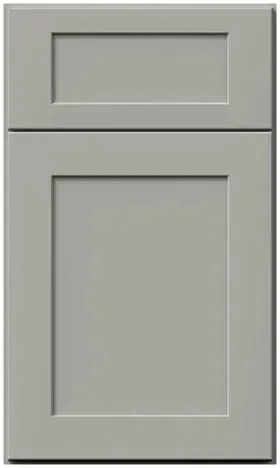


The wall appliance garage: one box, one width, and a receptacle inside it
Reviewed September 2026 · Captivating Cabinets
The appliance garage is sold on a fantasy: the counter clears itself, the toaster and the kettle disappear behind a door, and the kitchen looks like the photograph. It can genuinely do that. But it is a wall cabinet, which means it is twelve inches deep, and twelve inches is the number that decides whether this box solves your problem or becomes an expensive cupboard for tea bags. There is exactly one of them on the wall list in this finish, so the decision is simple — it just has to be made with the tape measure out and the electrician on the phone.
One code, thirty inches across

GN WAC3018, $796.25 at displayed prices. Thirty inches wide, eighteen inches high, twelve inches deep, and it is the only appliance box on the wall list in this finish — no 24-inch version, no corner version, no second height. That narrows the specification down to a yes or a no, which is more useful than a catalogue of near-misses.
Set it against the plain box of the same size and the cost of the mechanism becomes visible. GN W3018 — thirty wide, eighteen high, two ordinary doors — is $253.50. The difference is $542.75, which is to say the front costs more than twice what the cabinet costs. That is not a criticism; a retracting front is a real piece of engineering and it is the entire point of the product. But it is the number to have in mind when you are deciding whether one of these or two of something else is the better use of the money.
One thing to confirm before you order rather than after: how the front actually behaves. Appliance boxes are built variously with a tambour that rolls up inside the cabinet, a flap that lifts, or plain doors that fold back — and which one you get changes the interior depth, the clearance above, and whether the front is out of your way while you are using the machine. Send us the code and we will confirm what ships. It is the one spec on this page worth a five-minute phone call.
Twelve inches of depth is the whole decision
Not the height, not the width. Thirty inches across is more than enough for two machines side by side and eighteen inches of height clears most countertop appliances comfortably. The constraint is front to back, where you have under eleven inches of usable interior, and a surprising number of the things people want to hide are deeper than that.
Measure your own machines rather than trusting a category — depths vary enormously within a type, and a manufacturer’s spec sheet will give you the number in thirty seconds. Measure with the lid open if the lid opens upward, and add an inch for the cord bending behind it. Then sort:
- Usually fits: a two-slice toaster, a kettle, a compact espresso machine, a spice rack, a knife block, a small blender, a milk frother. These are the coffee-station items, and a coffee station is what this cabinet is genuinely good at.
- Usually does not: a tilt-head stand mixer, which is around fourteen inches deep before you lift the head. A full-size air fryer. A toaster oven. A large food processor. Many drip coffee makers, because the water reservoir sits at the back and pushes them to thirteen or fifteen inches.
- Depends entirely: bread makers, slow cookers and stand blenders, which range from eight inches to eighteen depending on the model. This is the group where measuring is not optional.
If the machine that is driving the whole project is the stand mixer, this is not the cabinet, and no amount of wanting will change the depth. The honest alternatives are below, priced.
| Option | Code | Price | Depth, and what that means |
|---|---|---|---|
| This box — appliance wall | GN WAC3018 | $796.25 | 12″ deep, 18″ high — coffee-station machines only |
| A lift-up wall box, 42″ | GN W421224LU | $689.00 | 24″ deep but only 12″ high — deep enough for a mixer, too short for a tall one |
| A lift-up wall box, 48″ | GN W481224LU | $747.50 | Same proportions, wider; a long shallow bay above a run |
| A base microwave bay, 24″ | GN BMC24 | $614.25 | 24″ deep at counter height — takes anything, at the cost of bending down |
| A base microwave bay, 30″ | GN BMC30 | $695.50 | The same, wider; the usual answer for a heavy machine |
One option deliberately left off that table: a microwave cabinet. If what you want hidden is the microwave rather than the toaster, the boxes built for it are on the microwave wall page, and they are a different shape entirely.
The pattern in that table is worth naming: on the wall you can have depth or height but not both, and at counter level you can have both but you have to stoop. Which is the right trade depends on what the machine weighs. Anything you would not want to lift down from shoulder height belongs at counter level, full stop.
The clearance that matters is on the counter, not in the cabinet
The box hangs at the standard eighteen-inch backsplash gap, so there are eighteen inches between the worktop and the underside. That is the working volume, and it is where people misjudge this cabinet: the machine does not get used inside it. It gets pulled forward onto the counter, used, and pushed back. So the requirement is not cabinet space, it is a landing zone — two feet of clear worktop in front, permanently, not borrowed from prep space.
Which decides the position. This cabinet belongs at the end of a run, in a corner of the kitchen nobody walks through, or in a dedicated coffee bay — not in the stretch between the sink and the range, where the counter is doing three jobs already. If the only place it fits is in the work triangle, it is the wrong cabinet for the room.
Two practical notes. Steam: a kettle or an espresso machine used with the front closed is venting into a wooden box, and doing that twice a day for years is not kind to it. Run them with the front open or keep them out. And the front itself — if it lifts, it needs clear air above, which means the cabinet beside it or the crown above it can interfere; if it rolls up, it eats interior depth you have already established is tight. That is the other reason to confirm the mechanism before ordering.
The outlet goes in before the drywall, or it does not go in
There has to be a receptacle inside the cabinet. That is not a refinement, it is the difference between an appliance garage and a cupboard: if the machines plug into the backsplash outside the box, the cords run out under the front, the front does not close, and you have paid $796.25 for a cabinet that stands open.
It is also the part of the job that cannot wait. A receptacle in the back wall of a wall cabinet is wired during rough-in, before the board goes on. Once the wall is closed, the counter is templated and the cabinet is hung, adding one means opening finished drywall and drilling a finished cabinet back, and the repair shows. So this belongs on the electrician’s drawing at the same time as the range circuit, months before the cabinets arrive.
What to tell them, in their terms: a receptacle inside a 30-inch wall cabinet whose underside sits at 54 inches above finished floor, positioned on the back wall a few inches up from the cabinet floor and off-centre so it does not collide with a machine pushed to the back. Give them the elevation drawing rather than a description — it takes the ambiguity out.
Two questions to put to them rather than to us, because the answers are local and they are the electrician’s call: whether that receptacle has to be GFCI-protected given where it sits relative to the counter, and whether it can share the countertop small-appliance circuit or wants its own. Worth asking either way if there will be a kettle, a grinder and a machine with a heating element all live at once — that is a combination that finds the limit of a circuit at about seven in the morning.
Before this one goes on the order
Four things, in this order. Measure the deepest machine going in, with the lid up. Confirm the front mechanism with us. Put the receptacle on the electrician’s drawing. Then decide where on the plan it sits, judged by the counter in front of it rather than by the wall behind it.
If any of those four comes back wrong, the alternatives above are real and none of them is a consolation prize — a counter-height bay for a heavy machine is a better cabinet than a wall box for a heavy machine, every time. Everything that goes inside a cabinet in this finish is on the accessories page, the whole wall grid is here, and a free 3D design will place the box against the run and mark the outlet on the elevation for the electrician to work from.
Common questions
- Does an appliance garage need an outlet inside the cabinet?
- Yes. Without one the cords run out under the front and the front will not close, which defeats the whole cabinet. The receptacle is wired during rough-in, before the drywall goes on — retrofitting it later means opening a finished wall and drilling a finished cabinet back.
- Will a stand mixer fit in a wall appliance cabinet?
- No. A tilt-head mixer is around fourteen inches deep before you lift the head, and a wall box gives you under eleven inches of usable depth. Heavy, deep machines belong at counter level — a 24-inch base microwave bay is $614.25 and will take anything.
- How much is an appliance wall cabinet in this finish?
- GN WAC3018 is $796.25 at displayed prices, 30 inches wide by 18 high by 12 deep. The plain two-door box of the same size is $253.50, so the retracting front accounts for $542.75 of the price.
- Where should an appliance garage go in the kitchen?
- At the end of a run or in a dedicated coffee bay — somewhere with two feet of permanently clear counter in front of it, because the machines get pulled forward to be used. Not in the stretch between the sink and the range, where the worktop is already doing three jobs.
- What kind of door does the appliance cabinet have?
- Confirm it against your specific order before you buy. Appliance boxes are built with roll-up tambours, lift-up flaps or folding doors, and which one you get changes the usable interior depth and the clearance the cabinet needs above it. Send us the code and we will tell you what ships.
- What small appliances fit in a 12-inch-deep cabinet?
- Toasters, kettles, compact espresso machines, small blenders, grinders and spice racks — the coffee-station group. Most drip coffee makers with a rear reservoir, toaster ovens, large air fryers and food processors are too deep. Measure the machine with the lid open before you commit.
Keep reading
The guides behind the numbers on this page.
- Space-Saving Cabinet Solutions
Every other way to get the machines off the worktop, compared.
- Important Kitchen Dimensions Before Buying Cabinets
Backsplash gaps, counter zones and the landing space this box needs.
- Beam-Mounted and Pull-Out Cabinet Accessories
What can be fitted inside a box, and what the box has to give it.
- Wall and Tall Kitchen Cabinet Sizes and Buying Guide
Where the 12-inch and 24-inch depths sit in the wall grid.
- Types of Kitchen Cabinets
The specialised boxes, set beside the ordinary ones.
- Fabuwood Cabinet Sizes and Specs
Catalogue dimensions for the box and its neighbours.
- How to Clean and Care for Kitchen Cabinets
Steam, heat and a closed wooden box — what that does over time.
- Free 3D Kitchen Design
What we need from you, and what comes back on the drawing.


