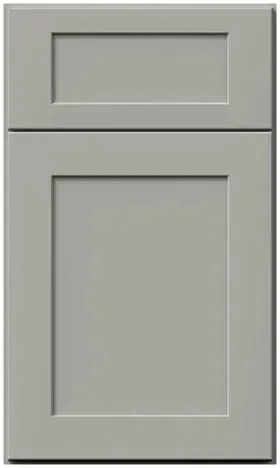


Twenty-four inches deep over the refrigerator: the Galaxy Nickel box nobody opens
Reviewed September 2026 · Captivating Cabinets
The cabinet over the refrigerator is the least interesting box in the kitchen and one of the easiest to get wrong, because two of its three dimensions are dictated by an appliance rather than by a wall. Get the depth wrong and you leave a two-foot ledge on top of the fridge that collects dust in full view of the room. Get the height wrong and the box either will not go in or leaves a gap. And then, once it is right, you will open it about twice a year — which is fine, as long as you knew that going in and put the right things in it.
Twelve inches or twenty-four, and why the answer is twenty-four
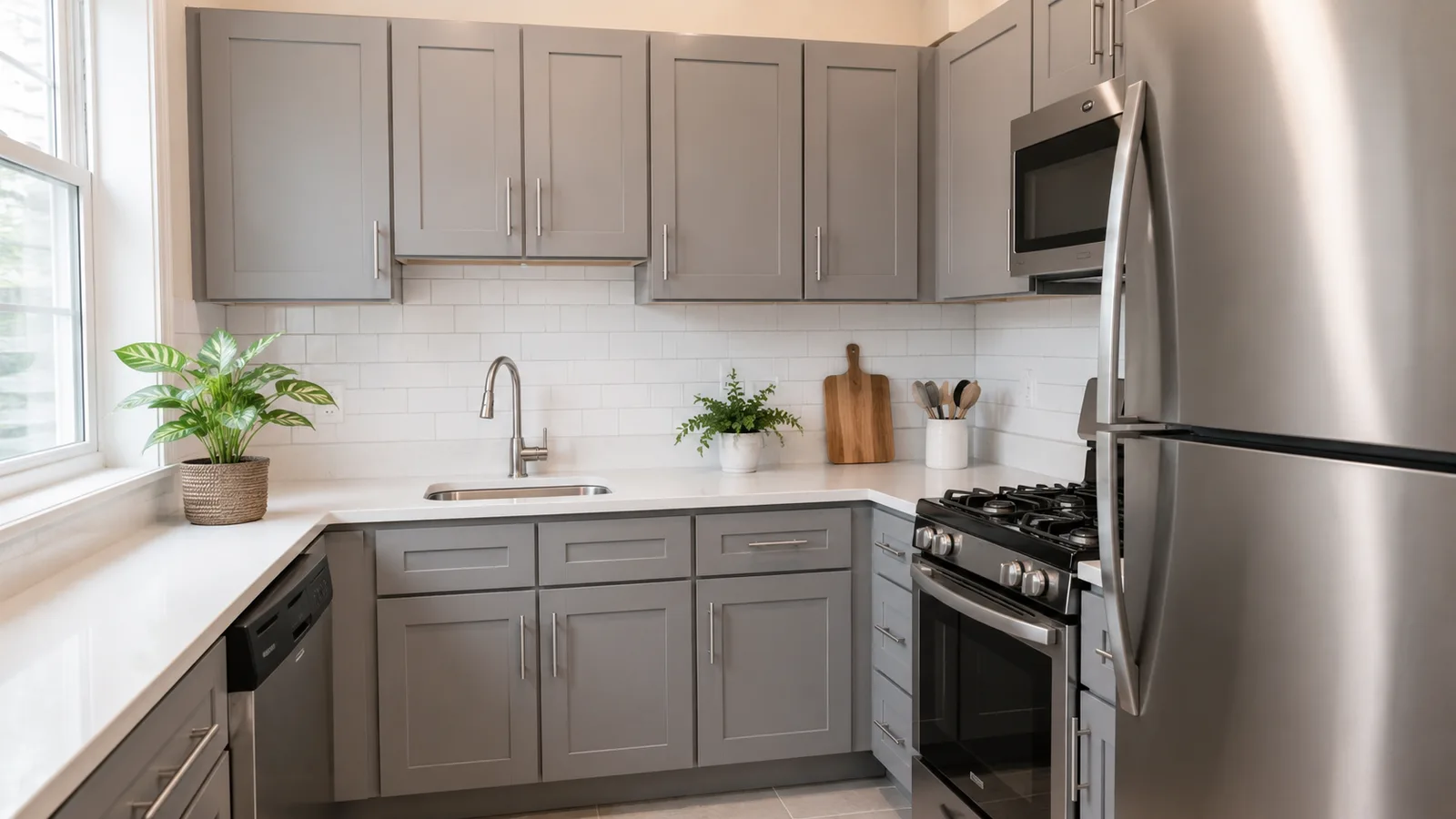
A standard wall cabinet is 12 inches deep. A refrigerator with its doors on is somewhere between 30 and 36 inches deep, and even a counter-depth model is around 27 to 30 once the handles are counted. Hang a 12-inch box over it and you have created a horizontal ledge a foot and a half wide on top of the appliance, at about six feet off the floor, in the eyeline of anybody standing in the room. It gathers dust, it is impossible to clean without a stool, and it announces that the fridge was fitted around the cabinets instead of into them.
Which is why every box on this page is 24 inches deep. The code tells you so: the last two digits of GN W301524 are the depth. Thirty inches wide, fifteen high, twenty-four deep. The box comes forward almost to the front of the appliance, the fridge reads as built in, and the only thing left to deal with is the strip of air between the cabinet face and the fridge door, which is a scribe job rather than a design problem.
The premium is modest and worth every dollar of it. GN W3612 — the standard 36-inch by 12-inch-high box at normal depth — is $253.50; the 24-inch-deep GN W361224 is $370.50. That is $117.00 for the difference between a fitted kitchen and a fridge with a shelf on it. At 30 inches wide the comparison is GN W3015 at $243.75 against GN W301524 at $351.00, a gap of $107.25.
| Width | 12″ high | 15″ high | 18″ high | 21″ high | 24″ high |
|---|---|---|---|---|---|
| 30″ | not stocked | GN W301524 — $351.00 | GN W301824 — $370.50 | GN W302124 — $438.75 | GN W302424 — $497.25 |
| 33″ | GN W331224 — $455.00 | GN W331524 — $461.50 | GN W331824 — $468.00 | GN W332124 — $497.25 | GN W332424 — $546.00 |
| 36″ | GN W361224 — $370.50 | GN W361524 — $403.00 | GN W361824 — $419.25 | GN W362124 — $487.50 | GN W362424 — $578.50 |
Read the 33-inch row against the 36-inch one before you settle on a width. At 12 inches high the narrower box is displayed at $455.00 and the wider one at $370.50 — the smaller cabinet prices well above the larger. Both figures are what the grid showed on the review date. Ask us before you order a 33 on price grounds, because on these numbers you would be paying more for less.
Take the height off the appliance, not off the ceiling
This is the box where the usual advice runs backwards. Everywhere else in an upper run you pick a height that lands the top of the run where you want it. Here the bottom is fixed by the fridge, so you measure up from the appliance and take whatever is left.
Measure the refrigerator’s full height including the hinge cap on top, not the number on the spec sheet, and add whatever clearance the manufacturer asks for above it — check the manual, because they differ and some want more air than you would guess. That gives you the height of the underside of the cabinet. Subtract it from the ceiling, take off an allowance for crown or scribe, and the answer is one of the five heights in the table.
Worked through on a standard eight-foot ceiling: a 70-inch fridge plus an inch of clearance puts the box bottom at 71 inches, leaving 25 to a 96-inch ceiling. A 24-inch box fits with an inch to scribe. A 69-inch fridge leaves 26, which is the same box plus a slightly more comfortable reveal. A taller counter-depth model at 72 inches leaves 23, and you drop to the 21-inch box. The arithmetic is not difficult; it is just arithmetic nobody does until the cabinets arrive.
Two cautions. Measure the appliance you are buying rather than the one being replaced — fridge heights have crept up, and a 70-inch appliance replacing a 66-inch one is four inches that have to come from somewhere. And if the fridge is not chosen yet, buy the cabinets last or leave the fridge box off the first order. Overall kitchen dimensions and appliance allowances are collected in the kitchen dimensions guide.
What actually lives up there, honestly
Two barriers stand between you and the inside of this cabinet, and they compound. The shelf starts somewhere around 71 inches off the floor, which is already above comfortable reach for most people. And to get to it you are reaching across the top of an appliance 30 to 36 inches deep, so you cannot stand under the cabinet — you stand a yard back and reach up and forward at the same time. That is a stepladder retrieval, not a stool one.
So be realistic about the contents. This is the right home for:
- The roasting tin you use in November and December, and the rack that goes in it.
- Large platters and the turkey plate, stood on edge where the height allows.
- A second slow cooker, a punch bowl, a cake carrier, a picnic set.
- Bulk paper goods — the things that are light, bulky and never urgent.
- Vases, which are awkward everywhere else and perfectly happy here.
And be equally clear about what should not be there: anything heavy, anything breakable you would mind dropping, anything wanted weekly, and anything that needs to come down while you are also carrying something. A 24-inch-deep box is also deep enough to lose things at the back of, so use one row rather than two and accept the waste — a cabinet you can inventory at a glance beats a cabinet that is full.
The deep shelves are priced separately if you want an extra: GNK AS-W3624D is $110.50 against $60.45 for the standard 36-inch shelf, which is a fair reflection of the fact that it is twice the board. The 30-inch deep shelf, GNK AS-W3024D, is $78.00.
The side of the fridge is a wall, and it has to be finished
A refrigerator standing in a run has one side exposed, sometimes two, and that side is a plane roughly two feet deep and seven feet tall. It is the largest uninterrupted surface anywhere in the kitchen after the tall run, which is precisely why it matters here and not on an ordinary upper: in a mid-tone, a panel that size read edge-on from the doorway is a piece of architecture rather than a piece of trim, and a bare appliance side next to it looks exactly like what it is.
The parts are on the decorative list. GN REP1296, the 12-inch by 96-inch refrigerator end panel, is $224.25. GN REP2496 at 24 by 96 is $295.75. GN RFPEC, the refrigerator side panel end cap, is $97.50 and closes the front edge. Thicker variants exist — GN REP1-1/2 at $250.25 and GN REP3 at $325.00 — for cases where the panel has to stand proud to meet the appliance face.
Which one your job needs depends on how the fridge is set into the run and how much of the side shows, so put the elevation in front of us rather than picking from the list. One thing to be clear about: the wall cabinet end skins, GN SK W30 through GN SK W42 at $50.05, are sized for a standard 12-inch-deep box. They are not the part for a 24-inch-deep cabinet side, and a quote that shows a skin where a panel belongs is a quote to query. The difference between a skin, a panel and a filler is set out in the end panels guide.
The fridge bay as one line item
Order the bay as a unit rather than as three unrelated parts: the deep box, the side panel or panels, and the filler or scribe that closes the gap to the wall. Three weeks apart they are three deliveries and an install held up by the cheapest item.
If the fridge is going between two tall cabinets rather than into an open run, the pantry on either side changes the panel question completely — see the tall cabinets page. And if you want the appliance genuinely enclosed rather than merely capped, that is a tall-cabinet surround and it is drawn differently. Send the elevation for a free 3D design, or start from the whole collection.
Common questions
- How deep should the cabinet above a refrigerator be?
- Twenty-four inches. A standard 12-inch upper leaves a ledge a foot and a half deep on top of the appliance that collects dust and is visible from the room. The deep boxes cost about $107 to $117 more than the standard ones at the same width, which is the cheapest way to make a fridge look built in.
- What height cabinet goes above a refrigerator?
- Whatever is left. Measure the fridge including the hinge cap, add the clearance its manual asks for, and subtract that from the ceiling less a scribe allowance. On a 96-inch ceiling a 70-inch fridge typically leaves room for the 24-inch box; a taller counter-depth model may only take the 21.
- What should I store above the refrigerator?
- Things you want twice a year and can lift down at arm’s length — roasting tins, platters, a punch bowl, a picnic set, vases, bulk paper goods. The shelf starts around 71 inches up and you reach across a three-foot-deep appliance to get to it, so nothing heavy, breakable or wanted weekly belongs there.
- Do I need a panel on the side of the refrigerator?
- If the side shows, yes. It is a plane roughly two feet deep and seven feet tall — the biggest flat surface in the kitchen after the tall run. The 12-inch by 96-inch panel is $224.25 and the 24-inch version is $295.75. A wall cabinet end skin at $50.05 is sized for a 12-inch-deep box and is not the right part here.
- What widths do refrigerator wall cabinets come in?
- Thirty, 33 and 36 inches, in heights of 12, 15, 18, 21 and 24 inches, all 24 inches deep. Match the width to the fridge opening rather than to the appliance itself, and check the 33-inch price against the 36-inch before ordering — the grid does not always run in a straight line between them.
- Can I use a standard 12-inch wall cabinet over the fridge instead?
- You can, and it is cheaper by around a hundred dollars, but it is the single most visible economy in an upper run. The ledge left on top of the appliance is at eye level from across the room and cannot be cleaned without a ladder. If budget is the issue, save it somewhere nobody looks.
Keep reading
The guides behind the numbers on this page.
- Important Kitchen Dimensions Before Buying Cabinets
Appliance allowances and the numbers this whole page depends on.
- Cabinet End Panels, Scribe Molding and Fillers Explained
Skin, panel or filler — which part covers which exposed side.
- Wall and Tall Kitchen Cabinet Sizes and Buying Guide
Where the deep boxes sit against the standard 12-inch grid.
- Types of Kitchen Cabinets
The fridge bay set beside every other specialised box.
- Gray Kitchen Cabinets: Finding the Right Shade
How a large flat panel of a mid-tone reads from across a room.
- Fabuwood Cabinet Sizes and Specs
Catalogue dimensions, including the 24-inch-deep wall boxes.
- What Is a 10x10 Kitchen? Cabinet Pricing Guide
What a standard package does and does not include around the fridge.
- Free 3D Kitchen Design
What we need from you, and what comes back on the drawing.


