


Open shelving that arrives as a box: a shelf unit against a site-built floating shelf
Reviewed September 2026 · Captivating Cabinets
Almost everyone who wants open shelving in a kitchen pictures floating shelves: two or three thick planks on concealed brackets, nothing under them, the wall showing between. The alternative is on this page — eight open shelf units in two widths and four heights, $399.75 to $757.25, which arrive as finished boxes with the shelves already in them and hang the same way every other upper does. They are not the same thing and the box is not automatically the better answer. But it wins on more of the comparison than people expect, and it wins on the two things that go wrong most often.
The honest comparison, including the rows the plank wins
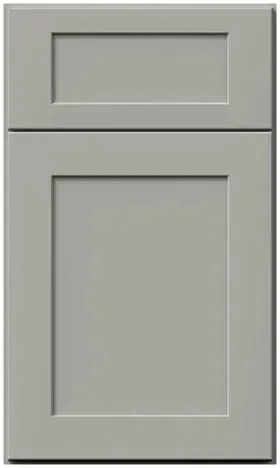
| What matters | Open shelf unit | Site-built floating shelf |
|---|---|---|
| Alignment with the run | Guaranteed — same box height and hang line as the cabinets either side | Set by whoever installs it, against a wall that is rarely straight |
| Load path | Carried by the carcass and the hanging rail, like any upper | Carried by brackets into studs; capacity depends entirely on what it hit |
| Finish match | Sprayed in the same batch as the doors, inside and out | Matched afterwards, in a different material, under different light |
| Wall damage | Two rails, same as a cabinet | Blocking, patching and often a re-skim if it ever moves |
| Install time | Hung with the rest of the run | A separate operation, usually after the cabinets are in |
| Thinness | Loses — a shelf unit has sides and a back, and reads as a box | Wins — a plank and nothing else, which is the look people want |
| Changing your mind | Loses — the box is a fixed configuration | Wins — a plank can be moved or removed and the wall made good |
So the plank wins on appearance and on reversibility, and it wins on those honestly. If what you want is a bare wall with a line of wood across it, buy the plank; nothing on this page will give you that and no amount of arguing changes it.
The box wins on everything structural, and that is where open shelving usually goes wrong. The two complaints we hear about floating shelves are always the same two: they sag, and they do not line up with the cabinets. A shelf unit cannot do either. It is a pre-assembled carcass on a hanging rail, square out of the carton, with its top and bottom on the same lines as the boxes on either side because it is the same box with a different front.
Two widths, four heights, and the premium over the plain open box
Eighteen and thirty inches wide, 12 inches deep, in the same 30, 36, 39 and 42-inch heights as the rest of the run. That is the whole range — there is no 24 and no 36, so if the bay in your drawing is 36 inches wide, this product does not make it and the no-door wall box does.
| Size | Open shelf — GN WOS | No-door box — GN NDW | Difference |
|---|---|---|---|
| 18″ × 30″ | $399.75 | $367.25 | +$32.50 |
| 18″ × 36″ | $448.50 | $422.50 | +$26.00 |
| 18″ × 39″ | $464.75 | $438.75 | +$26.00 |
| 18″ × 42″ | $500.50 | $468.00 | +$32.50 |
| 30″ × 30″ | $565.50 | $461.50 | +$104.00 |
| 30″ × 36″ | $672.75 | $542.75 | +$130.00 |
| 30″ × 39″ | $698.75 | $568.75 | +$130.00 |
| 30″ × 42″ | $757.25 | $620.75 | +$136.50 |
At 18 inches wide the two are within about thirty dollars of each other and the choice is purely one of appearance. At 30 the gap opens to $130 and becomes a real decision. Both are described on their listings as the matching-interior series — finished inside in this grey rather than lined with the wood veneer an ordinary cabinet has — and the difference between them is in how the front is built and how the shelves present. Look at both product photographs at the size you want before you spend the premium, and ask us if they still read the same; that is a thirty-second question that saves a hundred and thirty dollars or spends it deliberately.
What open shelving asks of you, stated before you buy it
A 30-inch unit with two shelves plus the base gives you three levels at 30 inches — 90 linear inches of surface that is visible from everywhere in the room, permanently, with no way to shut it. Nobody warns buyers about this part, and it is the reason a good proportion of open shelving ends up quietly replaced with doors.
The commitment, honestly:
- Everything on it has to be worth looking at. Not beautiful — worth looking at. A stack of plain white plates qualifies. A box of cereal does not.
- Everything on it has to match itself. Six matching glasses read as a set; six different glasses read as a cupboard with the door open.
- It has to stay that way on a bad week. A shelf you tidy for guests is a shelf you will resent.
- It has to be wiped. Roughly monthly away from the range, weekly near it, and a mid-tone grey shows the settled film earlier on the shelf edges than a white one would.
- It cannot absorb overflow. The day you have nowhere to put something, the open shelf is not the answer, and every shelf that becomes the answer stops working as a shelf.
The test we give people: go to the cupboard you would empty onto this shelf, take out what is actually in it, and set it on the counter in a row. If it looks like a kitchen, buy the unit. If it looks like a cupboard, buy the doored box and put glass doors on it instead — GNK GDW3036 is $234.00 and gets you most of the light with none of the tidiness contract.
On a grey box, the objects are the only colour
The shelves and the recess behind them are finished in the same mid-tone as the face, which makes this bay a grey rectangle with things in it. That is a different problem from open shelving in a white kitchen, where the background is bright and almost anything reads against it.
Here the background is mid-toned and slightly shaded, so contrast has to come from the contents. White ceramic reads brightest and is the reason most photographed grey kitchens have white dishes on the open bay. Warm wood — boards, bowls, a handle sticking out of a crock — reads warm and is the pairing that keeps the room from going cold. Clear glass very nearly disappears and needs a light behind or above it to be seen at all. Anything mid-toned and matte, which is to say most stoneware, will sink into the background and look like nothing from across the room.
Which makes the light less optional than it is on a white wall. A puck at $71.50 or the 48-inch interior strip at $221.00 from the lighting page turns the bay from a recess into a display, and it is the single cheapest thing you can do to a grey open shelf. The wider question of how much of this colour belongs overhead is argued on the wall cabinet page.
Ordering one properly
Pick the height to match the run, not to match the contents — a shelf unit that stops short of its neighbours is the one thing that makes the whole idea look accidental. Check whether either side of the box is exposed and add the finished side at $50.05 if it is. Count the shelves on the listing. Order the light on the same order as the box.
Then hold a door sample at $25.00 next to the dishes you plan to put on it, in your own kitchen, after dark. That is a five-dollar-a-minute test that tells you more than any rendering. A free 3D design will place the bay and itemise the run; everything ships pre-assembled in 7 days to 3 weeks. The rest of the finish is on the collection page, and trade orders go through Captivating Pro.
Common questions
- Are open shelf cabinet units better than floating shelves?
- Structurally, yes: a finished unit hangs like any other cabinet, arrives square, cannot sag and lines up with the run because it is the same box height. Floating shelves win on looking thinner and on being reversible. Pick the plank if you want a bare wall; pick the unit if you want it to line up and stay put.
- How much do open shelf wall units cost?
- From $399.75 for the 18 × 30 to $757.25 for the 30 × 42, at displayed prices. They come in two widths only — 18 and 30 inches — in the same four heights as the rest of the wall run.
- What is the difference between an open shelf unit and a no-door cabinet?
- They are separate products at separate prices. At 18 inches wide they are about $26 to $32 apart; at 30 inches the open shelf costs $104 to $136.50 more. Both are finished inside to match the face. Compare the two product photographs at the size you want before paying the wider premium.
- Do open shelves work in a grey kitchen?
- They work differently. The recess is grey rather than bright, so the contents supply all the contrast — white ceramic reads brightest, wood reads warm, clear glass nearly vanishes. Budget a light in the bay; it matters more here than it would against a white wall.
- How many open shelves should a kitchen have?
- Start with one, placed where you already look from the seat you use most. One well-placed bay reads as a composition; three in a row reads as a wall of possessions and commits you to keeping all of it tidy permanently.
- Do open shelf units come with the shelves fitted?
- Yes — they arrive pre-assembled as a finished box with the shelves in place, hung on the same rail as the rest of the run. The listings say adjustable shelves where applicable but do not publish the count, so check the product photograph before ordering.
Keep reading
The guides behind the numbers on this page.
- Pre-Assembled Kitchen Cabinets: A Buying Guide
Why a box that arrives built is square, and what that is worth on an open unit.
- Glass Cabinet Doors: A Buying Guide
The option for people who want the light without the tidiness contract.
- How to Clean and Care for Kitchen Cabinets
What to use on a painted surface, and what takes the sheen off in one wipe.
- Gray Kitchen Cabinets: Finding the Right Shade
The full ladder of greys, and the undertone question answered without hedging.
- 27 Kitchen Cabinet Ideas
Open bays in finished rooms, including the ones that were overdone.
- Wall and Tall Kitchen Cabinet Sizes and Buying Guide
The height, width and depth ladder every code on these pages is cut from.
- Kitchen Cabinet Terminology: Parts and Abbreviations
Face frame, reveal, matching interior, light rail — the words a quote assumes you know.
- Kitchen Cabinet Samples: How to Order and Evaluate
How to judge a grey against your own dishes before the order goes in.


