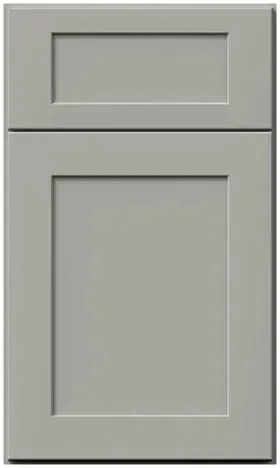


No doors, and an inside that was painted to be looked at
Reviewed September 2026 · Captivating Cabinets
Twenty boxes on this page, five widths by four heights, from $328.25 to $741.00. They look like ordinary uppers that somebody forgot to hang doors on, and nearly every shopper reads them that way and then wonders why they cost more than the doored version rather than less. They cost more because of something you cannot see in a thumbnail, and it is worth getting right before anything else on this page makes sense.
What “matching interior” means, stated plainly

An ordinary wall cabinet is finished inside with a natural wood veneer. That is a perfectly good interior and nobody sees it, because there is a door in the way. Take the door off that cabinet and you would be looking at a wood-lined hole in a painted run — two materials meeting at a frame, which is exactly the look the "matching interior" series exists to avoid.
These boxes are built the other way round. The listing for every one of them says the same thing: no doors, with the interior finished to match the exterior. Sides, back, shelf faces, the whole recess — painted in this grey, the same as the face frame. That is the entire product and the entire price difference. You are not buying a cabinet with a part left off; you are buying a cabinet with more finishing in it than the doored one has.
Which changes what the bay does to the room, and it is the reason this page bothers with the paint at all. An open box in a mid-tone run is not a warm gap. It is a grey recess, slightly darker than the face because it is in shadow, and it will read as a deliberate void rather than as relief. Everything that provides contrast has to be something you put on the shelf. White dishes read bright against it and wood reads warm; clear glass very nearly disappears. Plan the contents as part of the elevation, not as an afterthought, and put a strip of light in the bay if it sits away from a window — GNK LED 2-1/4″ PUCK is $71.50 and the 48″ interior strip GNK LED CAB INT 48″ STRIP is $221.00.
All twenty boxes, and the three places the grid prices oddly
Five widths, four heights, one depth — 12 inches, like every other upper here. Displayed prices on the review date:
| Width | 30″ high | 36″ high | 39″ high | 42″ high |
|---|---|---|---|---|
| 15″ | $328.25 | $383.50 | $406.25 | $445.25 |
| 18″ | $367.25 | $422.50 | $438.75 | $468.00 |
| 24″ | $455.00 | $484.25 | $484.25 | $503.75 |
| 30″ | $461.50 | $542.75 | $568.75 | $620.75 |
| 36″ | $468.00 | $604.50 | $656.50 | $741.00 |
Three rows in that grid are worth acting on. At 24 inches wide, the 36 and the 39 are the same money — $484.25 either way, so three free inches of height, and there is no reason to specify the shorter one unless the ceiling forces it. At 30 inches high, the 36-wide box ($468.00) costs the same as the 18-wide box at 42 inches high ($468.00): twice the width for the same money if the height is negotiable. And the top-right corner is where the grid turns expensive fast — GN NDW3642 at $741.00 is 58% more than GN NDW3630 at $468.00 for twelve more inches of height.
The practical reading of all that: buy width cheaply and height expensively. If you want one generous open bay in a run, a wide short box is much better value than a narrow tall one, and it usually looks better too, because a tall narrow open box in a run reads as a gap and a wide short one reads as a shelf.
Size the opening to what you already own
Twelve inches of depth is the first filter and it removes more than people expect. A dinner plate is about 10½ to 11 inches across and sits comfortably. A large charger at 13 does not. A cereal box is 12 to 14 inches tall and 8 deep, so it fits standing but its face is the thing you will be looking at every day. Most cookbooks are 9 to 10 inches deep and sit well; oversized ones overhang. A stand mixer is too tall and much too heavy for a wall shelf and does not belong here at all.
The second filter is quantity, and it is the one that catches people. The listings say "adjustable shelves where applicable" and do not publish the shelf count, so count the shelves in the product photograph before you order. Assuming a 36-inch box comes with two shelves plus the bottom, that is three levels at 36 inches each — 108 linear inches of display that you now have to fill with things worth looking at. Nine feet. Most kitchens do not have nine feet of handsome objects, and the ones that do usually have them because they cook constantly and the objects are in use.
- Things that genuinely fill an open bay: everyday bowls and plates in a stack, mugs, a row of glasses, cookbooks you actually open, a wooden board leaning, one plant, a pitcher, tinned goods decanted into jars.
- Things that fill it badly: packaging, mismatched plastic, anything with a printed label facing out, more than one plant, and objects bought specifically to sit there.
- Things to leave behind a door: everything you have more than six of, everything that came in a box, and everything you are honest enough to admit you do not use.
If the answer to "what goes in it" is thin, order a smaller one. A 15-inch box at $328.25 filled properly is a better-looking kitchen than a 36-inch box at $741.00 half full. The doored widths that replace it are on the single-door and double-door pages, and glass doors — from $97.50 for GNK GDW1530 — are the middle path if you want to see in without keeping it museum-tidy.
The dust question, answered rather than dodged
An open shelf collects. That is not a criticism of the product, it is physics: airborne cooking grease and household dust settle on horizontal surfaces, and a door is a lid. Two things make it worse than people expect in this particular kitchen, and both are worth knowing before you buy four of these.
The first is that a mid-tone grey shows settled dust more readily than white does. On a white shelf, dust is close to invisible until it is thick; on grey it shows as a lighter bloom, and it shows earliest on the shelf edges and the top surface, which are exactly the parts at eye level. The second is that anything you do not pick up regularly grows a ring — a jar moved after three months leaves a clean circle. That is true on any finish; it is simply more legible on this one.
The cadence that actually works, from people who live with these:
| Where the bay is | How often it needs a wipe | Why |
|---|---|---|
| Away from the cooking zone, holding things used weekly | Every month or two | The objects dust themselves by being handled |
| Away from the cooking zone, holding display pieces | Monthly, and you will notice | Nothing moves, so everything settles and rings |
| Within a few feet of a range or fryer | Weekly, with a degreaser | Airborne oil binds the dust into a film that dry cloths smear |
| Above a dishwasher or sink | Monthly, plus watching for water marks | Steam carries residue upward and dries as spots |
Our guide to cleaning and caring for cabinets covers what to use on a painted surface and what strips the sheen off in a single pass. The short version: warm water, a drop of dish soap, a soft cloth, dried immediately. Nothing abrasive and nothing with solvent in it near a painted interior.
Before you order one
Decide how many. One or two in a run is a composition; four is a different kitchen and a standing tidiness commitment. Decide the width against its neighbours rather than against the wall. Count the shelves on the listing. And if an end of the box is exposed, add the finished side — $50.05 for GN SK W30 through GN SK W42 under decorative accessories — because the exposed side of an open box shows more of itself than a doored one does.
Send the elevation through a free 3D design and we will place the open bays where the eye lands from the seat you use most, rather than where the plan happened to leave a gap. Everything arrives pre-assembled in 7 days to 3 weeks. The wider open-shelf variants sit on the open shelf page and the corner version on the no-door corner page; the full finish is on the collection page.
Common questions
- What does “matching interior” mean on a cabinet?
- The inside of the box is finished in the same colour as the outside, rather than the natural wood veneer an ordinary cabinet is lined with. It exists because these boxes have no doors, so the interior is on show. It is also the reason an open box costs more than the doored version of the same size, not less.
- Why does a cabinet without doors cost more than one with them?
- Because the interior has to be finished to be seen. A doored box hides a wood-veneer lining; an open one is painted throughout, sides, back and shelf faces. You are paying for finishing, not saving on hardware.
- How much is an open wall cabinet?
- From $328.25 for the 15 × 30 to $741.00 for the 36 × 42, at displayed prices, across five widths and four heights. Width is the cheaper dimension: a 36-inch box 30 inches high is $468.00, the same as an 18-inch box 42 inches high.
- Do open kitchen shelves collect a lot of dust?
- Yes, and a mid-tone grey shows it earlier than white does, particularly on shelf edges at eye level. Away from the cooking zone, plan on a wipe every month or two; within a few feet of a range, weekly with a degreaser, because airborne oil binds the dust into a film.
- How many open bays should a kitchen have?
- One or two in a twelve-foot run. They work as a composed opening; four in a row is an open-shelving kitchen, which is a different design decision and a standing commitment to keeping the contents tidy.
- What is the difference between a no-door wall cabinet and an open shelf unit?
- They are two separate products in this line. The no-door boxes come in five widths from 15 to 36 inches; the open shelf units come in 18 and 30 only, and cost more at the same size — $672.75 against $542.75 at 30 × 36. Compare the photographs on both listings before choosing.
Keep reading
The guides behind the numbers on this page.
- Kitchen Cabinet Terminology: Parts and Abbreviations
Face frame, reveal, matching interior, light rail — the words a quote assumes you know.
- How to Clean and Care for Kitchen Cabinets
What to use on a painted surface, and what takes the sheen off in one wipe.
- Glass Cabinet Doors: A Buying Guide
The middle path between a door and no door, and how clear, seeded and frosted differ.
- Wall and Tall Kitchen Cabinet Sizes and Buying Guide
The height, width and depth ladder every code on these pages is cut from.
- Gray Kitchen Cabinets: Finding the Right Shade
The full ladder of greys, and the undertone question answered without hedging.
- 27 Kitchen Cabinet Ideas
Open bays used well, and a few used badly, in finished rooms.
- How to Read Cabinet SKU Codes
Which digits are width, which are height and which are depth, before one goes on a quote.
- Fabuwood Cabinet Sizes and Specs
Every dimension the line is built to, in one grid.


