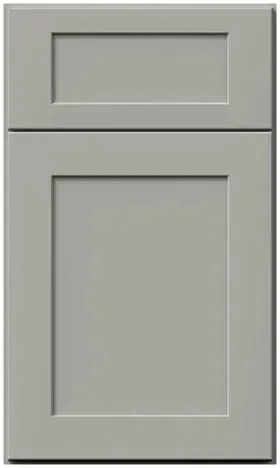


Twenty-seven inches: the width you land on when the wall will not divide
Reviewed September 2026 · Captivating Cabinets
Nobody sets out to buy a 27-inch wall cabinet. You arrive at one because a wall measured 105 inches instead of 108, or because a window sits three inches off centre, and the tidy combination you had in mind no longer fits. Ten units are built at this width, and knowing what they cost against the alternatives is the difference between solving that problem and paying for it twice.
Ten units, two families
Six double-door boxes — W2715, W2718, W2730, W2736, W2739 and W2742, $234.00 to $516.75 — and four diagonal corner units, WDC2730 through WDC2742, $539.50 to $682.50. That is the whole width. No blind unit, no doorless box, no open shelf, no wine rack, and none of the tall short-height boxes that 24, 30, 33 and 36 carry for gaps over appliances.
The corner units are the more interesting half. A 27-inch diagonal reaches deeper into a corner than the 24 does and gives a wider door on the angled face, at the cost of three more inches of each wall and roughly $85 over the equivalent corner unit at 24. In a large kitchen with wall to spare, that is a good trade; in a galley it is three inches you did not have.
What it costs to fill a wall in odd widths
Take a 108-inch run between two returns, leave three inches for fillers and scribes, and there are several ways to cover the remaining 105. They are not equal, and the difference is larger than most people expect.
| Combination | Boxes | Doors | Total displayed |
|---|---|---|---|
| 36 + 36 + 33 | 3 | 6 | $1,248.00 |
| 36 + 30 + 39 | 3 | 6 | $1,332.50 |
| 36 + 36 + 15 + 18 | 4 | 6 | $1,352.00 |
| 27 + 27 + 27 + 24 | 4 | 8 | $1,495.00 |
The all-27 elevation costs $247.00 more than the widest combination and breaks the run into four boxes instead of three, which means three interior partitions where the first option has two. Wide boxes are cheaper per inch and give longer, more useful shelves; that is the whole argument, and it holds at every height.
So use 27 where the layout forces it — not as a default. And check the double-door wall cabinet ladder before you commit: quite often a 30 and a 24 beat two 27s on both counts.
The case for it: symmetry around a hood or a window
There is one job 27 does that nothing else quite does. A 30-inch range with a matching hood in the middle of a 12-foot wall leaves 57 inches of upper on each side once the hood is placed. Two 27s and a filler fill each side evenly, and the elevation reads as a mirror. Splitting those 57 inches into a 36 and a 21 fills the same space for less money but gives you an asymmetric pair of doors either side of the hood, which is exactly the sort of thing you stop being able to unsee.
The same logic applies flanking a window. Where symmetry is the point, pay the difference; where it is not, take the wider boxes.
Six heights, and the one that is missing
The doored ladder runs 15, 18, 30, 36, 39 and 42 inches — the standard six. What you do not get is the 12, 21 and 24-inch boxes that the appliance widths carry, so a 27-inch gap under a soffit at 21 inches high has no cabinet. Build the elevation around a height this width actually offers rather than finding out at ordering.
Cost across that ladder is unremarkable: $234.00 at 15 inches tall, $377.00 at 30, $516.75 at 42. Roughly $14 per inch of width at the standard height, which puts 27 in the same value band as 24 and slightly behind 30.
Common questions
- Do they make 27 inch wall cabinets?
- Yes — six double-door heights from $234.00 to $516.75, plus four diagonal corner units. It is a genuine catalog width, just a sparse one: no blind, open or shallow appliance boxes are made at 27 inches.
- How do I fill a 9 foot wall with upper cabinets?
- Leave about three inches for fillers and scribes and cover 105 inches. Three wide boxes — 36, 36 and 33 — is the cheapest and gives the longest shelves; four narrower boxes cost up to $247.00 more for the same wall.
- Is a 27 inch corner cabinet better than a 24?
- It reaches further into the corner and gives a bigger door on the angled face, for roughly $85 more and three extra inches of each wall. Worth it in a roomy kitchen, wasteful in a tight one.
- What is the cost of a 27 inch wall cabinet?
- The 30-inch-tall box, which is what most runs use, displays at $377.00. The family spans $234.00 to $516.75, and the corner units $539.50 to $682.50.
- Should I use odd cabinet sizes or fillers?
- Fillers up to about three inches are normal and invisible once scribed. Past that, buy the width — a six-inch filler is a flat strip in the middle of your elevation and six inches of storage you paid for the wall to hold.
Keep reading
The guides behind the numbers on this page.
- Kitchen layouts guide
Where the awkward leftover lands in a galley, an L and a U, and how to place it.
- 10x10 kitchen cabinets
The standard pricing layout, and a useful sanity check on what a wall of uppers should cost.
- End panels, scribe molding and fillers explained
How much filler is normal, and how it is cut so it disappears.
- Fabuwood cabinets price list
For running your own version of the four-combination table above.
- Kitchen cabinet design service
What a drawn elevation gets you when the wall refuses to divide neatly.