

Seven profiles, one gap: picking crown molding for the space you actually have above the cabinets
Reviewed September 2026 · Captivating Cabinets
Crown is the one part of a kitchen that gets chosen from a picture. Somebody sees a photograph of a room with an eleven-foot ceiling, likes the heavy moulding in it, and specifies the tallest profile on the list for a kitchen with eight-foot walls. It arrives and there is nowhere for it to go. This is not a taste decision and it is not really a profile decision either: it is a measurement. Get a tape onto the gap between the top of your wall cabinets and whatever is above them, and everything below narrows to one or two answers.
Three gaps, and the number that tells you which one you have

Measure from the top of the wall cabinet box to the ceiling, at both ends of every run, because the two numbers will not match. Old ceilings sag, new ones are framed to a tolerance, and a half-inch of difference over ten feet is entirely normal. The larger of the two numbers is the one that decides the profile; the smaller one is the one the installer has to scribe out.
What comes back is one of three conditions. Zero to about an inch is the flush condition: a 42-inch box on a 96-inch wall, where the cabinet effectively touches the ceiling. Two to eight inches is the short condition, and it is by far the most common — a 36-inch box topping out at 90 inches under an eight-foot ceiling leaves six inches of wall showing. Anything more than eight inches usually means a soffit, a bulkhead, or a deliberate decision to stop the cabinets low, and that is a different problem with a different answer.
| Gap above the box | What works | Parts | Displayed price |
|---|---|---|---|
| 0″–1″ (flush) | A small profile that dies into the ceiling, or nothing at all | GN CM-1 or GN CM-3 | $117.00 / $123.50 |
| 2″–4″ | A mid-height profile that fills most of the reveal | GN CM-4 or GN CM-6 | $139.75 / $152.75 |
| 4″–8″ | A tall profile, or a starter plus a stacked assembly | GN CM-7 or GN CM-8 | $295.75 / $367.25 |
| 8″+ (or a soffit) | Close the gap first, then crown the new top line | GN STRM-8 starter, GN STKM-8 stacked | $133.25 each |
| A soffit you are keeping | Crown against the soffit face, small profile only | GN CM-1 or GN CM-9 | $117.00 / $152.75 |
One rule sits behind that whole table and it is worth stating plainly: a crown profile should never be taller than the gap it is filling. A four-inch profile in a three-inch reveal has to be furred down, which drops the whole assembly below the cabinet top and looks like a mistake, because it is one. When the numbers are close, go one profile shorter, not one taller.
The numbers are heights, not grades
Seven profiles are stocked in this finish and the numbering misleads people constantly. GN CM-1 at $117.00 is not the entry-level version of GN CM-8 at $367.25; they are different shapes at different heights, and the price tracks how much material is in the stick. The middle of the list is GN CM-3 at $123.50, GN CM-4 at $139.75, and then GN CM-6 and GN CM-9 sharing $152.75, which is the point where most kitchens land. GN CM-7 at $295.75 and GN CM-8 at $367.25 are the two tall assemblies, and they belong on nine- and ten-foot ceilings.
You will notice there is no CM-2 and no CM-5 on the live list. That is not an error on this page: the manufacturer publishes a wider series than the mill runs in every colour. If a drawing names a profile number we do not show, send it to us rather than substituting by eye.
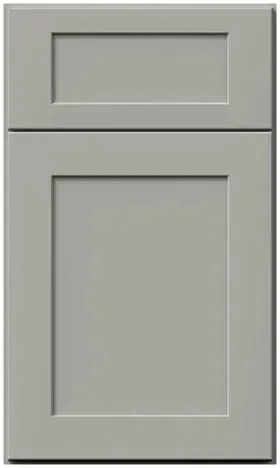
Height is where the finish changes the answer once. A crown profile carries the cabinet colour up onto the plane nearest the ceiling, and a mid-tone grey occupies that plane more insistently than a white does — the same six-inch assembly that disappears in a white kitchen stays visible in this one. It is not a reason to avoid a tall profile. It is a reason to look at the assembly height in the room rather than on a screen, and to scale down a step when the gap is marginal.
Stacking, and the two parts people forget to order
Where the gap is bigger than any single profile, crown gets stacked: a lower element sets the line, and the crown itself sits on top of it, so the assembly closes four or five inches instead of two. Two parts do that work. GN STRM-8, starter top moulding, is $133.25 for an eight-foot stick, and it builds the cabinet top forward so a profile too deep for the box has a bearing surface. GN STKM-8, stacked top moulding, is the same $133.25 and adds the second step.
Neither is optional on a tall profile. A big crown projects forward as well as upward, and nailed straight to a cabinet top with no build-out behind it, there is nothing structural to fasten into across most of its depth.
For gaps well beyond stacking range, the answer moves off this page entirely. Molding extension, GN MEX-8 at $289.25, raises the whole assembly; ship lap, GN SHL-8 at $169.00, clads the gap rather than moulding it; and both are listed with the rest of the decorative accessories. A twelve-inch gap is a carpentry job, not a trim job, and treating it as one is how you end up with a six-inch crown floating in a foot of wall.
Inside corners, outside corners, and why the corner count decides the order
Straight runs of crown are easy. Corners are where the material goes. Every inside corner — the re-entrant angle where two walls of cabinets meet — takes two mitred ends, and every outside corner, where a run turns the end of a cabinet and comes back, takes two more plus a short return piece that is frequently under six inches long and cannot be cut from an offcut because the grain and the profile have to run continuously through the turn.
That is why counting corners tells you more than measuring run length. An L-shaped kitchen with one bank of uppers returning at a window typically has one inside and two outside corners; a U-shaped kitchen with a hood surround and a tall cabinet at one end can easily have two inside and six outside.
- Inside corner: two mitres, and the run continues. Allow the profile’s own projection off each stick — a deep profile eats more.
- Outside corner: two mitres plus a return. Allow a full extra foot per outside corner, because the short piece has to come from a fresh length.
- End of a run into open air: the crown has to return onto itself against the cabinet side, which is another short piece and another two cuts.
- Over a hood surround: four corners in four feet, and the most material-hungry stretch of crown in most kitchens — see the range hood list.
- Across a tall cabinet: the crown steps forward where a 24-inch-deep pantry meets 12-inch-deep uppers — two more outside corners and a short piece across the front.
The practical consequence: two kitchens with identical run lengths can need quite different quantities of crown. If a takeoff was done off run length alone, add a stick for every outside corner past the first two.
Confirm two things before the order goes in
First, the stick length on the profile you have chosen. The eight-foot parts announce themselves in the code — GN STRM-8 and GN STKM-8 both carry the 8 — but the CM profiles do not publish a length on the live page, and crown is sold by the stick. Ask us before the quantity is calculated.
Second, whether the crown goes on before or after the ceiling is painted. Crown scribed to a wavy ceiling leaves a hairline that gets filled, and filling it is a painter’s job — deciding that in advance is what keeps a white caulk line off the top edge of a coloured profile. The technique is in the end panels, scribe moulding and fillers guide, and the scribe moulding page prices the part.
Everything above is priced on the crown moulding page against the rest of the collection, and the light rail at the other end of the cabinet is the piece most often ordered in the same breath.
Common questions
- How do I know which crown molding profile fits my kitchen?
- Measure from the top of the wall cabinet to the ceiling at both ends of each run. Zero to an inch takes a small profile such as GN CM-1 at $117.00 or nothing at all; two to four inches suits GN CM-4 at $139.75 or GN CM-6 at $152.75; four to eight inches is where GN CM-7 at $295.75 and GN CM-8 at $367.25 belong. Never specify a profile taller than the gap.
- What is starter molding and do I need it?
- GN STRM-8 at $133.25 for eight feet builds the cabinet top forward, so a profile too deep for the box has a bearing surface and a tall crown has something structural to fasten into. On a small profile you can often go without; on GN CM-7 or GN CM-8 treat it as part of the assembly.
- Can crown molding close the gap between cabinets and an 8-foot ceiling?
- Up to about eight inches, yes — with a stacked assembly of GN STRM-8 and GN STKM-8 under the crown if a single profile will not reach. Beyond that, close the gap with GN MEX-8 molding extension at $289.25 or GN SHL-8 ship lap at $169.00 first, then run crown on the new top line.
- Why is there no CM-2 or CM-5 on the list?
- The manufacturer publishes a wider profile series than is milled in every colour, and the live list for this finish shows what is actually stocked. If a drawing specifies a number we do not list, send it to us and we will check what it maps to rather than substituting by eye.
- How many corners does crown molding waste?
- Allow the profile’s projection off each stick at every inside corner, and a full extra foot at every outside corner, because the short return piece has to come from a fresh length. A hood surround alone is usually four corners in four feet, which is why counting corners predicts the order better than measuring run length.
- Does crown molding look heavier on a gray kitchen?
- It occupies the plane nearest the ceiling more visibly than it would in white, so a marginal gap is a reason to step down a profile rather than up. Judge the assembly height on an elevation drawing or in the room, not from a photograph of somebody else’s ceiling height.
Keep reading
The guides behind the numbers on this page.
- Kitchen Cabinet Molding Types
The whole trim vocabulary in one place, with what each profile is for.
- Important Kitchen Dimensions Before Buying Cabinets
Ceiling heights, cabinet heights and the reveal that is left over.
- Wall and Tall Cabinet Sizes and Buying Guide
Which box heights leave which gap under an eight- or nine-foot ceiling.
- Fabuwood Cabinet Sizes and Specs
Box dimensions to measure the gap against before choosing a profile.
- Cabinet End Panels, Scribe Molding and Fillers Explained
How a trim line is made to meet a ceiling that is not flat.
- Gray Kitchen Cabinets: Finding the Right Shade
Why a mid-tone reads more present at the ceiling plane than a white.
- 27 Kitchen Cabinet Ideas
Finished rooms with small crown, stacked crown and none at all.
- Free 3D Kitchen Design
The elevation drawing is where a crown height can be judged before it ships.


