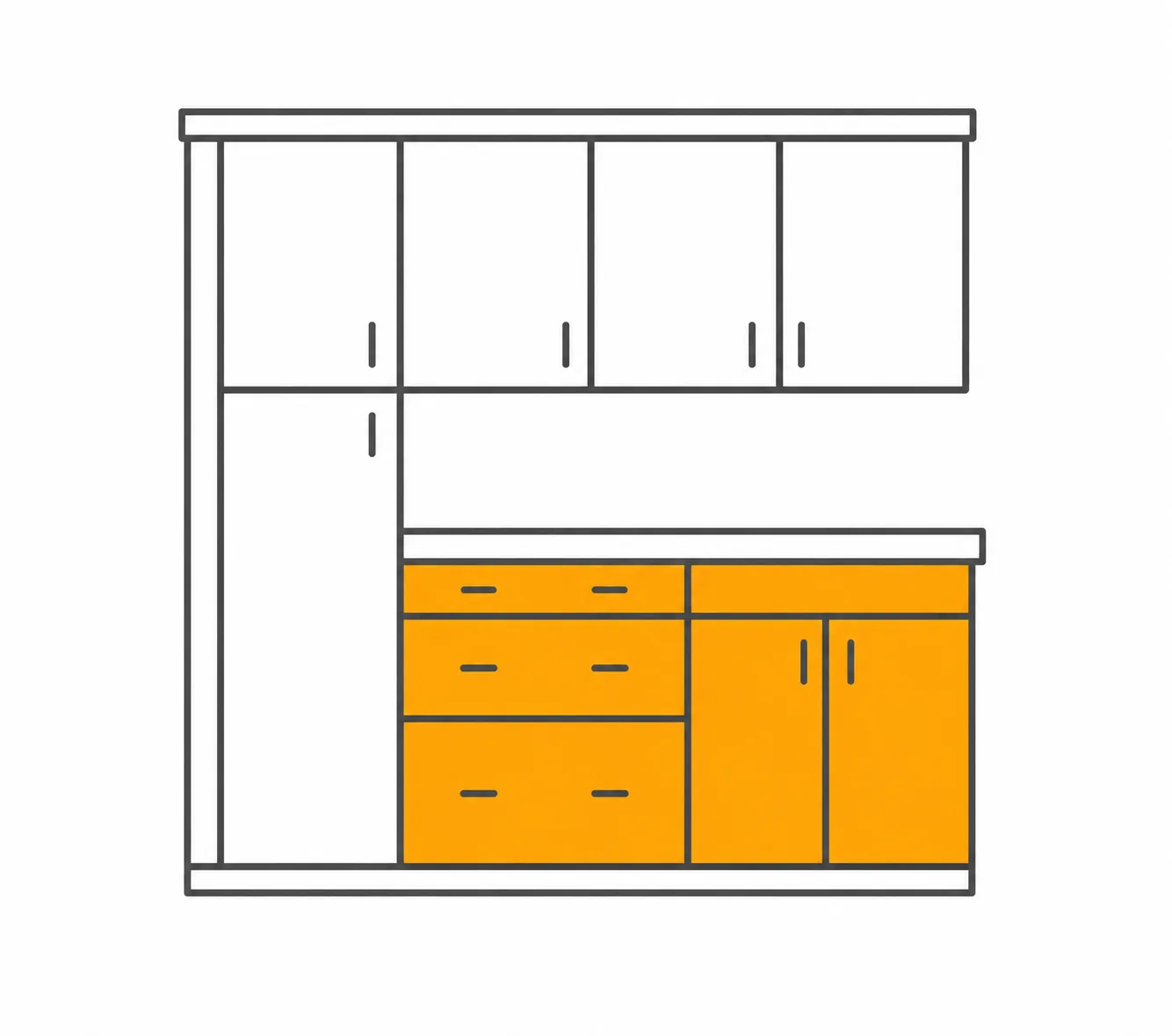


The specialist you can talk yourself out of: a Galaxy Nickel 4 drawer base cabinet and the fronts it must line up with
Reviewed September 2026 · Captivating Cabinets
Four tiers have to come out of the same 34½″ box as three, so every drawer here is shallow — roughly four to five inches of clear height by our tape, against eight or nine in the bottom drawer of a three-tier bank. That makes this a specialist, available in 15″, 18″ and 21″ and nothing wider. There are two jobs it does better than anything else in the line. There is also a good reason most kitchens should buy the three-drawer instead, and an installation problem nobody mentions until the fronts are hung. All three are below.
The two jobs four shallow tiers win outright
Both have the same shape: small flat things, sorted by category, reached while standing in one place. That is what four tiers are for, and it is a narrow description on purpose.
The gadget bank at the prep station
The problem with kitchen gadgets is not volume, it is migration. A peeler, a microplane, a thermometer, scissors, bag clips, a corkscrew, measuring scoops — in a deep drawer they all end up underneath something, and the drawer becomes a place you rummage rather than a place you look. Four shallow tiers fix that by arithmetic: four drawers is four categories, and a category per drawer is what makes a drawer findable.
Our usual assignment, top to bottom: cutting tools and the things with edges; measuring and mixing hand tools; wraps, bags and the foil boxes lying flat; then the odd-shaped survivors — the ricer, the spare blades, the jar opener. 18″ or 21″, immediately beside the main board.
The spice-and-tools bank at the range
A standard spice jar stands upright in a four-to-five-inch tier with its label facing the ceiling, which is the whole trick — you read a spice drawer from above in one glance, where a spice shelf is read one jar at a time from the side. Put tongs, spatulas and the instant-read thermometer in the tier below, foil and parchment flat under that, and trivets and mitts at the bottom.
The point is not capacity. A cabinet of the same width holds more with three tiers. The point is that four separate shallow layers put every small thing the range needs inside one arm’s reach with nothing stacked on top of anything.
Who should not buy one, said plainly
Nothing deep fits. Four to five inches of clear height takes a spice jar, a foil box, a stack of tea towels, a folded apron. It does not take a mixing bowl, a colander, a saucepan, a bottle of oil, or a stack of dinner plates with any headroom over them. If you cannot name four categories of small flat objects that genuinely need their own layer, you do not want this cabinet.
The alternative is sitting right next to it on the price list, and the gap is smaller than people expect.
| Width | Three-drawer bank | Four-drawer bank | What the fourth front costs |
|---|---|---|---|
| 15″ | GN DB15 · $627.25 | GN DB15-4 · $780.00 | +$152.75 |
| 18″ | GN DB18 · $646.75 | GN DB18-4 · $799.50 | +$152.75 |
| 21″ | GN DB21 · $672.75 | GN DB21-4 · $832.00 | +$159.25 |
About a hundred and fifty-five dollars, then, to trade one deep bottom tier for two more shallow ones. In the two positions above that is the best $155 on the order. In a general-purpose cabinet it is money spent to lose the only drawer in the box that could have held a pan — so if you are unsure which kitchen you have, order the three-drawer bank. It is the better default and we say so on the phone.
Against a door base of the same width the figure is roughly $400 flat — $403.00 at 15″, $390.00 at 18″, $399.75 at 21″ — which is the number to weigh if the comparison is really drawers against a shelf rather than four tiers against three.
The fronts cannot line up across a mixed run, and what to do about it

Here is the arithmetic that bites. Every base in this finish is 34½″ high, the toe kick takes about 4½″, and what remains — call it thirty inches — is what each bank divides into fronts. A three-tier bank splits it unevenly on purpose: a shallow drawer of roughly six inches over two of about twelve. A four-tier bank splits the same thirty inches into four near-equal fronts of about seven and a half.
Which means exactly two horizontal lines agree between them: the top edge of the top front, and the bottom edge of the bottom one. Every rail in between disagrees — by one and a half to four inches, and the four-tier bank carries a rail at a height the three-tier has nothing near at all. Put a four-drawer bank directly beside a three-drawer bank in the middle of an open wall and the eye reads it instantly as a mistake, because the eye is very good at horizontal lines and very bad at forgiving near-misses in them. This is not a defect and no installer can fix it. It is a planning decision that has to be made before the order.
- Put the four-tier bank at the end of a run, or against something with a vertical break — an appliance, a tall cabinet, a base end panel (GN BEP at $149.50). A break resets the eye and the mismatch stops registering.
- A matched pair either side of a range reads as deliberate, because the two banks agree with each other and the appliance separates them from everything else.
- Never a single four-tier bank between two three-tier banks on the same wall. That is the one arrangement that looks like a supplier error.
- A door base between them hides the mismatch better than another drawer bank does — a door has no rails, so there is nothing for the eye to try to line up.
- Align the run at the counter line and the toe kick and accept the disagreement between. Those two lines are shared by every base in the finish and they are the ones that carry the room.
- Use the same pull everywhere and centre it on each front. Do not try to match pull heights across banks of different drawer counts — it cannot be done, and the attempt leaves one pull visibly off-centre on its own front, which is worse than an unmatched rail.
Three widths, priced, with the inserts listed for them
Displayed prices on the review date. The inserts are listed by the drawer width they fit, which on this cabinet is only half the fitting question — see the note below the table.
| Width | SKU | Price | Inserts listed for that drawer width |
|---|---|---|---|
| 15″ | GN DB15-4 | $780.00 | GNK CD-15/18 · $201.50 · GNK UT-15/24 · $227.50 · GNK DCD-15 BLUM · $354.25 |
| 18″ | GN DB18-4 | $799.50 | GNK CD-15/18 · $201.50 · GN KCUP-18 · $224.25 · GNK DKI-18/24 · $214.50 |
| 21″ | GN DB21-4 | $832.00 | GNK CD-21/24 · $273.00 · GNK UT-15/24 · $227.50 · GNK DCD-21 BLUM · $468.00 |
The constraint here is height, not width. A tray built for a standard drawer may be taller than the four to five inches of clear space these tiers give you, so measure the open depth of the drawer before ordering one — and treat the inserts that come with their own Blum hardware as belonging in the deeper top tier of a three-drawer bank, where there is room for a second sliding level. The full range is on the accessories page.
And the range stops at 21″ deliberately. Above that, four fronts each a yard wide start to sag under their own proportions and hold less per dollar than three would; the line hands you a three-drawer bank or a double-door base instead, and it is right to.
The most-handled square foot in the kitchen
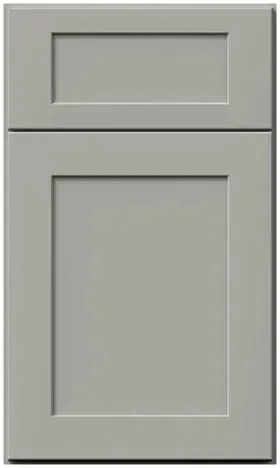
Four fronts inside fifteen to twenty-one inches of width puts more painted surface per foot at hand height than any other cabinet in the run, and each one gets opened by a hand that has just been holding food. This is the single place in a kitchen where a mid-tone neutral does work a white front simply cannot: the fingerprint beside a pull, the splash, the smear from a thumb — none of it reads from across the room on a gray at this depth.
The honest counterweight belongs in the same paragraph. Four rails collect twice the dust two rails do, and dust shows on a gray more readily than on a white. It is a weekly dry cloth along the top edge of each front, not a chore, but it is a real difference and worth knowing before you choose. The care guide has the method, and the gray shade guide has the rest of the colour argument, which belongs on the collection page rather than here.
Ordering one, or a pair
These arrive pre-assembled with all four fronts hung and aligned at the factory, seven days to three weeks after the order — which is worth something on this cabinet specifically, because squaring four fronts across a narrow box by hand is fussy work you are not doing.
Put the bank on the same order as its neighbours so the truck comes once, and add the parts the run needs at the same time: GN TK8 at $55.90 covers eight feet of toe kick, GN BEP at $149.50 is the base end panel that gives a bank at the end of a run its vertical break, and a door sample is $25.00. The rest of the line is on the base cabinet lineup and the full collection.
Common questions
- What is the difference between a three-drawer and a four-drawer base cabinet?
- The same 34½″ box, cut into a different number of fronts. Three tiers give roughly six, twelve and twelve inches of front; four give about seven and a half each, which works out near four to five inches of clear height inside. Four sorts better; three holds more, and holds deep things at all.
- Should I buy a four-drawer base cabinet?
- Only if you can name four categories of small flat objects that each deserve their own layer — gadgets at a prep station, or spices and tools beside a range. Otherwise buy the three-drawer bank. It costs about $155 less at the same width and keeps a deep bottom drawer that will hold a pan.
- Do drawer fronts line up across cabinets with different drawer counts?
- No, and nothing on site can make them. A four-front bank and a three-front bank share only the top edge of the top drawer and the bottom edge of the bottom one; every rail between differs by one and a half to four inches. Put the four-tier bank at the end of a run, or against an appliance or end panel.
- Where should the utensil and gadget drawer go?
- Directly beside the main cutting board, in the 18″ or 21″ width. The value is one category per tier — edges, hand tools, wraps, odd shapes — so that nothing has to be moved to find anything. A deep drawer holds the same items and buries them.
- What does the four-drawer bank cost against the three-drawer at the same width?
- $152.75 more at 15″ and 18″, $159.25 more at 21″ — GN DB15-4 at $780.00, GN DB18-4 at $799.50 and GN DB21-4 at $832.00, at displayed prices on the review date. Against a plain door base of the same width the gap is roughly $400 flat.
- Will spice jars stand upright in these drawers?
- Yes, with the label facing up, which is the reason to buy one for the range wall. Clear height is about four to five inches by our measurement — a standard jar, a foil box or a folded tea towel. Confirm your own drawer before ordering a tray; the constraint on these tiers is height, not width.
- Do gray drawer fronts show dust?
- More than white ones do, and a four-tier bank has twice the rails of a two-drawer to collect it. A dry cloth along the top edge of each front once a week handles it. The trade is that the same mid-tone hides fingerprints and splashes far better, which on the most-handled cabinet in the kitchen is the better bargain.
Keep reading
The guides behind the numbers on this page.
- Fabuwood Cabinet Sizes and Specs: The Complete Dimension Guide
The 34½″ box height that every front on this page is divided out of.
- How to Read Cabinet SKU Codes From B12 to WBC3042
What the -4 on the end of a drawer base code is telling you.
- Space-Saving Cabinet Solutions That Actually Work
Sorting small items when a shallow tier is all you have.
- Kitchen Cabinet Terminology: Parts, Terms and Abbreviations
Rails, reveals and stiles — the vocabulary the alignment section uses.
- Cabinet End Panels, Scribe Molding & Fillers Explained
The end panel that gives a bank at the end of a run its vertical break.
- Pre-Assembled Kitchen Cabinets: A Dealer’s Buying Guide
Why four factory-aligned fronts matter more than three.
- Gray Kitchen Cabinets: Finding the Right Shade
The colour argument in full, where it belongs.
- How to Clean and Care for Kitchen Cabinets
The weekly cloth along four rails instead of two.


