

The cheapest way to turn a corner, and the bill that arrives with it
Reviewed September 2026 · Captivating Cabinets
A blind corner is the least expensive way to turn ninety degrees, which is why almost every plan has one in it. The four boxes here — GN BLB36/39, BLB39/42, BLB42/45 and BLB48/51, $614.25 to $767.00 — buy the corner for less than any other answer, and they do it by giving one end of themselves away to the cabinet on the other wall. That trade is fair and it is worth making. It is just rarely priced out loud. So this page is the accounting: what the sticker leaves off, how much of the box an arm ever reaches, what the carriage that rescues the buried end really costs, and the order the installer has to work in so the two runs land square.
The sticker is not the price of the corner
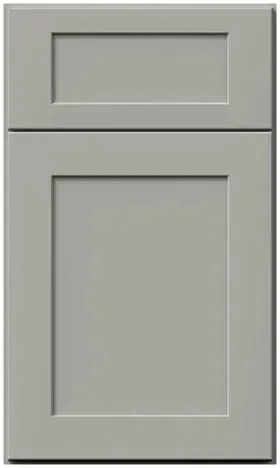
A corner is never one line on an order. It is a cabinet, a strip of filler to cover the reveal behind it, and a length of toe kick that has to turn an inside corner on a miter, and if the buried end has to be reachable it is a carriage as well. Below are the four ways to close a 90° corner in this finish, each totalled the way it would actually be quoted, using the displayed prices on the review date.
| How the corner is finished | What goes on the order | Displayed total | What you reach without kneeling |
|---|---|---|---|
| Blind box, plain | GN BLB36/39 $614.25 + GN BF3 $26.00 + GN TK8 $55.90 | $696.15 | The front of the box; the buried end is an arm-and-torch job |
| Blind box with the carriage | GN BLB42/45 $767.00 + GNK BPO-BLB42/45-L $1,277.25 + GN BF3 $26.00 + GN TK8 $55.90 | $2,126.15 | All of it, one tray at a time |
| Angled corner | GN ERB33 $838.50 + GN TK8 $55.90 | $894.40 | The whole square, with a long lean to the back |
| Rotating corner | GN LSB33 $1,030.25 + GN TK8 $55.90 | $1,086.15 | Whatever is facing you; turn it for the rest |
Two numbers in that table decide most kitchens. The plain blind box finishes at $696.15, which is $198.25 less than the angled box and $390.00 less than the rotating one — a real saving and the reason the blind corner is the default. And the blind box with its carriage finishes at $2,126.15, which is $1,040.00 more than the rotating corner and still leaves part of itself behind a neighbour. The carriage is the one line here we argue people out of more often than any other.
How much of the box you actually reach
Every one of these is 24″ deep and 34½″ high, the same as an ordinary base, with one door and one drawer over it. The label carries two widths because the cabinet is built to be drawn off the corner, and it carries only one door because the far end of the carcass is designed to sit behind the first cabinet on the perpendicular wall. That buried end has no opening of its own. Nothing in front of it moves. Getting to it means putting a shoulder through the single door and working sideways into a space you cannot see into, which is a different activity from opening a cupboard.
That is not an argument against buying one. It is an argument for deciding, before the order, what the far end is for. The honest division:
- Belongs in the buried end: the roasting pan that comes out at Thanksgiving, the stockpot, the slow cooker, cake tins, the spare bag of flour, platters, the picnic basket. Anything you fetch on purpose, with two hands and some warning.
- Does not belong there: anything you want on a weeknight, anything heavy enough that dragging it over the face frame is a job, and anything that leaks. A bottle that goes over in the dark end of a blind box is discovered by smell, weeks later.
- Does not belong there either: the thing you bought the corner for. If the corner is meant to hold the everyday pans because there is nowhere else, the blind box is the wrong box and the money is better spent on the footprint that opens all the way.
Our guide to base cabinet types sets the blind box beside every other base shape, and the space-saving guide covers the bins and risers that stop a deep dark shelf becoming a heap.
The reveal and the filler are not optional lines
The two widths on the label are the whole mechanism. GN BLB36/39 is a 36″ box that can be pulled up to 3″ away from the inside corner; GN BLB39/42 is a 39″ box with the same 3″ of travel, and so on. The gap that opens up behind it as it moves is the reveal, and the reveal is covered by a filler ripped to width on site. That travel is how an installer lands a run on a wall whose length does not divide neatly, so it is worth spending on purpose rather than discovering at install.
What that means for the order: GN BF3, a 3″ base filler at $26.00, for the ordinary case, or GN BF6 at $43.55 where a long bar pull on the neighbouring door needs clearance. Both are under decorative accessories, and both must ride on the same order as the cabinet so the paint comes out of one batch — a filler bought three weeks later lands within an inch of the corner door, which is the worst place in the kitchen for two sprayings to meet. If the dead 3″ genuinely bothers you, the catalogue does stock GNK TBPO-BF3, a base filler pull-out, at $432.25; it is a narrow tower of spice jars and it costs sixteen times the filler it replaces.
The install order that keeps both runs square
A corner cabinet is the datum for two runs at once, so an error set there is an error made twice. Installers who do this daily work in one order, and it is worth knowing because it decides what has to be on site on day one.
- Find the high point of the floor along both walls and strike one level line around the corner. Every cabinet on both runs is shimmed up to that line, never to the floor.
- Set the blind box first, plumb and level, held off the inside corner by exactly the reveal the drawing calls for — the number you decided on paper, not the one that looks right on the day.
- Fix the filler to the blind stile now, before anything stands on the return wall. Once a cabinet is in the way there is no room to get a drill in there, and that is how fillers end up face-nailed.
- Run the return wall next, working away from the corner, so whatever error accumulates lands at the far end of the run where a scribe or an end panel absorbs it.
- Then the first wall, the same way. Check the two runs against each other with a straightedge across the corner before the counter is templated, because the fabricator measures what is there, not what was drawn.
- Toe kick last, mitred at the inside corner. GN TK8 is an 8-foot length at $55.90 and GN TKC, the toe kick cap, is $7.80; a corner eats more length than a straight run because the recess turns as well.
One thing to settle before any of that: the hand. The buried end is cut at the factory, left or right, and cannot be swapped on site. Draw the L, mark the wall the blind end goes under, and if the drawing leaves it ambiguous send it through a free design request and we will call it before anything ships.
Why this is the box in the package kitchen
The 10x10 kitchen in this finish, FGNK10, is displayed at $3,500.00 against a $5,384.62 list price, and the cabinet list inside it includes exactly one corner: a blind corner base. That is not an accident of packaging. It is the manufacturer making the same calculation as the table above — the blind box closes the corner for the least money, and a package priced to a number closes it that way. Our 10x10 pricing guide breaks down what else is in that figure.
The upgrade path, if you want one, is not the carriage. It is the footprint: if both walls can spare 33″ or 36″ from the inside corner, the angled box or the rotating box buys a corner with nothing hidden in it, for less than the blind box plus its hardware. The rest of the finish, corner boxes included, is on the Galaxy Nickel collection page.
Common questions
- How much does a blind corner base cabinet actually cost once it is finished?
- About $696.15 for the smallest: GN BLB36/39 at $614.25, a GN BF3 filler at $26.00 and an 8-foot GN TK8 toe kick at $55.90, all as displayed. The larger boxes run to $767.00 before those same two parts.
- How much of a blind corner cabinet can you reach?
- The part in front of the single door. The far end of the carcass sits behind the first cabinet on the other wall and has no opening of its own, so reaching it means leaning in sideways. Plan that end for things you fetch on purpose, not for weeknight cookware.
- Is the blind corner pull-out worth the money?
- Rarely. The carriage is $1,277.25 for the 42/45 and $1,394.25 for the 48/51, which takes a finished blind corner past $2,100 — about $1,040.00 more than a rotating corner that hides nothing. It earns its price only when both walls are too short for a 33″ square box and the corner still has to work daily.
- What does the second number in BLB36/39 mean?
- The travel. The box is 36″ wide and can be drawn up to 3″ off the inside corner, making the run 39″; the gap that opens behind it is covered by a filler. That movement is how a run lands on a wall whose length does not divide evenly.
- What order should a corner kitchen be installed in?
- Level line first, blind corner box second, its filler third, then the return wall working away from the corner, then the first wall, then the toe kick mitred at the inside corner. The corner sets two runs at once, so any error there is made twice.
- Do I have to order the filler and toe kick with the cabinet?
- Put them on the same order. They are cheap — $26.00 and $55.90 — and they land within inches of the corner door, which is the last place in the kitchen you want two different spray batches meeting.
Keep reading
The guides behind the numbers on this page.
- Types of Base Cabinets
The blind box set beside every other base shape.
- Cabinet End Panels, Scribe Molding and Fillers Explained
What a reveal is, and when 3″ of filler stops being enough.
- What Is a 10x10 Kitchen? Cabinet Pricing Guide
Why the package kitchen closes its corner this way.
- Beam-Mounted and Pull-Out Cabinet Accessories
How the blind-base carriage works, if the plan forces one.
- How to Read Cabinet SKU Codes
BLB, ERB and LSB decoded before the corner goes on a quote.
- Kitchen Layouts Guide
Where the corner lands in an L, a U and a G.
- Space-Saving Cabinet Solutions
Bins and risers for the end of the box you cannot see.


