

A seat, not a cupboard: Galaxy Nickel drawer bench seat cabinets as furniture
Reviewed September 2026 · Captivating Cabinets
Every other box in this catalogue is 34½ inches high and holds kitchen things. This one is about 16⅜ inches high and holds a person. GN DBS24 at $338.00, GN DBS30 at $383.50 and GN DBS36 at $425.75 are the only cabinets in the finish built to be furniture rather than storage — a banquette, a window seat, a mudroom bench — and almost everything that makes them work is decided by that one difference in height. Seat height is not a smaller version of counter height. It is a separate number, arrived at from the table down rather than the floor up.
Why the box is sixteen inches and not thirty-four and a half
A dining chair puts a seat 17 to 19 inches off the floor. That is the number this cabinet is designed backwards from: the carcass stands about 16⅜″ with no top on it, which leaves room for a ¾″ seat panel and a compressed cushion to land inside that range. Counter height exists for standing and chopping; seat height exists for sitting at a 30″ table. They are unrelated dimensions, and this is the only box here built to the second one.
Two consequences follow. The bench cannot be pressed into service as a base cabinet — it is eighteen inches too short — and a base cabinet cannot be cut down to make a bench, because the drawer box, the hinges and the toe kick recess are all built to the taller carcass. If a plan needs seating, it needs these. The listing gives width and height; confirm the depth with us before any cushion is cut, because that is the dimension the upholsterer will ask for first.
Cushion thickness against finished seat height and knee room
A ¾″ seat panel on the carcass makes a deck at about 17⅛″. Everything after that is cushion, and cushion is where most benches go wrong — a thick soft one feels generous in the showroom and puts knees into the underside of the table at home. Foam compresses under an adult to roughly two-thirds of its free thickness, so specify by the loaded figure, not the label.
| On top of the carcass | Finished seat height | Clearance under a 30″ table | Verdict |
|---|---|---|---|
| ¾″ seat panel, no cushion | 17⅛″ | 12⅞″ | Hard, but the right height — the usual answer in a mudroom |
| Panel + 1″ firm foam (about ¾″ loaded) | 17⅞″ | 12⅛″ | The safe choice, and easy to add to later |
| Panel + 2″ firm foam (about 1½″ loaded) | 18⅝″ | 11⅜″ | Our default in a dining nook |
| Panel + 3″ soft foam (about 2″ loaded) | 19⅛″ | 10⅞″ | Comfortable — check the table apron before committing |
| Panel + 4″ soft or down (about 2½″ loaded) | 19⅝″ | 10⅜″ | Too high. Knees meet the apron and nobody sits there twice |
Two rules sit underneath that table. Finish somewhere between 17″ and 19″, and never let knee room fall below 11″. Under a window a third one applies: seat height plus the depth of a back cushion has to clear the sill, or the bench ends up sitting proud of the trim. Working to a table that is not 30″? Our dimensions guide tabulates the standard heights in a kitchen, seating included, so the same arithmetic can be redone against whatever you actually own.
What the drawer is for, which depends on the room

Each box carries a single drawer: ⅝″ solid wood, dovetailed at every corner, riding Blum Tandem runners with Blumotion that pull out to the back and shut themselves. Spec for spec it is the kitchen drawer — only much shallower, because the carcass under it is. Shallow is the whole character of the thing, and what a shallow drawer is worth depends entirely on the room around it.
In a dining nook
Table linens, placemats, candles, spare napkins, and the board games that are only ever played where people are already sitting. Flat things, at the place they get used.
Under a window
Throws, the second blanket, the reading pile, and the seasonal things that otherwise take a shelf in a cupboard. A window seat drawer is the one place in a house where bulky soft storage is genuinely convenient.
In a mudroom
This is where the drawer earns its keep. Shoes that come off at the door, dog leads, gloves, hats, the sunscreen. One shallow drawer directly under the seat gets used constantly, where a cupboard eighteen inches away does not get opened at all.
And the detail that decides whether it is ever opened
The seat panel has to project past the drawer front, and the cushion has to stop before the front edge does. Get either wrong and opening the drawer starts with moving somebody’s cushion — after a fortnight of that, the drawer becomes the place things go to be forgotten. Our guide to dovetail drawers covers the box itself.
Every side of a bench is a side somebody sees
A base cabinet in a run shows one face and hides everything else between its neighbours. A bench does the opposite: its front, both ends and often its back are all in the room, at eye level from a chair. Fabuwood finishes cabinet sides as interiors — natural wood veneer, meant to be seen only when a door is open — so every exposed end of a bench run needs a finished face on it. GN SK BASE, the base end skin, is $62.40; GN BEP, the applied shaker-profile end panel, is $149.50. Both are under decorative accessories, and both belong on the same order as the boxes so the paint comes from one batch.
A freestanding bench — the room side of a banquette, or a mudroom bench pulled off the wall — needs its back treated as well, and there is no catalogue part for a cabinet back. That is a beadboard or a panel from the carpenter, matched or deliberately contrasted. Priced end to end, a 72″ mudroom bench with both ends on show comes to $1,032.20 as displayed: two GN DBS36 at $425.75, two GN SK BASE at $62.40 and one 8-foot GN TK8 at $55.90, before the seat panel, the cushion and the carpenter’s time.
There is a fourth way to deal with the front, which is to buy less cabinet. Three carcass-only versions sit under loose parts — DBS24-BO at $217.75, DBS30-BO at $247.00, DBS36-BO at $273.00 — and they exist for a bench that is getting upholstery or a carpenter’s panelling across its face regardless. What the lower figure gives up is mostly the finished drawer front, which is the part that would disappear under that upholstery anyway. Confirm exactly what is in one of those cartons before choosing it.
A bench takes shoes, boots and hands all day

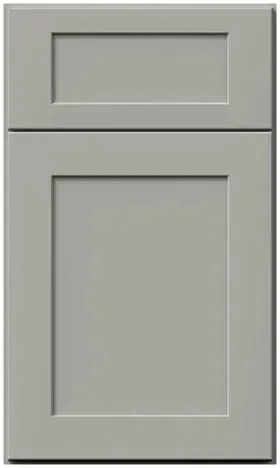
This is the one page in the collection where the paint changes a practical decision rather than a decorative one. A bench sits at hand height for an adult lowering themselves onto it and at shoulder height for a four-year-old climbing up. Its ends take boot heels. Its front takes the backs of shoes, every single day, from people who are not thinking about the cabinetry. A mid-tone gray is genuinely forgiving there in a way a white door is not: fingerprints along the top edge, the scuff a heel leaves, the grey mark from a wet sleeve — none of it reads from across the room. On a bench that gets used, that is worth more than it sounds.
It cuts the other way too, and we would rather say so. Dust settles visibly on a gray at this depth, and so do the dried spots that melting snow leaves on a mudroom bench — a white bench hides both better. Neither is a reason to choose a different finish; it is a reason to keep a microfibre cloth in the drawer, which is what the care guide recommends anyway. The gray shade guide has the rest of the case for this depth of gray, and a door sample taped where the bench will go answers it faster than either of us can in writing.
Three widths, and the run they make
This is easier as a worked example than as a formula, so take a real alcove: 94″ wall to wall, three adults to seat, about 24 inches of bench each. Only three widths exist, and they climb in 6″ steps — 24, 30, 36 — which is twice the 3″ ladder the ordinary bases use, so nothing is going to land on 94. The closest honest fill is 36 + 30 + 24: ninety inches of seating at $1,147.25, with four inches left over. Those four inches are the reason this section exists.
Divide the remainder between the two ends and scribe it out of sight. Two inches at each wall, cut to whatever the plaster is actually doing, reads as a deliberate margin; the same four inches left open somewhere in the middle of the run reads as a mistake, and no cushion detail will hide it. Plan on giving something up at both ends even when the arithmetic comes out even — old corners are rarely square enough to skip the allowance. And let the 36s carry the length wherever they can: at $425.75 they cost less per inch of seat than either of the narrower boxes, so the small ones should only ever be closing a gap.
An L-shaped nook has to be drawn before it is ordered. Of the two boxes meeting at the inside corner, one has a drawer that would open straight into its neighbour’s side, so that box is specified without a working drawer and the seat panel simply runs across the top of it. As for why a bench belongs in a tight plan at all — a chair needs floor behind it to slide into and a bench needs none — the floor-space arithmetic is set out properly in our small kitchen guide. The rest of the finish is on the Galaxy Nickel collection page.
Common questions
- How high should a built-in bench seat be?
- 17″ to 19″ finished, the same as a dining chair. The carcass is about 16⅜″, a ¾″ seat panel makes a 17⅛″ deck, and the cushion has to land inside that range once it is compressed.
- How thick should a bench cushion be?
- Two inches of firm foam is the usual answer: it compresses to about 1½″, finishing the seat at 18⅝″ and leaving 11⅜″ under a 30″ table. Three inches still works; four inches of soft foam pushes knees into the table apron.
- What does a bench seat cabinet cost?
- $338.00 for the 24″, $383.50 for the 30″ and $425.75 for the 36″ as displayed. A 72″ mudroom bench with both ends finished runs to $1,032.20 — two 36″ boxes, two end skins at $62.40 and a length of toe kick — before the seat panel and cushions.
- Does a bench cabinet need finished end panels?
- Yes, on every exposed end. Cabinet sides leave the factory finished as interiors, and a bench shows its ends at eye level from a chair. A GN SK BASE skin is $62.40 and a GN BEP applied panel is $149.50; order them with the boxes so the paint matches.
- Can these be used as a mudroom bench?
- It is the job they suit best. Seat height is the same, every side needs finishing either way, and the shallow drawer under the seat is exactly the right place for the shoes that come off at the door.
- Do gray cabinets work for a bench that gets heavy use?
- Better than white. A mid-tone gray hides handprints, heel scuffs and the marks a wet sleeve leaves. The trade is that dust and dried water spots show more than they would on white, so keep a cloth in the drawer.
Keep reading
The guides behind the numbers on this page.
- Important Kitchen Dimensions Before Buying Cabinets
Every standard height in a kitchen, tabulated — including the one you sit on.
- Small Kitchen Design and Layout Ideas
How much floor a chair needs behind it, and why a bench claims none of it.
- Dovetail Drawers and Cabinet Quality
What the box under the cushion is actually made of.
- Gray Kitchen Cabinets: Finding the Right Shade
What a mid-tone gray forgives, and what it does not.
- Cabinet End Panels, Scribe Molding and Fillers Explained
Which part closes which gap once the widths leave you a remainder.
- 27 Kitchen Cabinet Ideas
Finished rooms, several of them with a bench designed into the plan.


