

Pots, plates and mixing bowls: what actually goes in a Galaxy Nickel 2 drawer base cabinet
Reviewed September 2026 · Captivating Cabinets
People order this cabinet by nickname — the pot drawer — and almost nobody says what they intend to put in it. That is the whole question on this page. Two deep tiers instead of three, in 24″, 30″ and 36″, which buys roughly ten inches of clear height in each drawer instead of the six, twelve and twelve inches of front a three-tier bank divides the same box into. Below is an inventory rather than an adjective: the things that fit, the things that do not, and the one position in a kitchen where the deep pair beats the three-drawer bank outright.
An inventory, not an adjective: what a ten-inch tier swallows

Start from the box. Every base in this line is 34½″ high and 24″ deep, the toe kick takes about 4½″ of that height, and what is left is divided between two fronts of roughly fifteen inches each. Inside, our tape gives about ten inches of clear height and an interior five inches or so narrower than the cabinet — not a published figure, so confirm your own drawer before you buy anything to go in it.
What that measurement actually holds is more specific than “pots and pans” suggests, and the surprises run both ways.
| What you want to put away | Which tier | Smallest width that works | The catch |
|---|---|---|---|
| Dutch oven, 5 to 7 quart, lid on | Bottom | 24″ | The lid knob is what decides, not the pot; lid off and it fits anywhere |
| Skillets and sauté pans stacked flat | Bottom | 24″ | Three or four deep with a cloth between them — the stack is the point |
| Stockpot, 12 quart, lid on | Neither | — | Too tall for either tier. It lives behind a door, and always did |
| Nested mixing bowls, largest around 12″ | Top | 30″ | Nested, not side by side; the widest bowl sets the width |
| Dinner plates stacked flat, two or three piles | Top | 30″ | Two piles in the 30″, three in the 36″; pegs stop them sliding |
| Sheet pans and cooling racks on edge | Bottom | 30″ | Against the back, held upright by a divider or they lie down |
| Pot lids on edge in a rack | Top | 24″ | Lids out of the bottom tier is the trick that makes it hold four pans |
Read the list as a test. If most of what you are trying to house is on it, this is your cabinet. If what you actually own is wraps, containers, cutlery, tea towels and gadgets, you want a three-drawer bank instead — three tiers sort better than two, and at 30″ and 36″ they cost about the same. Nothing on this page is an argument for buying two of these.
Plates in a drawer beat plates overhead, and here is the argument
The best use of a deep tier has nothing to do with cookware. Put the everyday plates in it. A stack of ten dinner plates is heavy, and the difference between lifting that weight down from shoulder height and sliding it out at waist height is the single biggest ergonomic change available in a kitchen for a few hundred dollars.
Three concrete reasons. The dishwasher is at floor level, so plate-to-drawer is one turn and no lift, where plate-to-upper is a turn, a lift and a reach over an open door. You can see the whole stack from above, which you never can on a shelf. And anyone short, elderly or recovering from a shoulder can put the dishes away without a stool — the reason we specify it in nearly every accessible layout we draw. The trade is real too: an upper cabinet displays crockery and a drawer hides it, and a damp plate wants to be dry before it goes into a wood-lined box.
Width decides how many piles you get. Two stacks in the 30″, three in the 36″, one in the 24″ with room beside it for bowls. Pegs or a divider keep the piles standing when the drawer is closed briskly — without them the stacks walk toward the front over a few months. The base cabinet dimension guide has the rest of the family if the plate drawer turns into a rethink of the whole run.
Under a cooktop, the shallow tier is the one you lose
This is the position where the two-drawer configuration wins on geometry rather than taste. A drop-in cooktop hangs below the counter — commonly three to seven inches of body, sometimes more with a downdraft — and whatever it occupies comes out of the top of the cabinet underneath.
Put a three-drawer bank there and the tier the appliance eats is the shallow one, the six-inch cutlery drawer. You pay for a drawer and receive a fixed false front. Put the deep pair there and the appliance takes its bite out of a fifteen-inch tier, which usually still has enough left to work as a drawer. Same cabinet price, one working drawer more.
It is not automatic. A deep-bodied induction unit can still force a false front, and a shallow gas cooktop may leave a three-drawer bank fully intact. The only way to know is the appliance cut sheet, which is why we ask for it before the order goes in rather than after.
Three widths, and a width-for-width surprise
Displayed prices on the review date, with the three-drawer bank of the same width beside each one, because that is the comparison people actually make.
| Width | SKU | Price | Three-drawer bank, same width |
|---|---|---|---|
| 24″ | GN DB24-2 | $724.75 | GN DB24 at $705.25 — the three-tier is $19.50 cheaper |
| 30″ | GN DB30-2 | $835.25 | GN DB30 at $845.00 — the deep pair is $9.75 cheaper |
| 36″ | GN DB36-2 | $1,017.25 | GN DB36 at $1,030.25 — the deep pair is $13.00 cheaper |
At 30″ and 36″ the depth is free — you are not paying a premium for the deep configuration, you are simply choosing it, and two large dovetailed boxes cost the factory slightly less than three. Only at 24″ does it cost anything, and $19.50 is not a reason to do anything. Price is never the tiebreaker here. Capacity is.
There is no 18″ or 21″ version, and no 12″ or 15″ at all. Below 24″ a fifteen-inch-tall drawer becomes a narrow well you reach into rather than a drawer you look down into, and the line stops before it gets there. In those widths take a three-drawer bank or a single-door base and put a roll-out inside it.
Dovetail, Blum runners, and what a load rating does not promise
Each drawer is a ⅝″ solid-wood box, dovetailed at all four corners, running on Blum Tandem plus Blumotion full-extension concealed runners inside a ½″ select solid-wood cabinet with a natural wood-veneer interior. It arrives pre-assembled with the boxes hung and the runners adjusted, seven days to three weeks after the order.
Fabuwood does not publish a per-drawer load figure and we are not going to invent one for you. What matters in a loaded pot drawer is not a number on a box anyway — it is four things you can check. Full extension, so the back six inches of a 24″-deep drawer clear the face frame instead of staying under the counter where nobody looks. Undermount runners, which carry the box from below, so a heavy load pushes down through the hardware rather than prying the drawer sides outward the way an old side-mount epoxy slide does. Blumotion damping, which catches forty pounds of cast iron and closes it quietly instead of letting the mass slam the front into the frame. And dovetailed corners, which take the shear when somebody yanks a full drawer open with one hand.
The practical advice that follows is dull and correct: put the heaviest things in the bottom tier and toward the middle of the width, not stacked against one front corner. Uneven weight over years is what racks a front out of parallel, and a rubbing front is the failure people blame on the runner. More on the mechanism in what dovetail drawers tell you about cabinet quality and soft-close versus self-closing.
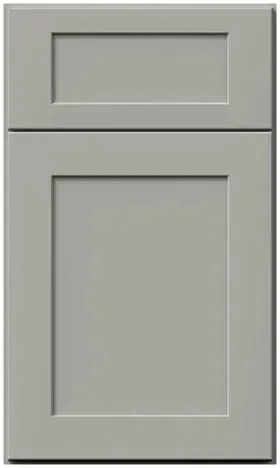
One finish note, because this is the only place it changes a decision. Two fronts a yard wide at hip height beside the cooking surface is the most-handled, most-splashed plane in the kitchen, and a mid-tone gray hides the grease film and the thumbprint beside a pull far better than a white front does. That is a maintenance argument, not a style one — the style case is on the gray shade guide.
Dividers: the bottom tier wants pegs, the top tier wants a tray

Fabuwood lists its inserts by the drawer width they fit, which is a useful label and an incomplete one. On this cabinet both tiers are deep, so the question is which tier each insert is worth its price in.
- Divided trays, sized to the box: GNK CD-21/24 at $273.00, GN CD-27/30 at $399.75 and GN CD-33/36 at $526.50. These occupy the top few inches of a tier, so they belong in the upper drawer where plates, lids and utensils live — not in the only deep tier you own.
- The wider inserts for the larger boxes: GNK DPS-18/27 at $256.75 and GNK DPS-30/33 at $302.25, both listed by drawer width on the accessories page.
- Tiered inserts on their own hardware, and the only two in the catalogue named for this exact cabinet: GNK DTD-DB30 BLUM at $884.00 and GNK DTD-DB36 BLUM at $932.75. They add a second sliding level inside a deep drawer. Note the arithmetic before you click — either one costs more than the cabinet difference between this configuration and a three-drawer bank, so if the goal is a third level, buy the third drawer.
- The narrow ones — GNK UT-15/24 at $227.50 and GNK DKI-18/24 at $214.50 — are built for the shallow top tier of a smaller bank and have no job here.
And the unglamorous truth: for pans and lids in the bottom tier, a set of spring-tension pegs from anywhere costs a fraction of any of the above and does the same work. The factory inserts earn their price in the top tier, where cutlery and small tools need compartments that hold their shape.
One per kitchen, and how to order it
Almost every plan we draw has exactly one of these, at the cooking surface, and spends the rest of the drawer budget on three-tier banks where the sorting happens. If a second one is going in, it belongs at the baking counter with bowls and the mixer bowl in the deep tier, not beside the first.
The rest of the run comes off the base cabinet lineup or the full collection. A door sample is $25.00 and should be judged at drawer height under the kitchen’s own bulbs, because a mid-tone gray moves with light more than a white does. Send the cooktop model with the order and the free 3D design service will draw the elevation before anything ships.
Common questions
- What actually fits in a deep pot and pan drawer?
- A 5 to 7 quart Dutch oven with the lid on, three or four skillets stacked flat, sheet pans on edge in the 30″ and 36″, nested mixing bowls, and two or three stacks of dinner plates. A 12 quart stockpot with its lid does not — that stays behind a door. Clear height is about ten inches by our tape.
- Can you store dinner plates in a drawer instead of an upper cabinet?
- Yes, and it is the best use of the top tier. Plate-to-drawer from the dishwasher is one turn and no lift, you see the whole stack from above, and nobody needs a stool. Two stacks fit the 30″, three the 36″. Add pegs so the piles do not walk forward when the drawer is closed hard.
- Does a cooktop stop the top drawer from opening?
- It can. A drop-in cooktop hangs three to seven inches below the counter and takes that height out of the cabinet below. With two deep tiers the bite comes out of a fifteen-inch drawer, which usually still works; with three tiers it lands on the shallow six-inch one and turns it into a fixed false front. Send the cut sheet.
- How much weight can a Fabuwood kitchen drawer hold?
- Fabuwood publishes no per-drawer rating and we will not quote one. What is specified is what matters: a ⅝″ dovetailed solid-wood box on Blum Tandem plus Blumotion full-extension undermount runners, which carry the load from beneath. Load heavy items low and toward the centre of the width.
- How much is a 36 inch deep drawer base in this gray shaker?
- $1,017.25 as GN DB36-2 at displayed prices on the review date. The 30″ is GN DB30-2 at $835.25 and the 24″ is GN DB24-2 at $724.75. At 30″ and 36″ that is slightly less than the three-drawer bank of the same width, so the extra depth costs nothing.
- Which drawer insert fits a 30 inch deep drawer?
- GN CD-27/30 at $399.75 is the divided tray listed for that width, and GNK DPS-30/33 at $302.25 is the wider insert. Both sit in the top few inches, so put them in the upper tier. GNK DTD-DB30 BLUM at $884.00 adds a second sliding level inside the deep one — worth checking against the price of a three-drawer bank first.
Keep reading
The guides behind the numbers on this page.
- Types of Base Cabinets: Sizes & Standard Dimensions
Where the deep pair sits among every other base configuration.
- What Dovetail Drawers Tell You About Cabinet Quality
The joint that takes the shear every time a loaded drawer is yanked open.
- Soft-Close vs Self-Closing Cabinet Drawers
Why damping matters more on a drawer carrying forty pounds than on one carrying cutlery.
- Space-Saving Cabinet Solutions That Actually Work
Pegs, racks and dividers for the tier the factory tray does not suit.
- Important Kitchen Dimensions to Know Before Buying Cabinets
Counter height, reach height and why the plate argument is an ergonomic one.
- Gray Kitchen Cabinets: Finding the Right Shade
Where this mid-tone sits among the grays, and how it behaves under different bulbs.
- Fabuwood Cabinet Sizes and Specs: The Complete Dimension Guide
The 34½″ by 24″ grid every number on this page comes off.


