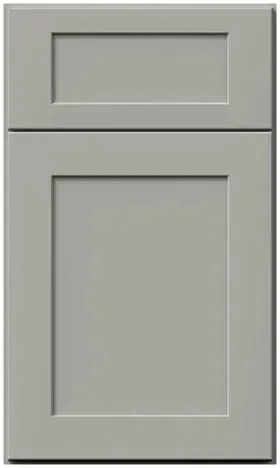


Farm sink cabinets in Galaxy Nickel: the one box you cannot change your mind about
Reviewed September 2026 · Captivating Cabinets
Every other cabinet in a kitchen can be swapped for a different width the week before delivery. This one cannot, because three separate decisions get chained to it and each one locks the next. The sink is chosen first and its exact apron dimensions decide the cabinet; the cabinet decides where the counter is cut; the counter is templated around the sink that is physically on site. Three widths exist in this finish — GN FS30 at $806.00, GN FS33 at $815.75 and GN FS36 at $825.50 — and the width is the least consequential thing on the page.
Sink first, cabinet second, fabricator third — and the order never runs backwards
A standard base hides its top front rail under the stone. An apron box has that rail cut away so the sink’s face sits in the opening and shows, and the bowl rests on a support built into the cabinet instead of hanging from the countertop. That single change is what fixes the sequence, because the opening was cut at the factory to a fixed size and the sink either fits it or does not.
- Choose the actual sink — the model, not the style. Get the spec drawing: outside width, apron height, apron thickness and filled weight. Nothing else on this page can be decided without those four numbers.
- Choose the cabinet against that drawing. Roughly three inches over the sink’s outside width, which puts a 30″ apron sink in GN FS33 and a 33″ in GN FS36. Send us the drawing and we check the opening height and the support before the order is released.
- Get the sink delivered to the job before the cabinets are set. The installer lands it on the support; the fabricator then templates the stone around the bowl that is actually there.
Two numbers govern this cabinet and neither appears on the listing. One is the height of the factory-cut opening, which settles whether a tall apron goes in at all. The other is what the internal support is rated to carry, which settles whether a heavy bowl is safe sitting on it. We can get both with the manufacturer before anything ships, and on an apron order we do it as a matter of course. Our notes for remodelers cover sequencing a fixture that has to arrive ahead of the cabinets.
What is still changeable at each stage, and what has already locked
The reason this reads as a commitment rather than a preference is below. Each row costs more than the one above it, and the last row is not a revision at all:
| Stage | Still free to change | Already locked | Cost of changing your mind |
|---|---|---|---|
| Before the sink is bought | Everything: apron or drop-in, width, bowl material | Nothing | None. This is the only free moment |
| Sink bought, cabinets not ordered | The cabinet width, the finish, the neighbours | The apron height and the outside width | A restocking fee on the sink, if the supplier takes it back |
| Cabinets ordered | The countertop material | The box, the opening and the run either side of it | A new cabinet at $806.00 to $825.50 and another week to three |
| Counter templated | Faucet and accessories | The stone is cut to that bowl | A new slab. This is the expensive row |
| Installed | Nothing that matters | Cabinet, counter and plumbing are one assembly | You are replacing the sink with the same model, or rebuilding the corner of the kitchen |
That last row is worth reading twice, because it is also the answer to the question we are asked most about this cabinet: no, a standard sink base cannot be converted to take an apron sink later. The missing rail is structural and the support is built in. If an apron is a maybe, it is a yes or a no at the order stage — a sink base from $386.75 is the alternative, and it is a different cabinet, not a downgrade.
Weight is the question the listing does not answer for you

An undermount stainless bowl weighs what a saucepan weighs and hangs off the stone. A fireclay or cast-iron apron sink does not: empty it is heavy, and full of water and dishes it is a static load sitting on a timber support all day, every day, for as long as the kitchen lasts. The box is ½″ select solid wood with dowel-and-glue and pocket-screw joinery and a veneered interior, which is a sound structure — but the question is not whether the cabinet is well made, it is what number the support was rated to.
The listing does not carry that rating, so we ask the manufacturer for it and match it against the filled weight on your sink’s drawing before releasing an apron order. For a stainless or a light composite apron the question is academic. For fireclay, cast iron or a thick natural stone bowl it is not, and it is the sort of thing that is trivial to confirm in advance and impossible to fix afterwards. If your installer wants to add blocking to the floor under the support as well, let them; nothing about doing so voids anything.
You lose storage under it, and the bin is usually what has to move
This is the part nobody mentions in the photographs. An apron bowl is typically deeper than a drop-in and it sits lower in the cabinet, because the apron itself occupies the height where a standard box has its top rail and its false drawer front. The clear space under the bowl is therefore shorter than it is under a standard sink of the same width — the bay is not gone, but the tall things stop fitting.
In practice that means the pull-out bin. A full-height bin unit is the first casualty, and the honest fix is to give it its own cabinet on the far side of the dishwasher rather than fight for what is left under the bowl: GNK TC15 BLUM at $617.50 or GNK TC18 BLUM at $734.50 on the trash pull-out page. A water filter or a small reverse-osmosis tank usually still fits, but check its height against the drawing rather than assuming. And there is no tilt-out tray on this cabinet, because there is no false front to retrofit one into — the apron is what that panel became.
The trade in the other direction is real too. There is no front rail to lean over, so the reach to the bottom of the bowl is shorter and washing a roasting tin stops being a wrestling match. People who choose this cabinet rarely regret it; they simply did not know the bin was moving.
What the apron actually costs, line by line
The cabinet is the visible part of the price and the smaller part of the difference. Set against the equivalent standard box on our displayed figures at review:
| Line | Standard | Apron | Difference |
|---|---|---|---|
| 30″ box | GN SB30, $461.50 | GN FS30, $806.00 | +$344.50 |
| 33″ box | GN SB33, $468.00 | GN FS33, $815.75 | +$347.75 |
| 36″ box | GN SB36, $490.75 | GN FS36, $825.50 | +$334.75 |
| The sink itself | A drop-in or undermount bowl, bought anywhere | A specific apron model, bought first and delivered early | Ask your sink supplier — it is usually the bigger number of the two |
| Countertop | Templated to a cutout | Templated to the bowl on site, with the front edge worked to the apron | Ask the fabricator; some charge for the apron detail, some do not |
| The bin | Shares the sink bay | Usually a cabinet of its own | +$617.50 for GNK TC15 BLUM, if it has to move |
Roughly $340 of cabinet, then, and anywhere from a little to a lot of everything else. That is not an argument against it — it is an argument for pricing the whole chain before the sink is bought, because the cabinet line item is the one part of it you can read off a page. Our piece on what Fabuwood cabinets cost puts a single specialty box in the context of a whole-kitchen number.
If the apron does not survive the spreadsheet
Plenty of people arrive here set on the look and leave with a deep single-bowl undermount, which is a sink base from $386.75 in the same gray, with the false drawer front across the top and the bin still under the sink where it was. A corner bowl is the diagonal sink base at $617.50, or the diagonal sink front at $149.50 for a corner built on site — and no apron version of either exists, in this line or in the corner generally. The rest of the kitchen is in the collection; if the apron is still a maybe, a free 3D layout will show you both plans before the sink is bought, which is the only stage at which changing your mind is free.
Common questions
- Can you add a farmhouse sink to a standard sink base later?
- No. The apron box has its top front rail cut away and an internal support built in to carry the bowl; a standard sink base has neither, and neither can be added on site without rebuilding the cabinet. Decide it at the order stage — after that it is a new cabinet at $806.00 to $825.50 and another week to three of lead time.
- What size farm sink cabinet do I need for a 30 inch apron sink?
- GN FS33 at $815.75. Allow about three inches over the sink’s outside width for the stiles and the support, and confirm it against the maker’s drawing rather than the marketed size — two brands’ 30-inch sinks can differ by an inch on the outside, and that inch is the whole allowance.
- Do farmhouse sinks need extra support?
- The cabinet is built with an internal support to carry one, which is what you are paying the premium for. What the listing does not publish is the load it is rated to, so for fireclay, cast iron or stone we confirm that figure with the manufacturer against the filled weight on your sink drawing before the order is released. For stainless or light composite it is not a concern.
- Do you lose storage with a farmhouse sink?
- Some, and it is height rather than width. An apron bowl sits lower in the box than a drop-in, so the clear space beneath it is shorter and a full-height pull-out bin usually will not fit. The common fix is to move the bin to its own cabinet. There is also no false drawer front, so no tilt-out tray.
- How much more does a farmhouse sink cabinet cost than a regular one?
- About $335 to $350 for the box itself — GN FS36 at $825.50 against GN SB36 at $490.75, for example. The sink is bought separately and is usually the larger of the two numbers, and some fabricators charge for working the countertop edge to the apron. Price the chain, not the cabinet line.
- Which comes first, the sink or the countertop?
- The sink, by a long way. It is chosen before the cabinet, delivered to the job before the cabinets are set, and the stone is templated around the bowl physically sitting in the opening. A counter templated from a drawing and a sink that arrives later is the most expensive mistake available on this page.
Keep reading
The guides behind the numbers on this page.
- Cabinets for Remodelers
Sequencing a fixture that has to be on site before the cabinets are.
- Fabuwood Cabinet Sizes and Specs
The catalog tables behind the 30″, 33″ and 36″ apron widths.
- How Much Do Fabuwood Cabinets Cost?
What one specialty box does to a whole-kitchen figure.
- Types of Base Cabinets: Sizes and Standard Dimensions
Where the apron box sits among the rest of the run.
- Kitchen Cabinet Materials and Construction
The ½″ box and the joinery carrying a filled fireclay bowl.
- Gray Kitchen Cabinets: Finding the Right Shade
The finish the apron is cut into, and what it pairs with.
- Kitchen Island Clearance Guide
Room for a dishwasher door beside a sink you lean into.
- Free 3D Kitchen Design: How It Works
Seeing the apron drawn in the run before the sink is bought.


