

Galaxy Nickel sink base cabinets: measure the bowl, then the plumbing, then order the width
Reviewed September 2026 · Captivating Cabinets
There is an order to this cabinet and almost nobody follows it. The bowl gets measured last, the plumbing never gets measured at all, and the width is picked off the elevation because it looked about right. Run it the other way round and the whole page becomes simple: the sink sets a minimum, the plumbing sets a second minimum, and the wider of the two is the box you buy. Eight widths, 21″ to 42″, $386.75 to $572.00 — ten listings once the two single-front versions are counted — all of them 34½″ high and 24″ deep in the line’s mid-tone gray.
The number on the sink carton is not the number you measure

A sink advertised as a 33″ is not 33″ across. That figure is the bowl or the nominal size the maker markets it under; the dimension the cabinet cares about is the outside width of the whole unit, rim to rim, including the flange on a drop-in and the mounting deck on an undermount. Take a tape to the actual sink, or to the maker’s spec drawing, and write down the outside width before you look at a single cabinet listing.
Then add three inches. That allowance is not padding — it is the two face frame stiles plus the room the clips, brackets or mounting rails need on either side, and it is why a sink sold as 33″ needs a 36″ box rather than the matching number. Undermount bowls are the ones that catch people out: the brackets sit outboard of the bowl and land on the cabinet sides if the fit is tight, so at the bottom of a size band go up one width. The countertop cutout is a fourth dimension again, taken from the sink template and never from the cabinet.
| Measurement | Where you take it | What it decides |
|---|---|---|
| Sink outside width, rim to rim | Across the actual unit, or off the maker’s drawing | The minimum cabinet width: outside width plus three inches |
| Sink outside depth, front to back | Same drawing | Whether a deep bowl fouls the back of a 24″ box or the drain stub |
| Drain centre height off the finished floor | The stub-out in the wall, before any cabinet is set | Whether the trap clears the cabinet deck or rests on it |
| Supply stop positions, left and right | Same wall, same day | Whether a stop ends up behind a side panel and forces a notch on site |
Those last two are the ones that get skipped, and they are the ones that turn install day into carpentry. Everything in this line arrives pre-assembled with the Blum hinges already hung, so there is no build stage in which to move a panel — the back gets hole-sawed to suit whatever the plumber left, or the plumbing gets moved. Our kitchen dimensions checklist has the rest of the numbers worth writing on the plan first.
Eight widths, priced, and what each one is honestly for
Both minimums in hand, the ladder below settles the rest. Displayed prices at review, with the collection discount already applied:
| Width | SKU | Price | What it is for |
|---|---|---|---|
| 21″ | GN SB21 | $386.75 | Bar or prep bowl. Not a main kitchen sink |
| 24″ | GN SB24 | $403.00 | Laundry or a small island prep bowl |
| 27″ | GN SB27 | $442.00 | A 24″ bowl, no disposal, in a tight galley |
| 30″ | GN SB30 | $461.50 | The builder default: a 25″ bowl and a trap |
| 33″ | GN SB33 | $468.00 | That bowl plus a disposal, or a 30″ bowl on its own |
| 36″ | GN SB36 | $490.75 | A 33″ single bowl — the most common order we ship |
| 39″ | GN SB39 | $526.50 | A 36″ bowl, or a double with a filter tank beside it |
| 42″ | GN SB42 | $572.00 | Double bowl, disposal and a pull-out bin in one bay |
Two of those widths come a second way. GN SB33SDF and GN SB36SDF carry a single continuous false drawer front rather than a split pair, at exactly the same $468.00 and $490.75 — a look, not a feature, covered below. Stuck between two widths? The step up costs between $6.50 and $45.50 here and we have never had it returned. Bathrooms are a different footprint altogether; the vanity range is shallower and lower.
The panel that does not open, and the one thing that can go behind it
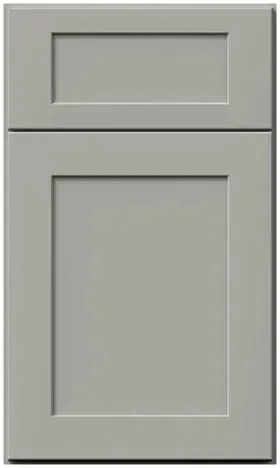
Across the top of every box on this page runs a drawer front that is not a drawer. Behind it sit the underside of the bowl, the rim clips and the tailpiece, which is why the bay below is left clear and why there is no shelf: the trap has to be able to drop wherever the sink puts it. The panel is the same five-piece front the drawer bases use — ¾″ solid stiles and rails around a ⅜″ recessed centre panel — so the shadow line running along the counter carries straight across the sink without a break.
Whether that panel is one piece or two is decided by its neighbour, not by taste. A three-drawer base has one wide top drawer, so the single-panel SDF version beside it keeps the line reading as one band; a pair of door bases with split fronts wants the split version. Read it off the elevation before ordering, because the two cost the same and only one of them looks deliberate.
The dead space is not entirely dead. A tilt-out tray retrofits into the false front and turns it into a sponge and scrubber holder — GNK TILTOUT 11″, 14″ and 24″, all $162.50 on the tilt-out tray page. It is the cheapest useful thing you can do to this cabinet, and from the room nothing changes. What else can share the bay around a trap is in our guide to pull-out and beam-mounted organizers.
The floor and the back panel are the parts that fail, and they fail differently

The box is ½″ select solid wood with a natural veneer interior, the warranty is a limited lifetime one, and neither fact is a defence against water. What matters is that the two surfaces at risk are at risk from different directions, and the habits that catch them are different too.
The deck fails from above. A weeping compression fitting, a tired disposal gasket or a slow drip off the tailpiece lands on the cabinet floor, sits there, and works into the veneer; by the time it shows as a dark ring the edge is already soft. The back panel fails from behind — a supply stop that seeps at the wall, or a dishwasher hose fitting on the far side of a side panel, wets the panel where nobody ever looks because the bin is in front of it. Both are silent, and both are the reason this cabinet is replaced more often than any other box in the kitchen.
- Put a moulded tray or a pale waterproof mat on the deck before anything else goes in. On a light liner a single drop is visible; on a wood-veneer floor under a bin it is not.
- Stand a battery leak alarm at the back of the bay, behind the bin rather than in front of it. They cost less than a filler strip and they are louder than anyone expects.
- Look at the back wall of the cabinet, not the floor, every time you change the bag. That is roughly weekly, which is early enough to make it a plumbing bill instead of a cabinet order.
- Keep drain cleaner and bleach in a caddy. A leaking bottle does the same damage as a leaking trap and gets blamed on the trap.
- The Blum hinges here are Quick-Release. Have the plumber lift the doors off rather than work around them — thirty seconds, and no tool marks on the paint.
One honest word about this finish at this position. A mid-tone gray forgives fingerprints and scuffs far better than a white door does, which is most of the reason people choose it — but dried water spots and drip marks show more on gray than they do on white, and the door in front of the sink is where the kitchen’s water actually lands. It is the one real disadvantage of the colour at this cabinet. A wipe with a damp cloth and a dry follow-up takes it off, and the care guide has the routine; the gray shade guide covers where this depth of gray sits among the rest.
If it does go wrong, the repair is one box and not a run: GN SB36 at $490.75 ordered like any other line and delivered in seven days to three weeks, in a catalog paint that still matches the cabinets either side of it years later. Our piece on how long cabinets last ranks the components that go first, and this box leads that ranking for exactly the reasons above.
What the dishwasher and the disposal do to the boxes either side
This cabinet is never ordered alone, and the two things plumbed into it reach sideways into its neighbours. The dishwasher takes one flank; its drain hose and supply cross through that side panel, so the side has to be decided before the order goes in, not on install day. The disposal hangs under the bowl on the same side as the dishwasher so the hose run stays short — which means that half of the bay is spoken for, and anything you wanted to keep under the sink has to live on the other half or move out entirely.
| Neighbour | What it needs | What goes wrong without it |
|---|---|---|
| Dishwasher | A 24″ opening, and not hard against a wall or a corner — allow a filler so the door and the racks clear | The door opens into the wall; the bottom rack will not slide out past the casing |
| Disposal | Its own side of the bay, plus a switched outlet in the cabinet rather than behind it | A bin that no longer fits, and an extension cord under a wet cabinet |
| Pull-out bin | The flank away from the disposal, or a cabinet of its own | Nothing fits under the sink once the trap and the disposal are in |
| A run that ends beside the dishwasher | A finished panel so the appliance flank does not end the kitchen | The last thing you see on that wall is an appliance side |
Two catalog parts settle most of that. GN DWR6, the 6″ dishwasher panel, is $201.50 on the decorative accessories page — ask us which panel your model takes. A bin that has been pushed out of the sink bay gets its own box: GNK TC15 BLUM at $617.50 or GNK TC18 BLUM at $734.50 on the trash pull-out page. Both belong on the same order as the sink base, because a $26.00 filler missing on template day stops a countertop as effectively as a missing cabinet.
When this is the wrong listing
All of the above assumes an ordinary bowl — drop-in or undermount — sitting in a counter along a straight wall, which is how most kitchens are built. An apron-front sink is a different box — the farm sink cabinet, $806.00 to $825.50 — because the apron replaces the very panel this page spends a section on. A bowl set across a corner at forty-five degrees is the diagonal sink base at $617.50, and the cheaper diagonal sink front at $149.50 next to it is a face with nothing behind it, for a corner an installer builds. The rest of the run lives under base cabinets, the whole kitchen in the collection, and a free 3D layout will tell you which of the four your plumbing actually wants.
Common questions
- What size sink base cabinet do I need for a 33 inch sink?
- A 36″ box — GN SB36 at $490.75. The working rule is three inches over the sink’s outside width, rim to rim, to clear the face frame stiles and the mounting hardware. Measure the actual unit rather than trusting the size on the carton, because two makers’ 33-inch sinks can differ by an inch outside.
- Do you measure the sink or the cabinet first?
- The sink, always. The bowl sets a minimum width and the plumbing sets a second one — the drain height and the supply stops have to land inside the footprint — and the wider of those two minimums is the cabinet you order. Sizing from the gap left over on the wall is how a 30″ box ends up with a disposal, a filter and nowhere for the bin.
- Which side should the garbage disposal go on?
- The dishwasher side, so the drain hose has the shortest run. That decides the layout of the whole bay: the disposal and the dishwasher tie-in occupy one half, and the bin, the tray or the filter has to take the other half or move into its own cabinet.
- How do you stop water damage under a kitchen sink?
- A moulded tray or a pale mat on the cabinet floor so a drop is visible, a battery leak alarm at the back of the bay, and a look at the back panel every time the bin bag changes. The deck fails from a dripping trap above it and the back panel fails from a seeping stop behind it, and both run for months behind a closed door before anything shows.
- Do gray cabinets show water spots?
- More than white does, yes — dried spots and drip marks are the one thing a mid-tone gray hides less well than a white door, and the sink front is where they land. In exchange it forgives fingerprints, splashes and scuffs far better. A damp cloth and a dry wipe clears them; it is worth knowing before you choose the finish, not after.
- How much clearance does a dishwasher need beside a sink base?
- A 24″ opening, and it should not sit hard against a wall or an inside corner — allow a filler so the door swings clear and the bottom rack pulls past the casing. Decide which flank it takes before ordering, because the drain and supply cross through that side panel of the sink base.
- How much is a Fabuwood Galaxy Nickel sink base, and does it arrive assembled?
- From $386.75 for the 21″ up to $572.00 for the 42″, with the 30″ at $461.50, the 33″ at $468.00 and the 36″ at $490.75. Every width ships built, hinges hung, on the ½″ solid wood box with Blum soft-close hardware, in seven days to three weeks.
Keep reading
The guides behind the numbers on this page.
- Gray Kitchen Cabinets: Finding the Right Shade
Where this depth of gray sits, and what it forgives that a white door does not.
- Important Kitchen Dimensions Before Buying Cabinets
The rest of the numbers to take before a single width is ordered.
- Types of Base Cabinets: Sizes and Standard Dimensions
The sink box among the other cabinets sharing its run.
- How Long Do Kitchen Cabinets Last?
Why the deck under a trap ages before anything else in the room.
- How to Clean and Care for Kitchen Cabinets
The wipe-down that takes water spots off a painted door.
- Beam-Mounted and Pull-Out Cabinet Accessories
What can share a bay with a trap and a disposal.
- Pre-Assembled Kitchen Cabinets: A Buying Guide
Why there is no build stage in which to move a back panel.
- How to Read Cabinet SKU Codes
SB, SDF and the width digits, decoded.


