

The centre stile tax: what a wide double door base will and will not swallow
Reviewed September 2026 · Captivating Cabinets
Somewhere in every plan there is a stretch of counter with nothing under it — no sink, no cooktop, no appliance — and the cheapest way to fill it is a wide box with two doors and a drawer or two across the top. These run 24 to 48 inches. They are also the boxes most often bought on the strength of the number in the name, by someone who has measured the thing they mean to put inside and assumed the two figures meet. They do not quite, and this page is about the gap between them.
A 36-inch box is not a 36-inch opening

This is framed construction. The face frame takes a bite out of both sides of the front, and on a two-door cabinet a further vertical member runs floor to counter between the doors. Open both doors on a 36″ box and you are not looking at a 36-inch hole, or even at one hole: you are looking at two apertures of roughly sixteen inches with a piece of frame standing between them.
That is what decides the load, and it decides it on objects rather than on accessories. A 26-inch roasting pan does not slide into a 36-inch box face on; it goes in tipped on its side, angled through one aperture, or not at all. A sheet-pan rack built to sit across the width has to be assembled inside the cabinet rather than carried in. Anything rigid and wide meets the stile first; anything soft, stacked or nested does not care.
Fabuwood does not publish the clear opening or the stile width per SKU, and we will not guess them in print. Name the widest thing you want in there and we check it against the spec sheet for that exact cabinet before anything is ordered — a five-minute email, and the difference between a wide box that works and the place the platters do not live.
What a wide Galaxy Nickel base is actually for

The argument for two doors is vertical. A drawer bank slices the same cubic feet into three or four tiers six to nine inches tall, and everything you own has to be shorter than a tier. Take the drawers out and you get one cavity a little under two feet high behind the doors of a plain B, at the full 24 inches of depth. Height and depth are the product; width is only how much of it you get.
So what belongs here is tall, bulky, awkwardly shaped or bought in quantity. Stock pots and Dutch ovens with their lids on. The stand mixer parked assembled. Nested bowls, colanders, a salad spinner. The roasting pan and the big platters, on edge. Bulk paper towels standing up, a case of water, the slow cooker between Sundays. None of that goes in a drawer bank unless the drawer is deeper than the item is tall, and at that point you are paying drawer money for door work.
What does not belong here is anything you reach for daily, because a door box makes you crouch, open and reach past a front row to get at a back row. That is the case for putting the cooking positions on drawer banks and this box on the wall you use twice a week — and, where a wide box has to carry daily items anyway, for the trays below.
Eight widths, and the drawer tier across the top
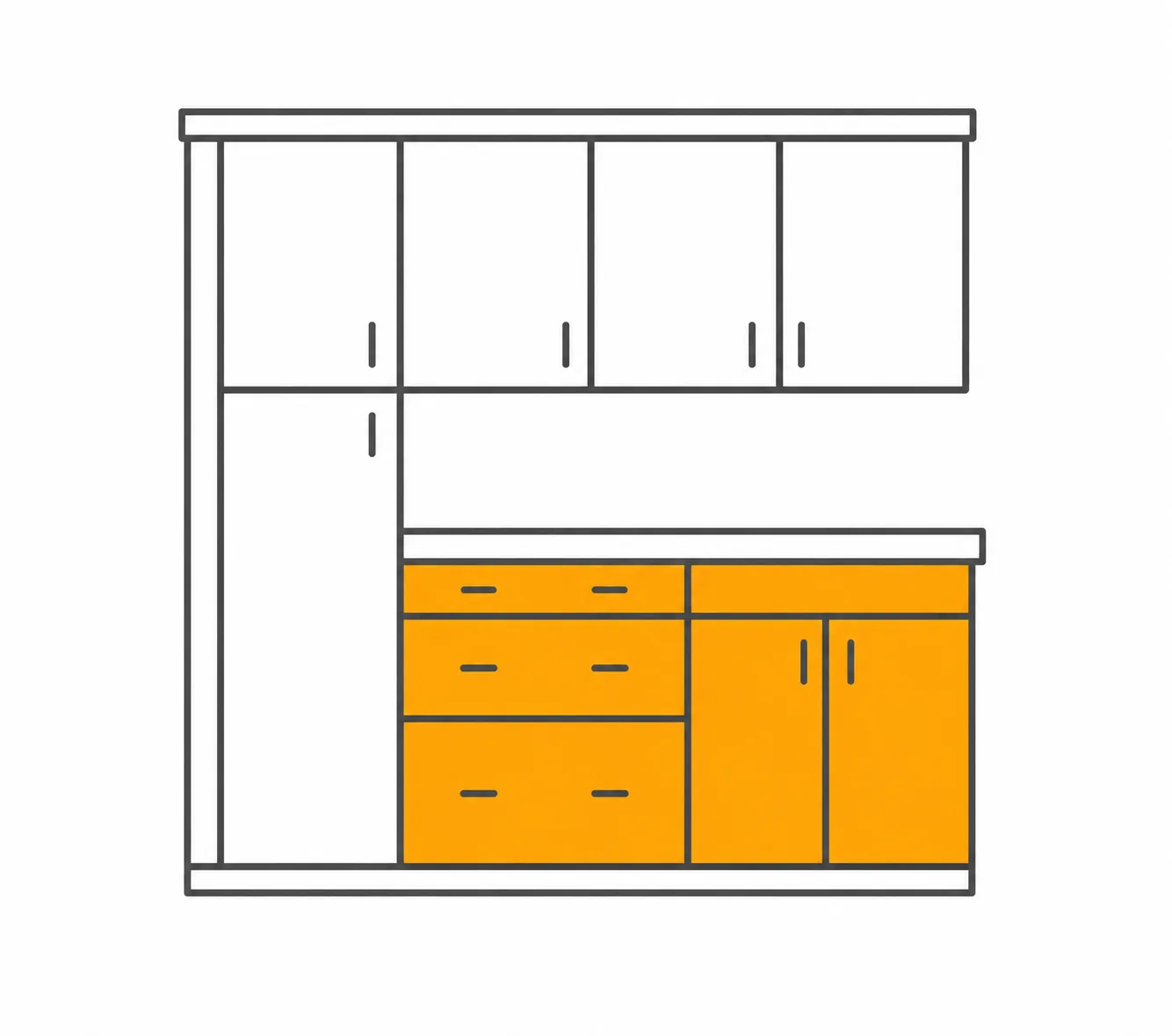
Every one of these is 34½″ high and 24″ deep, a pair of full-overlay doors under a drawer tier, each drawer a ⅝″ solid-wood dovetail box on Blum Tandem plus Blumotion runners. At 33 and 36 inches the catalog also offers the same cabinet with a single drawer front across the whole tier — the SDF suffix — at exactly the same money, which makes it a decision about how the line of fronts reads rather than about budget.
| Width | Box · price | Drawer fronts | Note |
|---|---|---|---|
| 24″ | GN B24 · $471.25 | Two | The narrowest two-door box; our filters currently file it with the drawer banks |
| 27″ | GN B27 · $516.75 | Two | Two apertures of about eleven inches each |
| 30″ | GN B30 · $555.75 | Two | Also the usual box under a 30″ drop-in cooktop |
| 33″ | GN B33 or GN B33SDF · $633.75 | Two, or one | Same price either way |
| 36″ | GN B36 or GN B36SDF · $676.00 | Two, or one | Same price either way |
| 39″ | GN B39 · $718.25 | Two | The last width that also exists without a drawer tier |
| 42″ | GN B42 · $757.25 | Two | Drawer tier is not optional at this width |
| 48″ | GN B48 · $815.75 | Two | Widest in the line; each door close to two feet across |
Cost per inch falls as the boxes widen — a 48″ works out around $17 an inch against $19.64 for the 24″ — but usefulness does not rise with it in a straight line. Past 39 inches the catalog’s roll-out trays run out entirely. For a long blank wall, two 24-inch boxes at $942.50 give you four apertures and two trays that exist; one 48 at $815.75 gives you two apertures and none. The saving is real and so is what it costs. Prices are our displayed figures on the review date.
Roll-out trays, and the 36-inch ceiling on them
The back eight inches of an eighteen-inch shelf is where things go to be forgotten. A roll-out tray fixes that without buying a drawer bank: it mounts on the floor of the cabinet, runs out on Blum hardware, and turns the bottom of a door box into something you can see into standing up.
| Box | Standard-height tray | High-sided tray | Box + one standard tray |
|---|---|---|---|
| GN B24 · $471.25 | GNK ROD-B24 BLUM E · $214.50 | GNK ROD-B24 BLUM H · $263.25 | $685.75 |
| GN B27 · $516.75 | GNK ROD-B27 BLUM E · $217.75 | GNK ROD-B27 BLUM H · $266.50 | $734.50 |
| GN B30 · $555.75 | GNK ROD-B30 BLUM E · $227.50 | GNK ROD-B30 BLUM H · $279.50 | $783.25 |
| GN B33 · $633.75 | GNK ROD-B33 BLUM E · $230.75 | GNK ROD-B33 BLUM H · $282.75 | $864.50 |
| GN B36 · $676.00 | GNK ROD-B36 BLUM E · $240.50 | GNK ROD-B36 BLUM H · $286.00 | $916.50 |
Two things the table is telling you. The E and H suffixes are side height: the standard tray has a low lip and suits pans and appliance bodies you lift out over the edge, while the high-sided one runs about fifty dollars more and keeps boxes and bottles upright as the tray moves. And the list stops at 36 inches, so a GN B39, B42 or B48 gets no roll-out from this catalog at all — the strongest practical argument on this page for splitting a long run into two boxes. The trays are on the roll-out page, each sized to what will pass the frame of one specific cabinet, so they are ordered against the cabinet SKU rather than a width you measure at home.
Three-quarter-inch shelf, eighteen inches deep, and where the weight goes
The shelf is ¾″ thick, adjustable on pins, and 18 inches deep in a 24-inch cabinet. That last number surprises people: roughly six inches of the box sits behind the front edge of the shelf as open height — useful, because a tall item stands there with its top above shelf level, and awkward, because anything you slide onto the shelf can slide off the back of it.
Load it accordingly. Cast iron and the stock pots belong on the cabinet floor or on a tray; the shelf is for light bulk. Across 36 or 48 inches a ¾″ shelf carrying a row of Dutch ovens will take a set over the years, and no adjustment pin fixes a shelf that has bowed. How many shelves a given width ships with is not on the listing — ask, and we read it off the current spec sheet.
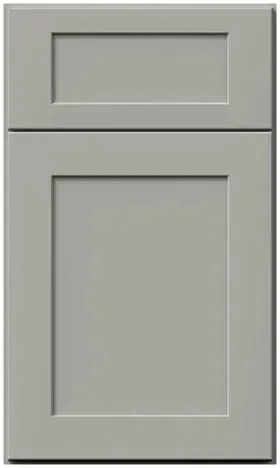
A word on the doors, since they take the abuse down here. Base doors meet the mop, the vacuum head and the toe of a shoe more than any other cabinet in a kitchen, and a mid-tone gray carries those marks better than a white one. The other half of the trade is dust and dried water spots, which sit more visibly on it under a dark counter — so it rewards a wipe and rarely needs a touch-up pen. The cabinet care guide has the routine.
Where a wide box is the wrong tool
A wide box under a sink is a sink base, not this. A wide box where you actually cook should be a three-drawer bank, however much more it costs per inch. Under 24 inches you are on the single door page; the same widths with no drawer tier across the front are the full-height two-door boxes, which stop at 39 inches. Trays, inserts and waste units are on the cabinet accessories page and the rest of the finish on the collection page. A plan with three wide boxes in it usually wants the free 3D design service first, because two of them are normally in the wrong place.
Common questions
- Does a 36 inch base cabinet give you a 36 inch opening?
- No. This is framed construction: the face frame takes a bite from each side and a vertical member runs between the two doors, so you get two apertures of roughly sixteen inches rather than one opening of thirty-six. Anything wide and rigid goes in angled or on its side.
- How much is a 36 inch double door base cabinet?
- GN B36 is $676.00 on our grid, as is GN B36SDF — the same box with one drawer front across the tier instead of two. That is an assembled 34½″ × 24″ cabinet with two full-overlay doors and dovetailed soft-close drawers above. The 30″ is $555.75 and the 48″ $815.75.
- What can I store in a base cabinet that will not fit in a drawer bank?
- Anything taller than a drawer tier: stock pots and Dutch ovens with the lids on, a stand mixer parked assembled, nested bowls, the roasting pan and platters on edge, bulk paper towels standing up. A door box gives close to two feet of uninterrupted height at full depth; a drawer bank gives three or four tiers of six to nine inches.
- Do roll-out trays fit a 42 or 48 inch base cabinet?
- Not from this catalog. The trays stop at 36 inches — GNK ROD-B36 BLUM E at $240.50 is the widest — so a GN B39, B42 or B48 has no listed roll-out. If trays matter to you on a long wall, build it from two narrower boxes instead of one wide one.
- How deep are the shelves in a base cabinet?
- Eighteen inches, in a box that is twenty-four deep, and ¾″ thick on adjustable pins. The six inches behind the shelf edge are useful open height for tall items. Keep the heavy pieces on the cabinet floor or on a roll-out rather than on a long span of shelf.
- Is one wide base cabinet cheaper than two narrow ones?
- Usually. GN B36 at $676.00 against two GN B18 at $409.50 each — $819.00 — saves $143.00. What the saving costs you is one shelf instead of two, one aperture per door instead of a clean opening, and, above 36 inches, the ability to add a roll-out tray at all.
Keep reading
The guides behind the numbers on this page.
- Types of Base Cabinets: Sizes and Standard Dimensions
The wide door box against drawer banks, sink bases and corners.
- Space-Saving Cabinet Solutions
Trays, frames and organisers for a deep cupboard you have to reach into.
- Kitchen Cabinet Terminology: Parts and Abbreviations
Stile, rail, face frame, clear opening — the words the spec sheet uses.
- Beam-Mounted Pull-Out Cabinet Accessories
Why weight in a two-door box belongs on the floor, not on a door.
- What Dovetail Drawers Tell You About Cabinet Quality
The drawer boxes behind the tier across the top of these cabinets.
- Gray Kitchen Cabinets: Finding the Right Shade
What a mid-tone gray does with the marks a base run collects.
- Fabuwood Cabinets Review
Construction, hardware and where the line sits on value.


