

Forty-five degrees and nothing that spins: the corner for a house that moves
Reviewed September 2026 · Captivating Cabinets
The angled corner is the compromise answer, and compromise is not an insult here. GN ERB33 at $838.50 and GN ERB36 at $848.25 hang one door across a 45° face with fixed L-shaped shelves behind it: the whole square footprint is open when the door swings, and there is not one part inside that turns, tilts, glides or wears. It sits between the blind box and the rotating one on price, but the reason to buy it is almost never the price. It is that some corners should not have a mechanism in them, and some houses should not either.
Who the angled corner is actually for
The buyer who does not want a moving part in the kitchen
A cabinet is a twenty-year purchase and the mechanism inside one is not. That is a perfectly rational thing to feel, and this box is the answer to it: two hinges, two shelves, a face frame and a door. The hinges are Blum Compact Clip — 110°, six-way adjustable, Quick-Release — and they are the only serviceable part in the box, which is exactly the point. Nothing else can go out of adjustment because nothing else moves.
The buyer whose corner is not square
Old houses are rarely square at an inside corner and almost never level across one. A fixed-shelf box does not care: it is shimmed plumb, scribed to the wall, and the shelves inside sit where they are screwed. A rotating corner cares a great deal, because a turntable runs to a fixed circle and any pinch in that circle shows up as a rub at the same point on every revolution. Check the corner before you choose, not after.
The buyer who stores flat, tall and awkward
Sheet pans on edge, a stand mixer with its head up, a 16-quart pot, the tray that holds the roasting tin. None of those ride a round shelf. All of them sit happily on a flat L that runs into the corner. If that list is what the corner is for, the mechanism was never the decision.
What a corner has to be before a turntable is worth buying

This is the part the product pages never say out loud: the angled box and the rotating box have the same footprint here — 33″ or 36″ along both walls — so choosing between them is not a size decision at all. It is a decision about the corner you are putting them into.
| Corner condition | How to check it | Fixed-shelf box | Rotating box |
|---|---|---|---|
| Walls out of square at the inside corner | A framing square in the corner, before anything is set | Forgiving — the shelves are fixed to the carcass and the carcass is shimmed plumb | The trays run a fixed circle; a tight spot becomes a rub in the same place every time |
| Floor falling away from the corner | A four-foot level across the corner in both directions | Shim it and move on | Shim it properly, or the tray settles toward the low side |
| One tall, heavy thing to store | Stand the stockpot up and measure it, lid on | Leave a shelf out and the full height is yours | Tray spacing is what the factory fitted |
| Sheet pans, racks and boards | Count them, then measure the longest | On edge along one leg, which is the best use of this box | Nothing long and flat rides a round tray |
| Daily pans, and nowhere else to put them | Open your current corner and look | The back of the L is a long lean, twice a day, for years | This is the case the mechanism is for — pay for it |
The last row is the honest one. If the corner is the cabinet the household opens most, the rotating box is worth its premium — $191.75 more at 33″ and $247.00 more at 36″, on a footprint that is identical. Buying the angled box purely to save that money, in a kitchen where the corner is the daily cupboard, is the version of this decision people regret.
A diagonal cabinet changes the countertop template

This is the consequence nobody mentions until the fabricator is standing in the kitchen. Over an ordinary run the countertop is a strip roughly 25½″ deep. Over this box it has to reach 33″ or 36″ back along both legs and then cut across at 45°, which makes the corner a large triangle of stone rather than a right angle. Four things follow from that, and all four cost money if they are discovered late.
- The corner piece is big. On a slab that was going to yield cleanly, a deep triangular corner is often the piece that forces a seam, and the seam has to be placed where it will not sit under the point of the diagonal.
- The diagonal front edge is a finished edge. It has to carry the same profile as the rest of the run, and it is priced by the linear foot like any other edge.
- The two 135° corners where the diagonal meets the straight runs are the fragile points of the whole top. Ask for a small eased radius at both rather than a knife point.
- The stone juts into the room at the diagonal. Measure the aisle from the diagonal edge, not from the wall run, or the walkway you drew is not the walkway you get.
And the sequence: template after the box is set, never off the drawing. A corner cabinet is shimmed to a level line and scribed to two walls, so where it finishes is a site measurement. The kitchen dimensions guide has the run depths and overhangs those four points are working from.
One door, and where it goes when it opens
The door on the 45° face swings out into the room rather than along the wall, which is a different arc from every other base door in the kitchen. Three practical consequences. Choose a knob over a bar pull on this one door: its two neighbours open toward it, and a long pull on any of the three is the piece that collides. Fit restrictor clips if the neighbours are close — GNK BLUM-COMPACT RES CLIP 10PK is $11.70 under loose parts — so the door stops before it finds a handle rather than after. And check the arc against whatever is across the aisle, because a dishwasher door and this door reach into the same square foot of floor.
The door width across the diagonal is not printed on the listing. If you are ordering a specific pull, or planning a run of matching hardware, ask us for the dimension first. And one small thing the mid-tone gray earns here: this is the widest single base door in the run and the one people push shut with a palm while carrying something, and a gray at this depth does not keep a record of that the way a white door would.
GN ERB33 or GN ERB36, and the carcass-only versions
A square box with the front corner cut off. The 33 takes 33″ along each wall from the inside corner, the 36 takes 36″, both stand 34½″ high, and whatever comes next on each leg starts where that footprint ends. They are $9.75 apart. Take the 36 whenever both legs can spare the extra three inches, because those inches appear as a wider door and a longer shelf on each leg — the $9.75 is the cheapest width in the catalogue. Two practical notes the product page will not raise: the carton is close to a 36″ cube and has to pass every doorway between the truck and the corner, and the box arrives assembled, which is a two-person lift.
Both sizes are also listed as carcass-only parts under loose parts — ERB33-BO at $539.50 and ERB36-BO at $546.00 — for a job that will fit its own door. Confirm what ships in that version before ordering it; on a corner the room looks straight at, the factory-finished door is most of what you are buying.
What arrives on the truck
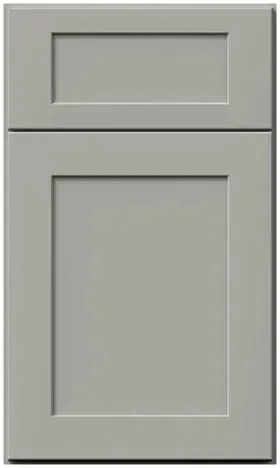
A five-piece shaker door — ¾″ solid wood stiles and rails 2½″ wide around a ⅜″ recessed MDF panel, mortise-and-tenon — on a ½″ select solid wood carcass with a natural wood-veneer interior and ¾″ adjustable shelves. Blum Compact Clip hinges with Blumotion soft-close, fitted. KCMA certified, AWI Premium Grade, covered by Fabuwood’s limited lifetime warranty, pre-assembled, and out of the door in 7 days to 3 weeks — Galaxy ships faster than the rest of the Allure line. The whole finish is on the Galaxy Nickel collection page, and the ordinary base cabinets that run out from this corner are the next thing to size.
Common questions
- What is an easy reach corner cabinet?
- A square corner box with the front corner cut off at 45°, carrying one door and fixed L-shaped shelves. Opening the door exposes the whole footprint at once, and there is no rotating or sliding hardware inside it.
- Easy reach or lazy Susan — which should I buy?
- They share a footprint, so it is a mechanism decision. Take the fixed-shelf box when the corner holds bulk, when the walls or floor are out of true, or when you would rather not own a moving part. Take the turntable when the corner is the cupboard the household opens every day.
- Does a diagonal corner cabinet need a different countertop?
- Yes. The stone has to reach 33″ or 36″ back on both legs and cut across at 45°, which makes a large triangular corner piece, adds a finished diagonal edge and creates two fragile 135° points. Tell the fabricator before the slab is cut, and template after the cabinet is set.
- Will an out-of-square corner cause problems?
- Not for this box — it is shimmed plumb and scribed, and its shelves are fixed to the carcass. A rotating corner is the one that suffers, because its trays run a fixed circle and any pinch becomes a rub at the same point on every turn.
- What are the dimensions of a 36 inch easy reach cabinet?
- 36″ along each wall from the inside corner and 34½″ high, with one door on the 45° face. The 33″ version is the same box three inches shorter on each leg, and the two are $9.75 apart.
- Knob or pull on the angled door?
- A knob. The diagonal door opens into the room while the doors either side of it open toward the corner, so a long bar pull on any of the three is the part that collides. Restrictor clips are $11.70 for ten if the neighbours are tight.
Keep reading
The guides behind the numbers on this page.
- Important Kitchen Dimensions Before Buying Cabinets
Run depths, overhangs and the aisle the diagonal edge eats into.
- Why Blum Soft-Close Hinges Are Worth the Investment
The only serviceable part in a fixed-shelf corner.
- Fabuwood Cabinet Sizes and Specs
Catalogue dimensions for both square corner boxes.
- Space-Saving Cabinet Solutions
Getting a deep fixed shelf to behave without a mechanism.
- Kitchen Cabinet Samples: How to Order and Evaluate
The door the room looks at square-on is the one to test.
- Pre-Assembled Kitchen Cabinets Buying Guide
Why a 36″ corner cube has to be measured against your doorways.
- Kitchen Layouts Guide
Which plans can spare 33″ on both legs and which cannot.


