

Where the run turns: covering the joint two finished panels leave at a corner
Reviewed September 2026 · Captivating Cabinets
A cabinet run does not always stop at a wall. It turns the end of an island, wraps a peninsula, comes forward around a tall cabinet, or returns into a hood surround — and everywhere it turns, two finished surfaces meet at ninety degrees and leave a line. Corner moulding is the part that covers that line. It is a small, cheap, unglamorous item that appears on perhaps one order in four, and the reason it is worth a page of its own is that the people who need it usually do not know they need it until the panels are already on the job.
Four places a corner actually turns up

Start by ruling one thing out, because it is where half the confusion comes from. The inside angle of an L-shaped run — where two banks of cabinets meet in a corner — is not a corner-moulding problem. That is resolved by a corner cabinet, a blind cabinet or a filler, and it is a layout decision made long before trim. The corners on this page are the ones where a visible finished surface changes direction.
- The end of an island, where a finished end panel meets the finished back panel. The most common of the four by a wide margin, and the one at seated eye level.
- A peninsula, same joint, but on two corners instead of one and usually with a counter overhang above it.
- A tall cabinet that projects forward of the run, where its 24-inch-deep side meets the face of the 12-inch-deep cabinets beside it.
- A hood surround or a built-out chimney, where the cladding turns at both front corners — often the only place in a kitchen with two outside corners within four feet.
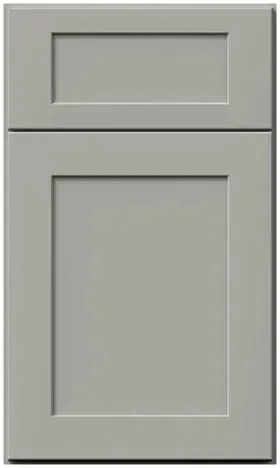
An outside corner is where the two best-lit faces of a run meet, and on a mid-tone finish the two planes take light quite differently from each other — one catches the window, one falls into shade. A seam at exactly that line is more legible here than the same seam in white, where both faces read as near-white regardless of angle. That is the one reason the colour changes this decision at all, and it argues for covering an island corner rather than trusting the joint.
Inside against outside, and what the third part is for
Three parts are stocked and the naming is literal. GN ICM8 at $59.80 is inside corner moulding, for a re-entrant angle — the joint sits in the crook, and the moulding fills the internal angle between two surfaces. GN OCM8 at $62.40 is the outside version, sitting over a projecting corner like a cap over the edge. Both come as eight-foot lengths, which the 8 in the code tells you.
The third part, GN OCM8-1 1/4″ at $78.00, is the same outside profile in a larger section. That extra quarter of material buys coverage: where a corner is made of thicker panels, or where the two surfaces are not perfectly flush and the seam is wider than a thin moulding will bridge, the bigger profile covers it. It is $15.60 more than the standard one and it is worth having on an island where the panels have been handled and the corner is not immaculate.
| Part | Code | Price per 8 ft | The joint it covers |
|---|---|---|---|
| Inside corner molding | GN ICM8 | $59.80 | A re-entrant angle — two surfaces meeting in a crook |
| Outside corner molding | GN OCM8 | $62.40 | A projecting corner, standard panel thickness |
| Outside corner molding 1-1/4″ | GN OCM8-1 1/4″ | $78.00 | A projecting corner with a wider or imperfect seam |
For context on where these sit against the other joint-closing parts: a scribe meets an irregular wall, a quarter round bridges a gap at the floor, a filler closes a constant space, and corner moulding covers a manufactured joint between two finished pieces. Four different problems, four different parts, and they are substituted for one another on site more often than any of us would like.
Why a butt joint between two good panels still shows
The panels are finished on their faces to a high standard, and they are cut square. So why does the corner not simply disappear? Three reasons, all of them mundane.
First, the corner is never a perfect arris. Two pieces of half-inch or three-quarter-inch material meeting at ninety degrees leave an edge, and the finish on that edge is thinner than on the flat by the nature of how finish is applied. In raking light — which is exactly what an island corner gets from a window — that edge reads as a line.
Second, the joint moves. A house takes on moisture in summer and loses it in winter, and the two panels move independently. A joint that is closed on installation day in June can show a hairline in February. That is normal timber behaviour rather than a defect, and covering the joint is how it is dealt with.
Third, and most practically: corners get hit. An island end is at hip height in a walkway and takes trolleys, chairs, bags and people. A moulding over it is a sacrificial part that costs $62.40 to replace, which the panel underneath is not — an argument that has nothing to do with appearance and is frequently the better one.
One eight-foot stick covers more corners than you think
The arithmetic here is unusually friendly, because corners are vertical and vertical dimensions in a kitchen are short. An eight-foot stick is ninety-six inches. A base cabinet corner is about thirty-four and a half inches tall, so one stick yields two base corners with more than two feet left over. A tall cabinet corner at ninety-six inches uses a whole stick exactly and leaves nothing, which is worth knowing before somebody plans to get a second corner out of it.
| Corner | Height | Per 8 ft stick | Left over |
|---|---|---|---|
| Base cabinet / island end | ~34.5″ | Two corners | ~27″ |
| Island with a raised bar | ~42″ | Two corners | ~12″ |
| Hood surround front corners | varies, 24″–36″ | Two to three corners | varies |
| Tall cabinet, 84″ | 84″ | One corner | 12″ |
| Tall cabinet, 96″ | 96″ | One corner | none — order per corner |
Two practical notes on top of the table. Cut every corner from a single length rather than joining — a butt joint in a vertical corner moulding is more visible than the seam it was covering. And where an island has a raised bar top, the corner is taller than the cabinet, so measure the finished height of the panel rather than the height of the box. The island clearance guide has the dimensions those two configurations actually come out at.
When a moulding is the wrong answer
A corner that wants presence rather than covering is a post job, not a trim job. GN CP36 corner post is $312.00, and it turns the corner of an island into a furniture element — a column of material with its own profile — rather than a covered joint. That is five times the price of the moulding and it is a different intention entirely. The pilaster and post page is where those live.
A corner nobody can see does not need covering. The back corner of a peninsula against a wall, or the corner of a tall cabinet in a pantry alcove, can be left as a butt joint without consequence. Mark the corners on the plan that are actually in a sightline and order for those.
And a corner where the two surfaces are not the same finish is a different problem. On a two-tone plan where an island in a second colour meets a perimeter run, the corner trim has to belong to one of them, and covering the joint draws attention to the change rather than hiding it. In that situation a clean butt joint, or a post in one of the two colours, is the sounder answer — the Fabuwood colour range shows what the second run is usually paired with.
Common questions
- What is outside corner molding for?
- Covering the joint where two finished surfaces meet at a projecting ninety-degree corner — the end of an island, a peninsula, a tall cabinet standing forward of the run, or a hood surround. GN OCM8 is $62.40 for eight feet.
- What is the difference between inside and outside corner molding?
- Inside corner moulding, GN ICM8 at $59.80, fills a re-entrant angle where two surfaces meet in a crook. Outside corner moulding, GN OCM8 at $62.40, caps a projecting corner. The 1-1/4″ version at $78.00 is the outside profile in a larger section for a wider or less-than-perfect seam.
- Do I need corner molding for an L-shaped kitchen?
- Not for the inside angle of the L — that is resolved by a corner cabinet, a blind cabinet or a filler, and it is a layout decision. Corner moulding is for outside corners where a finished surface changes direction, most often at an island end.
- Why does the joint between two panels show if both are finished?
- Because the arris between two pieces of half-inch or three-quarter-inch material always reads as a line in raking light, the finish is thinner on an edge than on a flat, and the two panels move independently with the seasons. A joint closed in June can show a hairline in February.
- How many corners does one stick of corner molding cover?
- An eight-foot stick is ninety-six inches: two base or island corners at about 34.5 inches with over two feet spare, or one 96-inch tall cabinet corner exactly. Cut each corner from a single length — a butt joint in a vertical moulding is more visible than the seam it was covering.
- Should I use a corner post instead?
- If the corner is meant to read as a furniture element rather than a covered joint, yes. GN CP36 corner post is $312.00 against $62.40 for the moulding — a different intention and a different budget. On a two-tone plan a clean butt joint or a post often beats trim, which draws attention to the colour change.
Keep reading
The guides behind the numbers on this page.
- Cabinet End Panels, Scribe Molding and Fillers Explained
The four joint-closing parts and which problem each one solves.
- Kitchen Cabinet Molding Types
The whole trim vocabulary in one place, with what each profile is for.
- Kitchen Island Clearance Guide
Island and bar heights — the dimension a vertical corner is cut to.
- Kitchen Layouts Guide
Which layouts generate outside corners, and how many.
- Kitchen Cabinet Materials and Construction
Panel thickness and seasonal movement, which is why the joint opens.
- Fabuwood Cabinet Colors
On a two-tone plan, which run a corner detail should belong to.
- Gray Kitchen Cabinets: Finding the Right Shade
Why two planes of a mid-tone read differently to each other in raking light.


