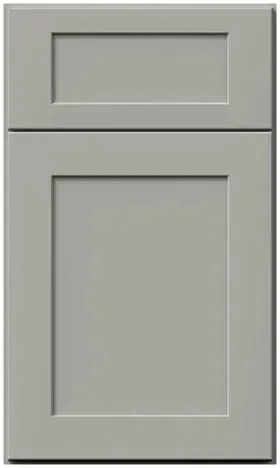


Four kinds of vertical: picking between a Galaxy Nickel pilaster, a post and a column
Reviewed September 2026 · Captivating Cabinets
Four different parts on this catalogue do something that sounds identical on paper: they put a finished vertical element on a run of cabinets. They are not interchangeable, they are not close in price, and choosing by picture is how people end up with a $594.75 post doing a job a $84.50 filler was already doing. This page sorts them out first, then argues the one that needs arguing — the fluted pilaster, which is a traditional detail being applied to a contemporary shaker programme, and which is either the best forty minutes of trim in the kitchen or a costume.
Four parts, one job description, and no overlap worth relying on

A pilaster is a flat-backed vertical applied to the face or the end of a cabinet. It is, historically, half a column stuck to a wall, and that is exactly what it is here: it sits against something and it reads from the front and one side only. A square post has four faces and stands at a corner where the room can walk round it. A corner post is the special case of a post that covers the outside corner where two finished faces meet. A column is the full-height version, tall enough to run from floor to crown.
| The part | Where it goes | SKUs | Displayed price |
|---|---|---|---|
| Wall pilaster | Applied to the face or end of an upper run | GN PP-W30 to PP-W42 | $201.50 – $243.75 |
| Base pilaster | Applied at base height, usually an island or run end | GN PP-BASE | $227.50 |
| Tall pantry pilaster | Applied to the side of a pantry or oven stack | GN PP-TP84 to PP-TP96 | $455.00 – $464.75 |
| A square post | A free corner — island end, peninsula end | GN SP3X3, GN SP36, GN SQP36 | $344.50 – $594.75 |
| A corner post | The outside corner where two finished faces meet | GN CP36 | $312.00 |
| A column | Full height — flanking a range wall, ending a tall run | GN CLM-3012 to GN CLM-96 | $217.75 – $624.00 |
One naming trap sits inside that table. GN SQP36, at $594.75, is titled a square pilaster post — it is the priciest single vertical in the group and it is filed with the pilasters rather than with the posts. If you are comparing on a spreadsheet, compare it against GN SP36 at $425.75 and ask what the extra $169.00 is buying before you assume it is the better part.
The pilaster ladder, height by height
Pilasters are sold to match the cabinet they are being applied to, which means the height is the specification and there is no cutting down. Nine heights cover the three runs.
| SKU | Height | The run it matches | Price |
|---|---|---|---|
| GN PP-W30 | 30″ | A 30-inch upper run | $201.50 |
| GN PP-W36 | 36″ | A 36-inch upper run | $221.00 |
| GN PP-W39 | 39″ | A 39-inch upper run | $224.25 |
| GN PP-W42 | 42″ | A 42-inch upper run to the ceiling | $243.75 |
| GN PP-BASE | Base height | A base run or island end | $227.50 |
| GN PP-TP84 | 84″ | An 84-inch pantry or oven stack | $455.00 |
| GN PP-TP90 | 90″ | A 90-inch tall run | $464.75 |
| GN PP-TP93 | 93″ | A 93-inch tall run | $455.00 |
| GN PP-TP96 | 96″ | A 96-inch tall run | $464.75 |
The tall four contain a genuine oddity and we would rather flag it than have you notice it and assume the whole page is careless: the 90-inch pilaster is $9.75 dearer than the 93-inch one. Eighty-four and ninety-three are both $455.00; ninety and ninety-six are both $464.75. There is presumably a manufacturing reason and it does not change what you order — you order the one that matches your run — but it does mean a quote is not wrong just because the taller line is cheaper.
Two things the list does not publish: the width of the pilaster face and how far it projects. Both matter, because a pilaster applied to the face of a 12-inch-deep upper adds its own projection to the run, and at the end of a walkway that is the difference between trim and an obstacle. Ask for both before you commit to a pair.
Where a fluted vertical reads intended on a shaker programme
Shaker is a quiet, rectilinear, flat-panel door. Fluting is a classical detail with a completely different ancestry, and dropping one onto the other is a real decision rather than an accessory choice. It works — genuinely well — but only when the rest of the kitchen has already committed to the same vocabulary.
The test we use is a count. Look at the plan and tick off the traditional moves already on it: a stacked or heavy crown profile rather than a flat one, a furniture-look island with feet or a decorative end panel, a valance across the sink window, a panelled hood surround, a beaded or reeded end. Three or more of those and a pair of pilasters is the fourth member of a family that already exists — it will read as though the kitchen was designed that way, because it was. One or none, and the pilaster is the only ornamental thing in the room, which is precisely how a part ends up looking stuck on.
The other reliable position is the one where the pilaster has a structural excuse. Flanking a tall run, a pilaster on each side turns a 24-inch-deep slab of cabinetry into something with edges, which is the same instinct that produced door casings. Flanking a range wall it frames the hood. In both cases the vertical is explaining a junction that exists anyway, and that is when applied trim stops looking applied. Where the door programme sits on the traditional-to-contemporary spectrum is set out in contemporary versus transitional and in the Fabuwood door styles.
Where it reads applied-on, and the case for skipping it entirely
We would talk most people out of these in three situations, and we would rather do it here than after the delivery.
- A flat-crown, slab-pull, minimal-trim kitchen. If the rest of the specification is working to take ornament out, a fluted vertical is the one thing going the other way, and it reads as a leftover from a different quote rather than as a happy contrast.
- A ceiling-height run in an eight-foot room. A 42-inch upper to the ceiling already has a strong vertical stop at both ends, and a pilaster there competes with the line rather than making one.
- Any position where an overlay filler is already doing the job. A 3-inch by 36-inch overlay filler, GN OLF336, is $84.50 and gives you a faced vertical standing proud of the door line — a deliberate break with a shadow either side of it. The 36-inch wall pilaster is $221.00 and gives you the same break with a profile on it. If what you wanted was the vertical line rather than the ornament, you have already bought it for $136.50 less.
- A single one, anywhere. See the next section — this is the common one.
None of that is an argument against the part. It is an argument against buying it as a finishing touch. Pilasters are a design decision made at the same time as the crown profile and the hood surround, not a line added at the end because the quote looked plain.
Which pairs are worth buying, priced
Since they come in twos, price them in twos. A pair of 36-inch wall pilasters flanking a sink window or a hood is $442.00. A pair of base pilasters at an island end is $455.00. A pair of 96-inch tall pilasters framing a pantry run is $929.50 — which is real money, and the point at which it is worth asking whether a full column at $624.00 each is the piece you actually wanted, since it does the same thing with more presence and terminates properly at the floor.
The practical rule for placement: put them where two different things meet, not in the middle of something continuous. The end of a run against open wall, the junction of a tall stack and an upper run, either side of a hood, either side of a window opening. Applied trim in the middle of an otherwise uninterrupted run of doors has nothing to explain and therefore nothing to justify it.
One note on this finish and only one. A pilaster stands proud of the door face and throws a shadow down its own edge, and on a mid-tone that shadow is a darker version of a colour already mid-toned — so the profile reads softer here than the same part does on white. If the ornament is the reason you are buying, look at it on a sample before ordering two of anything. Door and finish samples are on the samples page.
Getting a vertical onto the order
These are loose finished parts. They arrive not attached to anything, and the installer cuts, scribes and fixes them on site — which means the back face gets worked and the visible faces must not. Nothing here is drilled, handed or bored, so there is no left and right to get wrong; what there is instead is a height that has to match the run exactly, because there is no trimming a profiled vertical down a size.
So walk the plan, mark every junction where a vertical would be explaining something, count in pairs, and decide the ornament question once for the whole kitchen rather than cabinet by cabinet. The full trim list, including the fillers and mouldings that are often the better answer, is on the decorative accessories page, the loose finished parts are under loose parts, and the whole finish sits on the collection page. Trade buyers order through Captivating Pro.
Common questions
- What is a cabinet pilaster?
- A flat-backed decorative vertical applied to the face or end of a cabinet — historically half a column stuck to a wall, and functionally the same thing here. It is applied trim, it is not structural, and it arrives as a loose finished part for the installer to cut and fix. Heights run 30 to 42 inches for upper runs at $201.50 to $243.75, base height at $227.50, and 84 to 96 inches for tall runs at $455.00 to $464.75.
- What is the difference between a pilaster, a post and a column?
- A pilaster is flat-backed and sits against something, so it reads from one side. A post has four faces and stands at a corner the room can walk round. A corner post is a post shaped to cover an outside corner where two finished faces meet. A column is the full-height version, sized to run from the floor to the crown.
- Does a fluted pilaster suit a shaker kitchen?
- It can, but only when the kitchen has already made other traditional moves — a stacked crown, a furniture-look island, a valance, a panelled hood surround. Three or more of those and the pilaster joins a family. On a flat-crown, slab-pull kitchen it is the only ornamental object in the room and it looks stuck on.
- Is there a cheaper way to get a vertical line at the end of a run?
- Yes. A 3-inch by 36-inch overlay filler, GN OLF336, is $84.50 and stands proud of the door line, so you get the deliberate vertical break with a shadow either side of it. The 36-inch wall pilaster is $221.00 for the same break with a profile on it. If the line was the point rather than the ornament, buy the filler.
- Do I need pilasters on both sides?
- Practically always. Applied verticals work by symmetry — they flank a range, a window, a tall run or an island, and the eye reads the pair. A single one with nothing answering it is the most common way this part is wasted. Budget them in twos: a pair of 36-inch wall pilasters is $442.00, a pair of 96-inch tall ones $929.50.
- Why is the 90-inch pilaster dearer than the 93-inch one?
- It is, and we have flagged it rather than smoothed it over: GN PP-TP90 and PP-TP96 are $464.75, while PP-TP84 and PP-TP93 are $455.00. It does not change what you order — the height has to match your run — but a quote showing the taller part costing less is not necessarily an error.
Keep reading
The guides behind the numbers on this page.
- Kitchen Cabinet Molding Types
The rest of the applied-trim family a pilaster has to belong to.
- Cabinet End Panels, Scribe Molding and Fillers Explained
The overlay filler that often does the same job for less.
- Contemporary vs Transitional Kitchen Cabinets
Which vocabulary your kitchen is already speaking.
- Shaker vs Slab Cabinets
What a shaker door is doing, and what ornament does to it.
- Fabuwood Door Styles
The door programme these verticals get applied to.
- Cabinet Terminology: Parts and Abbreviations
What PP, SP, CP and CLM mean on a quote.
- 27 Kitchen Cabinet Ideas
Rooms with applied verticals that work, and rooms without any.
- Free 3D Kitchen Design
Send the wall and the shelf line, the blocking and the posts come back drawn.


