

Ninety-six inches of applied trim: where a decorative column earns its price
Reviewed September 2026 · Captivating Cabinets
A column is the largest, most expensive and least functional thing on the decorative list, and it is the only one capable of changing what the room is rather than how it is trimmed. A pair of full-height columns either side of a range wall turns a line of cabinets into an architectural composition. The same pair bought for the wrong wall is $1,248.00 of timber standing in a kitchen explaining nothing. This page is about telling the two apart before the order goes in.
Seven parts, and they split into two families
The list looks like a single range and is not. Four of these are sized to the wall-cabinet grid — 30, 36, 39 and 42 inches, all with a 12-inch figure in the title — and they are the parts that flank an upper run or a hood surround. One is full height at 96 inches. One is a base, which is the plinth a full-height piece lands on. And one is a custom oversized part, which is the answer when the ceiling does not agree with any of the above.
| SKU | Size | Price | What it is for |
|---|---|---|---|
| GN CLM-3012 | 30″ × 12″ | $217.75 | Flanking a 30-inch upper run or a hood surround |
| GN CLM-3612 | 36″ × 12″ | $240.50 | The same, against a 36-inch run |
| GN CLM-3912 | 39″ × 12″ | $243.75 | The same, against a 39-inch run |
| GN CLM-4212 | 42″ × 12″ | $260.00 | The same, against a ceiling-height upper run |
| GN CLM-96 | 96″ | $624.00 | Full height — ending a tall run, framing a range wall |
| GN CLM-BASE | Base | $299.00 | The plinth a full-height column terminates on |
| GN CUSTOM CLM-OS | Oversized, custom | $1,088.75 | When the ceiling fits none of the above |
What the list does not publish is the projection and face width on the 96-inch piece, the base and the custom part. The four short ones carry a 12-inch figure; the rest carry nothing. That is a dimension you need before you can decide whether the thing will clear a hood surround or a door casing, so ask for it — and ask what the base is dimensioned to accept, since a plinth that does not match the column it is under is a visible mistake at ankle height.
The two jobs worth buying one for

The first is the range wall. A chimney hood between two uppers is already a symmetrical composition wanting to be framed — it has a centre, a vertical axis, and it is the thing everybody looks at on the way in. A full-height column each side of the surround takes that from cabinets-with-a-hood to a built feature with edges, and it is the one position where the expense does something the cheaper parts cannot.
The second is terminating a tall run. A pantry or oven stack that stops in the middle of a wall presents a 24-inch-deep slab, and its outside corner is the biggest raw edge in the kitchen. A column there gives the stack a side rather than an end, and because it is deeper than any pilaster it resolves the depth rather than decorating it. This is also the position where it competes hardest with cheaper parts, which is the subject two sections down.
What columns are not for: the middle of a run, an island, a galley wall, or an eight-foot ceiling with 42-inch uppers already running to it. In that last case there is no wall left for the column to be seen against, and a full-height vertical squeezed between a run and a ceiling reads as a stripe rather than as architecture.
The scale decision, which is really about what it lands on
A column reads well when it terminates at both ends and badly when it does not. At the top it wants to die into crown, a soffit or the ceiling itself. At the bottom it wants a plinth — which is what GN CLM-BASE at $299.00 exists for, and why a full-height column is really a $923.00 decision rather than a $624.00 one. One that stops on a toe kick, or short of the ceiling with a raw top edge showing, looks cut off, and no moulding afterwards fixes the proportion.
The proportion is worth a moment. Ninety-six inches by roughly a foot of face is about eight to one — slender, classical, and why the full-height piece looks right on a tall run. The short ones are nearer three to one, which is not a column proportion at all; it is a pier, and it reads as heavy applied trim. Not an argument against them, but it does mean they belong tight against something — a hood surround, a run of uppers — rather than standing where they will be read on their own.
Ceiling height decides which family you are in. Under nine feet, with uppers to the ceiling, the short parts against the hood surround are usually the right scale and the full-height one has nowhere to be. Nine feet and above, with a soffit gap or a tall run ending in open wall, the 96-inch piece is what the wall is asking for. If the ceiling is somewhere the list does not reach, GN CUSTOM CLM-OS at $1,088.75 is the honest answer and it is priced like one. Ceiling and run heights are in the wall and tall cabinet guide.
What a pair actually costs, next to the rest of the kitchen
Columns are bought in twos, so price them in twos and then put the number somewhere it can be judged.
| What you are buying | Parts | Total |
|---|---|---|
| A pair of full-height columns | Two × GN CLM-96 | $1,248.00 |
| The same, terminated properly at the floor | Two × GN CLM-96 + two × GN CLM-BASE | $1,846.00 |
| A pair of short columns at a hood surround | Two × GN CLM-3612 | $481.00 |
| A pair of tall pilasters instead | Two × GN PP-TP96 | $929.50 |
| A 30″ open shelf wall box — for comparison | GN WOS3036 | $672.75 |
The second row is the number to sit with. Eighteen hundred and forty-six dollars is more than half the price of the whole ten-by-ten package on this finish, which is $3,500.00 for seven wall cabinets, four bases, a dishwasher panel, two toe kicks and six finished ends. That is not an argument against columns — plenty of kitchens are worth architecture and this is how you buy it. It is an argument for deciding early, because a decorative line at that scale competes with real cabinets.
It also explains why the short parts exist. A pair of GN CLM-3612 flanking a hood surround is $481.00 and does a large share of the visual work, because the hood is at eye level and the top of a full-height column is not. If the range wall is the reason you want columns, start with the short pair and see whether the wall still wants more. What the rest of a kitchen costs is in how much Fabuwood cabinets cost.
Three cheaper parts that do most of the job
For the tall-run position specifically, there is a clean ladder, and most kitchens should stop before the top of it.
- To finish an exposed side and nothing more, a tall end skin at $169.00. It is not a vertical element; it is a finished face, which is all a great many tall runs actually needed.
- For a vertical line at the edge of the run, a 96-inch overlay filler, GN OLF396, at $230.75 — faced like a door, standing proud, with a shadow on each side. The cheapest way to make the end of a tall run read as deliberate.
- For an ornamented vertical, a 96-inch tall pantry pilaster at $464.75 — $159.25 less than the column, and being flat-backed it takes less floor. It reads from the front and one side, which on a run against a wall is all anyone sees.
Buy the column when the element has to be read from more than one side, or when it is framing something rather than ending something. That is the whole test. Ending a run is a finishing problem and the cheap parts solve it; framing a wall is a composition problem, and the column is the only part here that solves it.
A free-standing vertical in a mid-tone room
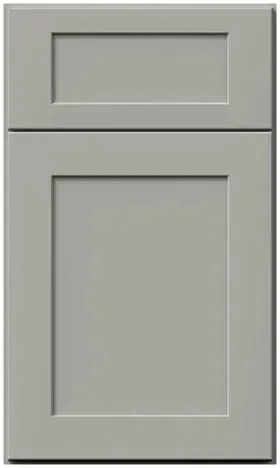
One colour note, and it is a real one rather than a restatement. Every other part in this group sits flat against a cabinet, so it is lit the way the cabinet is lit. A full-height column stands clear, which means it catches light on two or three faces at once — and the face turned toward a window will read appreciably lighter than the face turned away from it. On a white kitchen that spread is narrow. On a mid-tone it is wide enough that the same column can look like two different colours from opposite sides of the room.
That is not a defect — it is how the eye knows the thing is three-dimensional, and it is what gives a free-standing element its weight. But it does mean a column should be judged in the room rather than on a sample, ideally at the time of day the kitchen is most used. More on that in finding the right gray and the Fabuwood colour range.
Then the ordinary business. Confirm the projection and face width, confirm what the base accepts, order in pairs, and order with the cabinets — a full-height plane of colour is the least forgiving place in the kitchen for a batch difference. The rest of the trim is on the decorative accessories page, the tall boxes these frame are under tall cabinets, the upper runs under wall cabinets, and everything else on the collection page.
Common questions
- Where does a decorative column belong in a kitchen?
- Two positions earn it. Flanking a range wall, one each side of a chimney hood surround, where it turns a symmetrical composition into a built feature. And terminating a tall run that stops in open wall, where it gives a 24-inch-deep slab a side instead of an end. Not in the middle of a run, not on an island, and not on an eight-foot ceiling with uppers already running to it.
- How much does a pair of cabinet columns cost?
- Two 96-inch columns, GN CLM-96, are $1,248.00. Terminated properly with a plinth under each — GN CLM-BASE at $299.00 — the pair comes to $1,846.00. The short columns are far cheaper: a pair of GN CLM-3612 flanking a hood surround is $481.00 and does much of the visual work, because the hood is at eye level and the top of a full-height column is not.
- Do I need a column base?
- If the column is full height, effectively yes. A column reads well when it terminates at both ends — into crown or a ceiling above, onto a plinth below. One that stops on a toe kick looks cut off, and nothing added later fixes the proportion. Confirm what the base is dimensioned to accept, since a plinth that does not match the column above it shows at ankle height.
- Is there a cheaper alternative to a decorative column?
- Three, in ascending order. A tall end skin at $169.00 if you only need the exposed side finished. A 96-inch overlay filler, GN OLF396, at $230.75 for a faced vertical line. A 96-inch tall pantry pilaster at $464.75 for an ornamented vertical that reads from the front and one side. Buy the column only when the element has to be read from more than one side.
- What size column do I need for my ceiling?
- Under nine feet with uppers to the ceiling, the short parts at 30 to 42 inches are the right scale and the full-height one has nowhere to be. Nine feet and above, with a soffit gap or a tall run ending in open wall, the 96-inch piece is what the wall wants. If your ceiling fits neither, GN CUSTOM CLM-OS is $1,088.75.
- Why does a column look like two different shades?
- Because it stands clear of the cabinets and catches light on two or three faces at once, so the side facing a window reads lighter than the side turned away. On a white kitchen that spread is narrow; on a mid-tone it is wide enough to notice from across the room. Judge it in the room at the time of day the kitchen is actually used.
Keep reading
The guides behind the numbers on this page.
- Wall and Tall Kitchen Cabinet Sizes and Buying Guide
Ceiling heights, soffit gaps and where a full-height vertical fits.
- Kitchen Cabinet Molding Types
The crown a column has to die into at the top.
- Cabinet End Panels, Scribe Molding and Fillers Explained
The skin and the overlay filler that do most of the job for less.
- How Much Do Fabuwood Cabinets Cost
What $1,846.00 of trim is competing with on the same quote.
- Gray Kitchen Cabinets: Finding the Right Shade
Why a free-standing vertical reads two shades at once on a mid-tone.
- 27 Kitchen Cabinet Ideas
Range walls that are compositions, and range walls that are runs.
- Fabuwood Cabinet Sizes and Specs
The box heights a column is being scaled against.
- Free 3D Kitchen Design
Send the wall and the shelf line, the blocking and the posts come back drawn.


