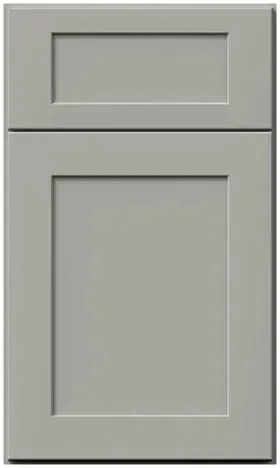


The wall is never straight: scribe molding, the technique, and why installers ask for it on day two
Reviewed September 2026 · Captivating Cabinets
The phone call comes on the second day of an installation, almost never on the first. Day one is boxes on the wall and everything going well. Day two is the finished end panel against the wall by the fridge, and the wall bows out three-eighths of an inch in the middle, and the gap it leaves runs from nothing at the floor to a visible line at chest height. Scribe moulding is what closes that gap, it costs $39.00 a length, and nobody orders enough of it because until the boxes are up nobody can see the problem.
What a normal wall actually does

Framing tolerances are generous, plaster and drywall add their own variation, and a stud that has taken on a bow is not a defect anybody will come back to fix. A wall that deviates three-eighths of an inch over eight feet is within what any builder would accept, and it is also enough to leave a gap you can see across a room.
Corners are worse than flats. An internal corner is almost never ninety degrees — it is usually eighty-eight or ninety-two, because the two walls were framed independently and finished with tape and compound that builds up in the angle. A cabinet pushed into that corner touches at one point and opens out from there.
And the room is not plumb either. A tall cabinet standing ninety-six inches high against a wall that leans a quarter of an inch will either be plumb and gapped at the top, or tight at the top and visibly leaning. The installer chooses plumb every time, which means the gap is a decision rather than an accident. None of it is visible on a drawing, which is exactly why the part gets left off the order.
How scribing is actually done
Worth knowing even if you are not doing it yourself, because it tells you what to ask of an installer and how long to allow.
- Set the piece in position, plumb, with its finished face where it will live and its edge standing off the wall at the widest point of the gap. It should not be touching anywhere yet.
- Open a pair of dividers — or a compass, or a scribing block — to exactly that widest gap. This setting is not changed again for the rest of the operation, and changing it is the commonest way the job goes wrong.
- Run the point along the wall from top to bottom with the pencil leg bearing on the trim. The line that appears on the trim is now a perfect record of the wall’s shape, offset by the divider setting.
- Cut to the line, back-cutting at about five degrees so only the front edge touches. A block plane is the traditional tool and a jigsaw with a fine blade is the fast one; either way, work from the face side so any tear-out lands at the back.
- Offer up, check, and take off the last shaving. A scribe that goes on perfectly at the first attempt was either lucky or not tight enough.
Allow fifteen to twenty-five minutes a piece for someone who does this regularly. It is the one operation in a cabinet installation that cannot be hurried and cannot be faked.
Simple or decorative, and why the cheaper one is usually right
Two versions are stocked, eleven per cent apart in price and considerably further apart in how they behave under a plane.
| Profile | Code | Price per 8 ft | Edge | Scribes |
|---|---|---|---|---|
| Scribe molding simple | GN SM8-S | $39.00 | Flat and square | Cleanly — a plane takes the full edge in one pass |
| Scribe molding decorative | GN SM8-D | $41.60 | Profiled | Awkwardly — the shaped edge fights the tool |
The technical point in that last column matters more than the $2.60. A flat edge can be planed to a line in a few strokes and the result is a clean, square edge that sits tight to the wall. A profiled edge has to be cut with a knife or a jigsaw and then cleaned up, and the profile is interrupted wherever the wall pushed the line in, which means the decorative detail wanders along its length. Use the decorative version where the gap is small and consistent and the profile is wanted for its own sake. Use the simple one wherever there is real scribing to do — which is most of the time.
Both are eight-foot lengths, as the 8 in each code says. For what the other joint-closing parts do, the end panels, scribe moulding and fillers guide sets out the whole family.
The five joints it goes on
- A finished end panel against a wall. The classic case, and the one at eye level — see the end panel list for the panels this is scribed to.
- A tall cabinet against a wall or into a corner. The longest vertical joint in the room and therefore the least forgiving of a taper.
- An upper run meeting a bowed wall at the end of the line, where the last cabinet’s stile stands off the plaster.
- Crown against a wavy ceiling, where the scribe is horizontal and the wave runs along the top edge of the moulding — the crown moulding page covers the sequencing that goes with it.
- A cabinet meeting a window casing or an architrave, where the existing joinery is the thing that is out rather than the wall.
A pattern in that list: four of the five are vertical joints at or above waist height. That is the reason scribe is the part worth spending time on and quarter round is not — one is at the floor and one is in your eyeline. The quarter round page argues the other side of the same decision.
The order-extra rule, and what caulk really costs
Here is the rule, and it is per elevation rather than per kitchen: order one length more than the takeoff says for every wall elevation that has a cabinet against it. Not ten per cent more — one whole stick more, per elevation. At $39.00 that is the cheapest insurance on the entire order, and it exists because scribing is destructive. A piece cut to the wrong line is scrap, and the second attempt needs fresh material.
The alternative, when the material runs out on day two, is caulk. Everybody reaches for it and it is sometimes the right answer: a hairline of a sixteenth of an inch, filled and painted, is invisible and is normal practice. A quarter-inch bead is not a joint, it is a confession, and it will crack within two seasons as the house moves.
And on a coloured finish there is a specific penalty. Caulk comes in white, off-white and a small range of approximations, and none of them is this grey. A painted white bead against a mid-tone panel is a permanent pale line at eye level, running the height of a tall cabinet, in exactly the spot the scribe was supposed to make disappear. It is the most visible false economy on a cabinet job, and it costs $39.00 to avoid.
Scribe, filler or nothing
Three outcomes are possible at any cabinet-to-wall joint and choosing the wrong one is what produces a bad-looking install.
If the gap is constant along its length — the cabinet run is simply narrower than the wall by an inch and a half — that is a filler, not a scribe. GN BF3 is $26.00 at base height and the filler page carries the rest. A filler is a flat piece that fills a known space, and trying to scribe one is wasted effort.
If the gap varies along its length, it is a scribe, every time. No flat piece will fit a tapering space, and pushing the cabinet harder against the wall only moves the problem to the other end of the run.
And if there is genuinely nothing — a run ending against a plumb, true wall with the panel flat on it — nothing is required. In an older house, assume otherwise.
Common questions
- What is scribe molding?
- A narrow strip in the cabinet finish that is cut to follow an irregular wall so the square cabinet beside it does not have to. GN SM8-S simple is $39.00 for eight feet and GN SM8-D decorative is $41.60.
- How do you scribe a cabinet to a wall?
- Set the piece plumb with its edge standing off the wall at the widest gap, open a pair of dividers to exactly that gap, run the point along the wall with the pencil leg on the trim, then cut to the resulting line with about five degrees of back-cut so only the front edge touches. Allow fifteen to twenty-five minutes a piece.
- What is the difference between scribe molding and a filler?
- A filler closes a constant gap — the run is simply narrower than the wall — and GN BF3 is $26.00. A scribe closes a gap that varies along its length, which no flat piece will ever fit. Measure the gap at both ends: if the two numbers differ, it is a scribe.
- Should I buy simple or decorative scribe molding?
- Simple, in almost every case. GN SM8-S at $39.00 has a flat edge that planes to a line cleanly. The profiled edge on GN SM8-D at $41.60 fights the tool and the detail wanders wherever the wall pushed the line in — keep it for small, consistent gaps where the profile is wanted for itself.
- How much scribe molding should I order?
- One whole length more than the takeoff says, for every wall elevation with a cabinet against it — not a percentage. Scribing is destructive: a piece cut to the wrong line is scrap and the second attempt needs fresh material.
- Can I just caulk the gap between the cabinet and the wall?
- A hairline of a sixteenth, filled and painted, is normal practice. A quarter-inch bead is not, and it will crack within two seasons. On a coloured finish it is worse still, because no caulk colour matches — a white bead down the side of a tall cabinet is a permanent pale line at eye level.
Keep reading
The guides behind the numbers on this page.
- Cabinet End Panels, Scribe Molding and Fillers Explained
The full family, and the constant-gap versus varying-gap test.
- Kitchen Cabinet Molding Types
The whole trim vocabulary in one place, with what each profile is for.
- Pre-Assembled Kitchen Cabinets Buying Guide
Why a factory-square box makes the wall’s shape the installer’s problem.
- Important Kitchen Dimensions Before Buying Cabinets
What to measure before the takeoff, including the corner angles.
- Free 3D Kitchen Design
The elevation count the order-extra rule is applied to.
- Kitchen Cabinet Materials and Construction
Seasonal movement, and why a caulked joint cracks and a scribed one does not.
- Cabinet Terminology: Parts and Abbreviations
Scribe, filler, arris and back-cut, defined.
- Gray Kitchen Cabinets: Finding the Right Shade
Why a white caulk line is so much more visible against a coloured panel.


