

Turning a box end into furniture: the five ends in a kitchen, and which ones deserve a panel
Reviewed September 2026 · Captivating Cabinets
There is exactly one decorative end panel in this finish: GN BEP, the base end panel, at $149.50. That is not a thin page, it is a clear one, because the real question was never which panel to buy. It is which ends in your kitchen are worth $149.50 and which ones are worth $62.40 — and the answer changes end by end, depending on whether a person sees the flat of the panel or only its edge. So this page is a walk round a kitchen with a verdict at every stop.
Panel or covering: the distinction that decides everything below

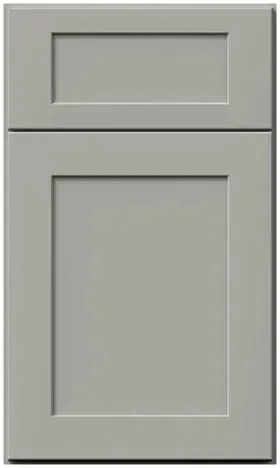
A panel carries a frame and a recessed field, built exactly the way the doors are built: ¾-inch solid stiles and rails two and a half inches wide around a ⅜-inch recessed centre. It stands proud of the carcass and throws the same shadow line the doors throw. A covering is a flat sheet fixed over the box side; it makes the end finished, and it stops there.
The test is not how visible the end is. It is which part of the end is visible. An end you only ever see edge-on — walking along the run, catching two feet of vertical line — needs to be finished and nothing more. An end whose flat face is presented to a room, at the distance and height people actually stand or sit at, is being read as a piece of furniture whether you spent money on it or not.
One catalogue fact to get out of the way, because it changes what is possible. In this finish the base end is the only height with a framed decorative panel of its own. Exposed wall and tall ends are served by coverings — GN SK W30 through SK W42 at $50.05, GN SK TALL at $169.00, GN SK T12D at $126.75 for a shallow tower, GN SK WD at $169.00 for a wall cabinet with drawers — or by sheet material cut to size. A shaker-faced end at upper or pantry height is therefore a made-to-order conversation rather than something you add to a basket, and it is worth having that conversation early rather than discovering it at quoting stage.
The five ends, and our call on each
| The end | What people actually see | Our call | Part and price |
|---|---|---|---|
| Island, seating side | The full flat face, from a seated eye height, for the length of a meal | Panel, every time | GN BEP — $149.50 |
| Peninsula return | The face from the room side, the edge from the kitchen side | Panel if the room side is a living space; covering if it faces a wall | GN BEP $149.50 or GN SK BASE $62.40 |
| Run people walk past | The face at walking distance, briefly, several times a day | Panel if the run ends in open floor; covering if it ends at a doorway | GN BEP $149.50 or GN SK BASE $62.40 |
| Run dying into a wall | A two-foot vertical edge, and only edge-on | Covering. There is nothing to look at | GN SK BASE — $62.40 |
| End beside a fridge or a tall run | A tall plane two feet deep, beside an appliance | Neither — this is a different part | See the fridge and skin pages |
Read down the third column and the pattern is clear enough to apply to an end this table does not list: a panel buys you a face, so pay for one wherever a face is presented to a room and not otherwise. Two of the five stops above are genuinely marginal, and on those the deciding factor tends to be the floor rather than the cabinet — an end that stops in open floor is read as furniture; an end that stops at a door frame or a wall return is read as joinery.
The exposed sides at fridge and tall height are covered properly elsewhere, because the parts and the reasoning are different: refrigerator end panels for the appliance bay, and cabinet skins for the price comparison on every other height.
The island end is the one worth arguing about
Everything else on that table is a judgement call. The island end is not, and the reason is posture. Somebody sitting at an island is at roughly the same height as the middle of the panel, two to three feet from it, for as long as a meal lasts — and there is nothing else in their field of view. No counter edge to distract, no hardware, no appliance. Just a flat rectangle of the kitchen at eye level.
A covering on that end will not look broken. It will look thin, in the literal sense: the face sits back where the doors sit proud, the plane reads as a sheet rather than as a piece of the cabinet, and the eye picks it up because everything else in the run has a frame in it. The $87.10 difference between GN SK BASE and GN BEP is the smallest sum in the whole kitchen that changes something you look at every day.
If the island end is going to carry more than a plain face, the parts exist for that too, and they are on the same decorative list rather than on this page. Reeded and slatted interlocking panels — GN RFP696 and GN SFP696, both $250.25 for a 6-inch by 96-inch length — clad an island back with a vertical texture, and GN BPP-12 beaded plank at $126.75 does the cottage version. Whether any of them suits the room is a style question rather than a cabinet one; 27 kitchen cabinet ideas shows finished rooms with each.
Where a framed end pays off on a mid-tone finish
A shaker end panel and the door beside it are separated by a reveal — a narrow gap with a shadow in it. On a bright white kitchen that shadow is the strongest line in the assembly: white face, dark gap, white face, and the eye reads three separate objects. On this grey the tonal step between the face and the shadow is smaller, so the reveal reads as a seam in one continuous surface rather than as a join between two parts.
The practical consequence is that a framed end integrates better here than it does on a white run. The panel does not announce itself as a bolt-on; it reads as the run turning the corner and carrying on. That is a genuine argument for spending the $87.10 on this finish specifically — and the same effect is why a flat covering, which has no reveal at all, looks more obviously like a covering here than it would in white. How this mid-tone handles shadow and light generally is worked through in finding the right shade of grey.
The bottom of the panel, the toe kick and the order it goes in
A base end panel finishes at the floor, and the floor is where end panels go wrong. Two details settle it.
First, order against the finished floor height, not the subfloor. If tile or engineered board is going down after the cabinets, that thickness belongs in the number. Getting it wrong in one direction leaves a gap at the bottom of the panel; in the other it means trimming a finished edge on site, which is the one cut you did not want to make.
Second, the panel goes in before the kick, not after. GN TK8 is $55.90 for an 8-foot length, GN TK8-3/4 is $58.50 in the thicker version, and GN TKC toe kick caps at $7.80 close the end grain where the kick dies into the panel. That last part is under eight dollars, it is left off more orders than any other item on the decorative list, and it is at ankle height in the most-walked part of the room. The kick range sits on the toe kick page.
If the end also has to meet a wall that is out of plumb, the part doing the scribing should be a filler or a scribe moulding, not the panel — GN SM8-S is $39.00 and GN SM8-D $41.60 for eight feet of decorative scribe. The distinction is set out in the end panels and fillers guide.
What to send us, and what comes back
The cabinet code the end belongs to, which side of the run it is on as you face it, the finished floor height at that point, and one photograph or elevation showing what is around it. That last item is the one that changes the answer most often, because an end that looks open on a plan frequently turns out to be three feet from a wall.
Everything ships pre-assembled in seven days to three weeks, finished in the same run as the doors, on a KCMA-certified AWI Premium Grade build with the Fabuwood limited lifetime warranty. The ends themselves are here, the rest of the trim is on the decorative accessories page, and the base cabinets these are finishing are on the base cabinet page. The whole range is on the collection.
Common questions
- Do I need a decorative end panel or just a skin?
- Ask which part of the end people see. If they see its flat face from a room — an island seating side, a peninsula facing a living space, a run that stops in open floor — pay for the framed panel. If they only ever catch it edge-on, as on a run dying into a wall, a covering finishes the job and the money is better spent elsewhere.
- How much is a base end panel in this finish?
- GN BEP is $149.50 displayed. The alternative covering, GN SK BASE, is $62.40, so the decision at any given base end is worth $87.10.
- Is there a shaker end panel for wall or pantry cabinets?
- Not as a stock item in this finish. The base end is the only height with its own framed panel; exposed wall and tall ends are served by coverings from $50.05 to $169.00, or by sheet material cut to size. A framed end at upper or pantry height is a made-to-order conversation, so raise it early.
- Does every island end need a panel?
- The seating end does. Somebody eating at an island looks at that rectangle from two feet away at eye height for the length of a meal, and a flat covering reads as a sheet rather than as part of the cabinet. A back or side of an island that faces a wall does not need one.
- Can I put a textured panel on the back of an island?
- Yes. Reeded and slatted interlocking panels, GN RFP696 and GN SFP696, are $250.25 each for a 6 by 96 inch length, and GN BPP-12 beaded plank is $126.75. They live on the decorative accessories list rather than on this page, and whether they suit the room is a style decision rather than a cabinet one.
- Which goes on first, the end panel or the toe kick?
- The panel. The kick is then cut to die into it, and GN TKC caps at $7.80 close the end grain where the two meet. Order against the finished floor height, not the subfloor, so the panel does not need trimming after the flooring goes down.
Keep reading
The guides behind the numbers on this page.
- End Panels, Scribe Molding and Fillers Explained
Panel, covering and scribe: three parts, three jobs, three prices.
- Kitchen Island Clearance Guide
The overhang and knee space a seating-side panel sits behind.
- 27 Kitchen Cabinet Ideas
Finished island and peninsula ends, plain and textured.
- Shaker vs Slab Cabinets
Why a framed face and a flat one read so differently at an end.
- Types of Base Cabinets
The boxes whose ends this page is finishing.
- Gray Kitchen Cabinets: Finding the Right Shade
Why the reveal beside a panel behaves differently on a mid-tone.
- Small Kitchen Design and Layout Ideas
Where a peninsula end becomes the most-seen surface in the room.
- Kitchen Cabinet Molding Types
Scribe, kick and cap — the trim that finishes a panel at the floor.


