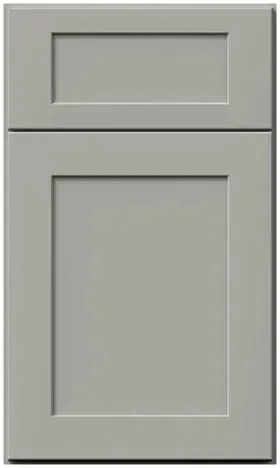


The applied front: what the DWR panels are for, and the three numbers that get one ordered right
Reviewed September 2026 · Captivating Cabinets
This is a two-SKU page, which is unusual enough to be worth explaining rather than padding. An applied front is a finished face with no cabinet behind it: it is fixed to something that already exists — a drawer box, an appliance, a carcass edge, a site-built structure — so that the thing behind it reads as part of the run. The two parts listed here are narrow, and that narrowness is the whole story of where they get used.
What an applied front is, and what it is not

Every drawer in this line arrives with its face already on it: a ⅝-inch solid-wood dovetail box on Blum Tandem plus Blumotion runners, with the five-piece shaker front fitted at the factory. You do not order a front for a drawer you are also buying. An applied front is for the cases where there is no cabinet in the order to carry the face.
The common ones are all gaps rather than storage. A narrow strip between a drawer bank and an appliance, where a plain filler would look like a filler and a faced piece looks like part of the run. The return at the end of a peninsula where a drawer bank stops. A site-built structure — a bench, a plinth, a boxed-in duct — that has to read as cabinetry. And occasionally a genuine false front, where a sink or an appliance sits behind what looks like a drawer.
What it is not is a replacement front for a cabinet you already own from another line. Reveals, overlays and rail widths differ between manufacturers, and a face built for these boxes will not land correctly on somebody else’s. If that is the job, the parts you want are on the refacing panel page and the conversation starts with photographs.
The two parts, and an honest note on how narrow they are
| SKU | Width as listed | Price | Typical use |
|---|---|---|---|
| GN DWR1-1/2 | 1-1/2″ | $123.50 | A hairline gap beside an appliance or at a run return |
| GN DWR3 | 3″ | $130.00 | The standard narrow strip where a filler would be too plain |
One and a half inches and three inches are not drawer widths. They are strip widths. That matters, because a shopper arriving from a search for "drawer front" is usually picturing an 18 or 30-inch face, and neither of these is that. Read together with the third member of the same family — GN DWR6 at $201.50, which the store titles as a dishwasher panel and which lives on the dishwasher panel page — the DWR codes read as an ascending series of narrow finished faces, 1-1/2, 3 and 6 inches, sized for the gaps around appliances rather than for drawers.
We are not going to resolve that from a product title. The listing says drawer panel and the family behaves like an appliance-gap panel, and those two readings imply different parts arriving in the box. Tell us the opening and what is behind it, and we will confirm which part the code ships as before the order is released. That is a design question, not an extra charge.
Three numbers get an applied front ordered right
An applied front is specified against an opening, not against a cabinet code, which is the opposite of how everything else in this catalogue is ordered. The SKU reading guide explains the cabinet convention; this part sits outside it. Three measurements do the work.
- The finished opening, width and height, measured where the face will land — not the nominal gap on the plan. On an existing structure, measure at the top, middle and bottom, because the number you want is the smallest one.
- The reveal you are matching. Look at the drawer tier beside the opening and measure the gap between fronts. The applied piece has to sit in the same rhythm or the eye catches it immediately, and a half-millimetre at eye level on a base run is more visible than people expect.
- What is behind it, and how it will be fixed. A drawer box, an appliance door, a plywood carcass edge and a site-built frame all take a different fixing, and that decides whether the piece needs to be supplied oversize for trimming.
Send those three with a photograph of the opening. Anything that has to be trimmed on site should go out with GNK EDGE-BAND at $7.15 in the same box, because a cut edge on a narrow piece is proportionally far more visible than the same cut on a big panel — there is less face to look at and more edge.
Where these earn their keep on a kitchen plan
The best use we see is the appliance gap in a drawer run. A dishwasher or a panel-front appliance set into a bank of drawers leaves a strip either side, and the eye reads that strip against the drawer fronts above and below it. A flat filler there breaks the rhythm; a faced strip in the same paint continues it. That is a three-inch decision that changes how the whole run photographs.
The second is a peninsula or island return. Where a drawer bank stops and the end of the run has to turn, a narrow applied face closes the corner in the same plane as the fronts. What you are choosing between there is this part, a filler, and a proper end panel, and the answer depends on how much of the end is seen — the decorative end panel page takes that decision on directly.
The third is the one nobody plans for: a change on site. A duct turns out to be where a cabinet was going, a structural post cannot move, a window sits two inches lower than the drawing. A narrow finished face is what turns that improvisation into something that looks intended, which is also the argument for having the elevation drawn properly first. Send it for a free 3D design and most of these surprises get found on paper.
Ordering, lead time and what ships with it
These are made in the same run as the doors, on the same five-piece shaker construction — ¾-inch solid stiles and rails around a ⅜-inch recessed MDF centre — and they carry the same Fabuwood limited lifetime warranty as everything else on a KCMA-certified, AWI Premium Grade order. Lead time is the collection’s: seven days to three weeks, pre-assembled.
Order them with the cabinets. A face this small is exactly the sort of item that gets added later, and later means a different finishing batch — which on a narrow strip sitting directly between two doors is the worst possible place for a variance. On a mid-tone grey, two adjacent faces from different runs is a thing you will see every time you walk past, and there is no fixing it afterwards short of reordering.
The full parts list is on the decorative accessories page; the applied fronts themselves are here. If you want to check the paint against your floor before committing to anything at all, a door sample is the cheap first move, and the whole range is on the collection.
Common questions
- What is an applied drawer front?
- A finished face with no cabinet behind it, fixed to something that already exists — a drawer box, an appliance, a carcass edge or a site-built structure — so that thing reads as part of the cabinet run. Drawers you buy from this line arrive with their fronts already fitted, so you only need an applied front where there is no cabinet in the order to carry the face.
- How wide are the DWR panels in this finish?
- GN DWR1-1/2 is listed at 1-1/2 inches and is $123.50; GN DWR3 is listed at 3 inches and is $130.00. Those are strip widths, not drawer widths, which is why they are usually specified beside an appliance or at a run return rather than on a drawer box.
- Is a drawer panel the same thing as a dishwasher panel?
- They are the same family — GN DWR6 at $201.50 is titled as a dishwasher panel and sits directly above these two in the series. The titles read one way and the family behaves another, so tell us the opening and what is behind it and we will confirm which part the code ships as before the order goes out.
- Can I order a matching front for a cabinet from another brand?
- Not reliably. Reveals, overlays and rail widths differ between manufacturers, so a face built for these boxes will not land correctly on someone else’s cabinet. If that is the job, start on the refacing panel page and send photographs.
- Should I use an applied front or a filler in an appliance gap?
- A filler if the gap is just a gap — GN BF3 is $26.00. An applied front if the strip sits in the middle of a drawer tier, where a flat piece breaks the rhythm of the fronts above and below it. In a run of drawers the faced version is usually worth the difference.
- What do you need from me to quote one?
- The finished opening measured at top, middle and bottom; the reveal on the drawer tier you are matching; and what the piece will be fixed to. A photograph of the opening with those three numbers is enough to price it first time.
Keep reading
The guides behind the numbers on this page.
- How to Read Cabinet SKU Codes
The convention this part deliberately sits outside.
- Cabinet Terminology and Abbreviations
Reveal, overlay, applied front — the words this page uses.
- End Panels, Scribe Molding and Fillers Explained
The three neighbouring parts, and when each one is right.
- Full Overlay vs Partial Overlay vs Inset
Why the reveal beside an applied front has to be matched.
- Fabuwood Cabinet Sizes and Specs
Door and drawer dimensions an applied face has to agree with.
- Fabuwood Door Styles
The five-piece shaker construction these faces are built on.
- Free 3D Kitchen Design
How to get the appliance gaps drawn before they are improvised.


