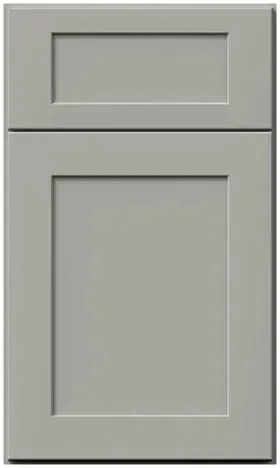


Order by the opening, not by the glass: framing a bathroom mirror in Galaxy Nickel
Reviewed September 2026 · Captivating Cabinets
Almost every builder-grade bathroom has the same mirror: a rectangle of plate glass held to the wall with four metal clips, cut to no particular dimension, finishing at no particular line. It is the last thing in the room that still looks like the day the house was handed over, and it is sitting eighteen inches above a vanity that has just been replaced. Mirror moulding is the part that closes that gap — a rabbeted profile in the cabinet finish, made to frame glass. There is one of it in this finish, it is $87.75, and the only difficult thing about it is the measurement, which is not the measurement most people take.
What the part is

GN MIRROR MOLDING is a length of profile finished on its faces and rabbeted along the back inner edge, which is to say there is a step cut into it that the edge of the glass sits into. Four pieces mitred at the corners make a frame; the rabbet holds the glass; the outside face is the finish. It is $87.75 on the live list.
Two jobs come out of that. The first is framing a mirror that is already on the wall — the frame is assembled around it in place, or assembled and dropped over it, and fixed to the wall rather than to the glass. The second is building a frame for a new mirror, in which case the glass is ordered to suit the frame instead of the other way round, and everything gets easier.
What it is not: a medicine cabinet, a mirror, or a kit. It is material by the length, and there is no hardware in the box. Whoever cuts it needs a mitre saw and somewhere flat to glue up.
The measurement people take, and the one they should take
Here is the mistake, and it is close to universal. Somebody measures the mirror — thirty inches by thirty-six, say — and orders enough moulding for a frame with those inside dimensions. The frame is then built to thirty by thirty-six as a daylight opening, the glass is offered up, and it will not go in, because the rabbet has to overlap the glass edge to hold it. The frame that fits a thirty-by-thirty-six mirror has an inside dimension slightly smaller than the glass on every side, and an outside dimension larger again by twice the profile width.
So work in three numbers, in this order, and the part will fit the first time.
- Measure the glass itself, both dimensions, at both ends. Plate mirrors are cut by hand and are rarely square; use the largest number in each direction.
- Subtract the rabbet overlap from each side to get the daylight opening — the visible aperture the frame leaves. This is the dimension the frame is actually built to.
- Add twice the profile width to each glass dimension to get the outside size of the finished frame. That is the number to check against the wall, the light fixture above and the backsplash below, because it is the thing that has to physically fit the space.
Then the material: total stick length needed is the perimeter of the outside dimension, plus roughly eight inches per corner for the mitres, rounded up to whole sticks. A thirty-by-thirty-six mirror in a two-inch profile has an outside perimeter of around eleven feet before waste, which is more material than the small numbers in your head suggest.
The honest caveat: the live list publishes this as one part at one price and does not give the rabbet depth, the profile width or the stick length. Those three numbers are what the arithmetic above depends on. Ask us for them before ordering — it takes one message and it is the difference between one order and two.
Framing what is on the wall against building new
| Framing an existing wall mirror | Building a new frame | |
|---|---|---|
| Order sequence | Measure glass, then order moulding | Order moulding, then have glass cut |
| Tolerance | Whatever the glass happens to be — often out of square | Cut to the sixteenth, square |
| Assembly | Mitred and glued around the glass in place, or dropped over it | Glued up flat on a bench, then hung |
| Fixing | To the wall, never to the glass | To the wall, with the glass captive in the rabbet |
| Risk | The frame fouls the existing clips or the light fixture | Very little — everything is known before cutting |
The first column has one specific trap worth naming. Builder-grade mirrors are held by J-clips at the bottom and spring clips at the top, and those clips stand proud of the glass. A frame assembled around the mirror has to clear them or the clips have to come off first, which usually means somebody is holding a large sheet of glass against a wall. Decide which before the moulding is cut.
Judge the frame under the bathroom light, not the kitchen one
A framed mirror puts the cabinet finish at eye level, eighteen inches above the vanity, directly under whatever fixture is over it — and bathroom fixtures are the warmest lights in most houses, frequently 2700K and frequently very close to the surface. A mid-tone grey under a very warm light at close range loses a little of its crispness and can read slightly dull, where the same finish on the vanity doors three feet lower, catching daylight from the door, does not.
This is not an argument against the frame. It is an argument for looking at a sample on the wall, in that position, with the fixture on, before ordering — and for choosing a cooler lamp if the bathroom is being relamped anyway. The gray shade guide covers how much lighting moves a mid-tone, and a door sample held where the frame will go answers it in a minute.
The proximity point cuts the other way too, and in your favour. A frame and a vanity door are the two pieces of this finish that a person will ever see closest together at the same eye height, which makes the match more convincing than anything achievable in a kitchen, where the nearest comparison is a wall cabinet six feet from a base one.
When we would not use it
The mirror is wider than about sixty inches. A long mitred frame in an applied profile will move with the bathroom’s humidity, and the corners are where that shows. Above that width a mirror with its own integral frame, or a pair of mirrors over a double vanity, is the sounder answer.
There is a medicine cabinet. A surface-mounted cabinet has its own door and edge and does not want framing; a recessed one wants a trim that suits the wall, not the vanity.
The bathroom is deliberately contemporary. A frameless mirror with a polished edge is the current default for a reason, and a traditional framed mirror over a flat-fronted vanity can look like it came from a different project. This is a taste call rather than a technical one, but it is worth making consciously — the vanity buying guide has both versions.
Everything on this page is priced on the mirror moulding page, and the vanity accessories list carries the rest of what goes around a bathroom run in the same finish.
Common questions
- How do I measure for a mirror frame?
- Measure the glass at both ends in both directions and take the largest number each way. Subtract the rabbet overlap per side for the daylight opening the frame is built to, and add twice the profile width to each glass dimension for the outside size that has to fit the wall. Order by those numbers, not by the mirror’s bare dimensions.
- What is mirror molding?
- A length of profile in the cabinet finish with a rabbet cut along the back inner edge for the glass to sit into. GN MIRROR MOLDING is $87.75. Four mitred pieces make a frame — it is material by the length, not a kit, and no hardware comes with it.
- Can I frame a mirror that is already glued to the wall?
- Yes, and it is the commonest use. The frame is mitred around the glass in place and fixed to the wall, never to the mirror. Check the existing clips first: J-clips and spring clips stand proud of the glass and either have to be cleared by the frame or removed before it goes on.
- How much mirror molding do I need?
- The perimeter of the finished outside dimension, plus about eight inches per corner for the mitres, rounded to whole sticks. A 30″ × 36″ mirror in a two-inch profile is around eleven feet before waste. The live list does not publish the stick length or profile width, so confirm those with us first.
- Will the frame match my vanity exactly?
- It is the same finish on the same programme, and because a frame and a vanity door sit at the same eye height about eighteen inches apart, it is the closest side-by-side comparison of this finish anybody will make. Look at a sample in that position under the actual bathroom light before ordering.
- Is a framed mirror still in style?
- In a traditional or transitional bathroom, yes. Over a deliberately contemporary flat-fronted vanity, a frameless polished-edge mirror usually reads better. It is a taste decision rather than a technical one, and worth making on purpose rather than by default.
Keep reading
The guides behind the numbers on this page.
- Fabuwood Bathroom Vanities: Sizes, Styles and Buying Guide
The vanity the frame has to match, and the mirror conventions above it.
- Kitchen Cabinet Molding Types
The whole trim vocabulary in one place, with what each profile is for.
- Gray Kitchen Cabinets: Finding the Right Shade
How much a warm bathroom lamp moves a mid-tone at close range.
- Kitchen Cabinet Samples: How to Order and Evaluate
Hold one where the frame will go, under the fixture that will light it.
- How to Match Cabinets, Countertops, Backsplash and Flooring
Where a framed mirror sits in a whole-room palette.
- Cabinet Terminology: Parts and Abbreviations
Rabbet, daylight opening, mitre — the words on a frame quote.
- How to Clean and Care for Kitchen Cabinets
A mirror frame lives in steam; the care routine is the same as the vanity’s.


