

Over the sink window: what a valance spans, what it can carry, and whether you still want one
Reviewed September 2026 · Captivating Cabinets
There is a gap in every kitchen where the cabinets stop and the window starts. Two wall cabinets flank it, the run of colour and doors breaks for thirty-six or forty-eight inches, and above the sink there is nothing — no box, no light, no line. A valance is the horizontal piece that spans that opening: fastened to the sides of the two cabinets either side, with no box behind it, doing two jobs and one of them genuinely useful. It is also the most divisive item on the whole trim list, and this page is going to be straight with you about that rather than pretending otherwise.
The piece has no box behind it, and that changes how it is ordered
A valance is a face with no carcass. It fastens to the inside faces of the cabinets on either side of an opening and hangs there, closing the top of the gap so the eye reads a continuous line across the run instead of a break. Because it spans rather than stands, the width that matters is the opening between the two cabinets, not the width of the window, not the width of the sink, and not the wall.
That catches people out on their own measurements. A window can be forty-two inches wide in a fifty-four-inch gap between cabinets, and the valance that fits is a fifty-four. Measure cabinet side to cabinet side.
One honest limit on our data: the live list publishes the width of each valance and its price, and does not publish the height of the face or how far it projects. Those two numbers decide whether it clears a tall faucet and how much of the window head it covers, and we would rather you asked us than assumed. Send the opening width and the faucet height and we will check both before anything is ordered.
The decorative job, and the one that actually justifies it
The first job is visual: the valance closes the top of the opening so the horizontal line of the upper run carries across the window instead of stopping dead at each cabinet. In a kitchen with a strong horizontal emphasis that helps. With a tall window running up to the ceiling it fights the window and should be left off.
The second job is the one worth paying for. Above a sink there is no cabinet, which means there is no under-cabinet fixture, which means the single most-used work surface in the kitchen is the only one without a light over it unless a ceiling fitting happens to land there. A valance gives you something to mount a fixture behind. A slim linear light fitted to the back of the valance face lights the sink and the window sill, the source is hidden exactly the way light rail hides one under a cabinet, and the problem is solved with a part you were considering anyway.
If you are undecided about a valance and the sink lighting is unresolved, that is your answer. If the sink already has a pendant or a well-placed downlight, the second job disappears and you are back to a purely decorative decision.
Three families, and the price gap between them is large
| Family | Code | Width | Price | Character |
|---|---|---|---|---|
| Standard | GN VAR36 | 36″ | $91.00 | Plain face, shallow |
| Standard | GN VAR54 | 54″ | $100.75 | Plain face, shallow |
| Premium | GN VARP36 | 36″ | $217.75 | Shaped and deeper |
| Premium | GN VARP42 | 42″ | $221.00 | Shaped and deeper |
| Premium | GN VARP48 | 48″ | $230.75 | Shaped and deeper |
| Premium | GN VARP54 | 54″ | $234.00 | Shaped and deeper |
| Straight tall | GN VST96 | 96″ | $188.50 | Flat, long, cut to suit |
Read the price column and the pattern is immediate: premium costs roughly twice standard at the same width, and the whole premium family sits within $16.25 of itself from 36 to 54 inches, while the two standard sizes differ by $9.75. The width barely moves the price. The family does. Whatever you are choosing between, you are choosing between plain and shaped, not between sizes.
The straight tall, GN VST96 at $188.50, is the outlier and the most useful item in the table for reasons that have nothing to do with its intended use. It is ninety-six inches long, flat, and it can be cut — which makes it the answer for any opening the other two families do not have a size for.
The sizes that are missing, and what to do about them
Look at the widths again as a ladder. Standard exists at 36 and 54 only. Premium exists at 36, 42, 48 and 54. So a 42-inch opening has a premium option and no standard one; a 48-inch opening is the same; and anything at 30, 60 or 66 inches has nothing in either family.
Three ways out, in the order we would try them. First, check the opening against the ladder before the layout is fixed — a 54-inch gap and a 60-inch gap are often interchangeable on a drawing, and choosing the one with a part available costs nothing at design stage. The wall cabinet page is where that gap is set.
Second, buy the next size up and cut it down. A valance is a face, not a box, so shortening one is straightforward — provided the cut lands where the cabinet side it fastens to will hide it.
Third, for anything long or awkward, the 96-inch GN VST96 at $188.50 is cheaper than a premium 54 and can be cut to any width up to eight feet. It is flat rather than shaped, which for a contemporary kitchen is the better look anyway.
The honest answer on whether this looks dated
It depends entirely on which of the three families you are looking at, and lumping them together is why the internet cannot agree about it.
The shaped premium profiles — the arched and scalloped ones — are the ones that read as a particular period. They belong in a traditional kitchen with a detailed door and they look coherent there. Over a flat-fronted contemporary run they are the single detail most likely to make an otherwise current kitchen look a decade older than it is. If that is the version on your quote and you are not building a traditional room, that is the one to question.
The straight versions are a different proposition. A flat horizontal face spanning a window opening is a plain architectural move, not a decorative one, and it reads as current — particularly when it is carrying a light, because it then has an obvious reason to exist. The straight tall at $188.50 is the safest choice on the table for a modern kitchen.
And the third answer is no valance at all, which is the commonest outcome in new kitchens. The uppers stop at the window casing, the window does its own work, the sink gets a pendant. If you are on the fence with no lighting problem to solve, that is the default we would steer you to.
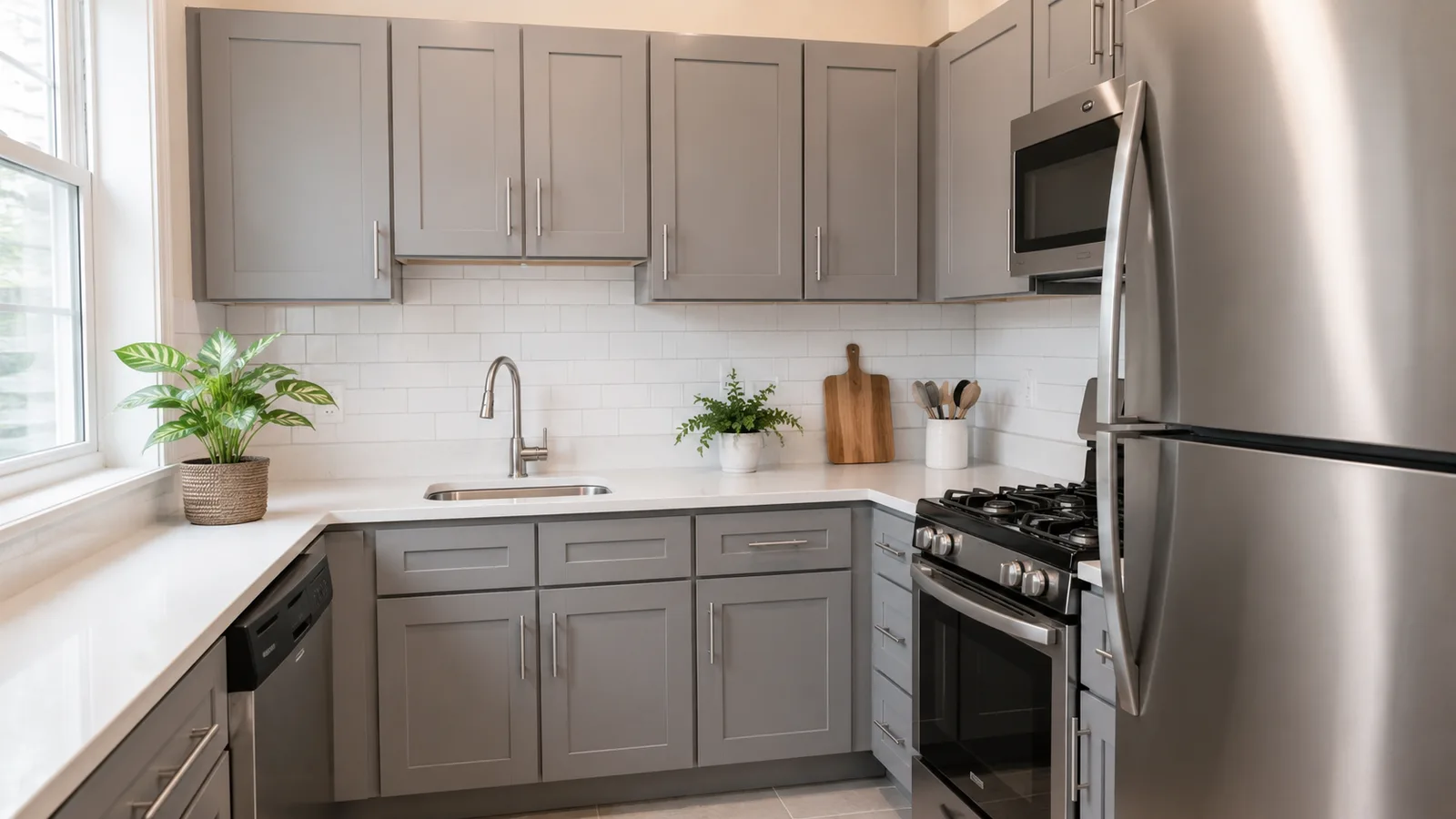
One thing to look at first, specific to a coloured kitchen: a valance sits against the brightest part of the wall, so in daylight you see it in silhouette rather than in colour, and a mid-tone reads very dark against a window — much darker than the same finish three feet to either side. Photographs of finished rooms in the cabinet ideas gallery show both versions, and are usually shot with the window blown out, which hides exactly this effect.
What people use instead
Return the light rail onto the cabinet sides. The horizontal line then stops cleanly at each cabinet rather than running across, which on a contemporary run looks deliberate. Cheaper too, since the light rail is already on the order at $149.50.
Run a shelf across instead. Where there is depth above the window head, a shelf spans the opening and holds something, which a valance does not. The floating shelf list has the options in this finish.
Take the cabinets to the window casing on both sides and stop. This is the plain answer and it is right more often than the trim list implies — it is also what most of the kitchens in the 10x10 pricing guide are configured as.
Common questions
- What is a kitchen valance for?
- It spans the opening between two wall cabinets — usually over a sink window — so the horizontal line of the upper run carries across the gap. It also gives you something to mount an under-valance light behind, which is the more useful of its two jobs since there is no cabinet over the sink to hold a fixture.
- How do I measure for a valance?
- Measure cabinet side to cabinet side at the height the valance will sit, not at the counter and not across the window. Runs get scribed and shimmed, so the gap at the top can differ from the gap lower down by a quarter of an inch.
- What is the difference between a standard and a premium valance?
- Roughly double the price and a shaped rather than plain face. GN VAR36 is $91.00 against GN VARP36 at $217.75 in the same 36-inch width. Width barely changes the price within either family — the family is the decision.
- Are kitchen valances outdated?
- The shaped premium profiles read as a particular period and look out of place over a flat-fronted contemporary run. A straight valance is a plain architectural move and still reads as current, especially when it carries a light. And no valance at all is the commonest choice in new kitchens.
- What size valance do I need for a 60-inch opening?
- Nothing in the standard or premium families goes past 54 inches, so the answer is GN VST96 straight tall at $188.50 — ninety-six inches, flat, and cut to the width you need with the cut landing where the cabinet side hides it. It is also cheaper than a premium 54.
- Can a valance hold under-cabinet lighting?
- Yes, and it is the best argument for fitting one. A slim linear fixture mounted behind the face lights the sink and the sill, with the source hidden the same way light rail hides one under a cabinet. If the sink already has a pendant or a downlight, that argument disappears.
Keep reading
The guides behind the numbers on this page.
- Kitchen Cabinet Molding Types
The whole trim vocabulary in one place, with what each profile is for.
- 27 Kitchen Cabinet Ideas
Finished rooms with shaped valances, straight ones and none at all.
- Wall and Tall Cabinet Sizes and Buying Guide
Setting the opening width at design stage so a part exists for it.
- Kitchen Cabinet Styles and Color Trends for 2026
Which decorative details are currently being specified and which are not.
- What Is a 10x10 Kitchen: Cabinet Pricing Guide
How a standard package configures the run either side of a sink.
- Gray Kitchen Cabinets: Finding the Right Shade
Why a mid-tone reads so much darker in silhouette against a window.
- Small Kitchen Design and Layout Ideas
Where a horizontal line across an opening helps a small room and where it crowds it.
- Cabinet Terminology: Parts and Abbreviations
VAR, VARP and VST on a quote, decoded.


