

Sheet goods in the finish: who buys plywood panels off a cabinet order, and what they build with them
Reviewed September 2026 · Captivating Cabinets
Everything else in this collection arrives as a finished object. This page is raw material — large sheets in the same paint and the same finishing run as the doors, sold to be cut up. Almost nobody buys one by accident, and the people who do buy them are usually solving a problem the catalogue has no part number for. If you have arrived here from a search for a cabinet, you are probably in the wrong place; if you have arrived because a wall, a duct or an appliance has defeated the standard grid, read on.
Who actually buys a sheet

Three groups, and they want different things from the same product.
Cabinet shops and millworkers buy sheets to build something the line does not make: a bespoke island carcass, a banquette, a window seat, a bar front, a run at a width or depth that does not exist as a box. They are buying the finish, not the plywood — the point is that the bespoke element comes out of the same paint batch as the factory cabinets beside it, which is the one thing a local supplier cannot offer at any price.
Installers buy sheets to solve a site problem. A boxed-in soil stack that has to read as cabinetry, a bulkhead, a radiator cover, a stair return that clips the end of a run, an appliance surround that does not fit any stock enclosure. These are usually one-off cuts on a job that is otherwise standard, and the sheet is bought as insurance as much as anything.
And builders and remodellers running several kitchens buy them as stock, because a sheet on the van converts an awkward wall into a finished detail without a second delivery. If that is the pattern of your work, the Captivating Pro programme is built for the repeat side of it, and cabinets for remodelers and cabinet supply for builders cover how the ordering works.
The six sheets, and what the codes are telling you
Two variables run through the list: thickness, and whether the sheet is finished on one face or two. A one-side sheet is for anything fixed against something — a carcass side, a clad face, a boxed-in structure. A two-side sheet is for anything seen from both directions: a divider, a shelf, an island panel with a walkway behind it, the inside of an open structure.
| SKU | Thickness | Published size | Price |
|---|---|---|---|
| GN PLY-1/2 | ½″ | not published on the live list | $448.50 |
| GN PLY-3/4 | ¾″ | not published on the live list | $516.75 |
| GN PLY-1/2 48X120 | ½″ | 48″ × 120″ | $806.00 |
| GN PLY-3/4 48X120 | ¾″ | 48″ × 120″ | $910.00 |
| GN IN PLY 1/2-2 SIDE | ½″, finished both faces | not published on the live list | $390.00 |
| GN IN PLY 3/4-2 SIDE | ¾″, finished both faces | not published on the live list | $455.00 |
The two sheets that do publish a size give you the only reliable rate on the page. At 48 by 120 inches a sheet is 40 square feet, so GN PLY-1/2 48X120 at $806.00 works out at $20.15 a square foot and GN PLY-3/4 48X120 at $910.00 at $22.75. That is the number to hold in your head when you are deciding whether a bespoke element is worth building.
Two things in those prices that do not rank the way you would expect
We would rather flag these than have you notice them and assume the whole page is careless.
The first: four of the six sheets do not publish a face size on the live list. The trade assumption for a cabinet-grade sheet is 48 by 96, and the existence of explicitly named 48 by 120 variants points the same way — but an assumption is not a dimension, and a sheet is bought by area. Confirm the size before the order is released, particularly if you are costing a job off a square-foot rate.
The second is stranger. The two-side finished interior panels are cheaper than the one-side plywood panels of the same thickness: GN IN PLY 1/2-2 SIDE at $390.00 against GN PLY-1/2 at $448.50, and GN IN PLY 3/4-2 SIDE at $455.00 against GN PLY-3/4 at $516.75. More finishing for less money is not how sheet goods normally price, which almost certainly means the two families are different sizes or different grades rather than the same sheet with a different face count. We are not going to guess which. Ask us which sheet suits the job and we will confirm the dimensions and the grade in writing before anything is cut.
What gets built from them
- Appliance surrounds. A fridge enclosure, a built-in coffee machine housing, a wine fridge in a run — anything where the appliance dimensions do not match a stock opening.
- Boxed-in services. Soil stacks, waste runs, ducting from a hood, and the bulkhead above a run. Cladding these in the cabinet finish is what turns a compromise into a detail.
- Seating. Banquettes, window seats and bench bases, where the seat has to match the kitchen but is not a cabinet and never will be.
- Island and peninsula structures. A bespoke carcass, a raised bar back, a waterfall return that carries down to the floor, or simply a deeper island than the grid allows.
- Shelving and dividers, where the two-side finished sheet earns its premium — anything seen from both faces.
- Repairs and refaces, where an existing box needs a new visible face rather than a whole new cabinet. The refacing panel page has the parts cut for that specific job.
One warning that applies across all of them: a sheet is not a cabinet. It carries no shelf, no hinge, no runner and no warranty on anything you build with it — the Fabuwood limited lifetime warranty covers the manufactured product, not a site-built structure made from its material. That is not a trap, it is just worth being clear about before a structural element gets built out of cladding.
Cutting, edges and getting the grain of the job right
Every sheet on this page becomes several cut edges, and every cut edge is raw core in a colour nothing like the face. That rule is set out properly on the decorative accessories page; the only thing to add here is scale. One end panel produces one or two edges to deal with. One sheet cut into a banquette produces twenty. Order GNK EDGE-BAND at $7.15 and GNK TOUCH-UP-KIT at $62.40 as a matter of course, not as a contingency, and order more banding than you think — it is on the loose parts page.
Two practical notes. Cut so the blade exits through the raw face rather than the finished one; tear-out on paint cannot be sanded out and a painted sheet gives you no second chance. And plan the cutting list before the sheet arrives, because a 48 by 120 sheet weighs enough that you want to be moving it once, and an unplanned rip is how a $910.00 sheet becomes two offcuts.
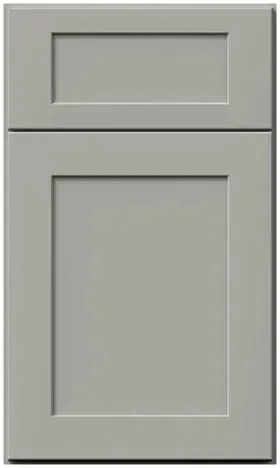
Finally, batch. Sheets should be ordered with the cabinets so the whole job comes from one finishing run. This is the single most important thing on the page for a bespoke element, because a site-built piece sitting directly against a factory door is the hardest possible test of a paint match — and a mid-tone shows a batch difference where a bright white can hide one.
Ordering sheets alongside a kitchen
Tell us what you are building, not just which sheet you want. Half the time there is a manufactured part that does the job better and cheaper, and the other half the answer is a sheet plus a part — a sheet for the structure and a stock skin or panel for the visible end.
Lead time is the collection’s: seven days to three weeks, shipping with the rest of the order. Sheets are the item most worth consolidating into one delivery, because a single sheet arriving separately is an awkward and expensive parcel.
The sheets are here, the cut-to-purpose alternatives are on the refacing and skin pages, and the full range is on the collection. If the work is repeat trade rather than one kitchen, start at Captivating Pro.
Common questions
- Who buys finished plywood panels?
- Cabinet shops building something the line does not make, installers solving a site problem such as a boxed-in stack or an appliance surround, and trade buyers keeping a sheet on the van. The point is never the plywood — it is that the sheet comes out of the same paint batch as the factory cabinets beside it.
- How much is a finished plywood sheet in this colour?
- GN PLY-1/2 is $448.50 and GN PLY-3/4 is $516.75. The 48 by 120 inch versions are $806.00 and $910.00, which at 40 square feet works out at $20.15 and $22.75 a square foot. The two-side finished interior panels are $390.00 and $455.00.
- What size are the sheets?
- Only the two 48 by 120 inch sheets publish a size on the live list. The other four do not, and we are not going to state a dimension we cannot show you — ask us to confirm before the order is released, especially if you are costing a job off a square-foot rate.
- Why is the two-side finished panel cheaper than the one-side sheet?
- It should not be, on the face of it, which is why we flag it rather than explain it away. Almost certainly the two families are different sizes or grades rather than the same sheet with a different face count. Tell us the job and we will confirm the dimensions and grade in writing before anything is cut.
- Should I build a cabinet from sheets or buy one?
- Buy one wherever the grid fits. A standard base is $273.00 at the narrowest and $555.75 at 30 inches, delivered pre-assembled with a dovetail drawer and Blum hardware in it, and nothing you build from a sheet will match that on cost or on function. Sheets are for the cases where nothing in the grid fits.
- Does the warranty cover something I build from a sheet?
- The Fabuwood limited lifetime warranty covers the manufactured product, not a site-built structure made from its material. That is worth being clear about before a structural element gets built out of cladding.
Keep reading
The guides behind the numbers on this page.
- Kitchen Cabinet Materials and Construction
Cores, veneers and grades, and why a cut edge behaves as it does.
- Cabinets for Remodelers
How sheet goods fit a job that is otherwise standard cabinets.
- Cabinet Supplier for Builders
Ordering material and boxes on the same schedule.
- Cabinets for Contractors
Trade pricing and the repeat-order side of sheet purchasing.
- Is Refacing Kitchen Cabinets Worth the Money?
The other reason people buy sheet material in a cabinet finish.
- What Makes a Cabinet High End?
What you give up when a site-built element replaces a box.
- Fabuwood Allure Series Explained
The line these sheets are finished to match.
- Fabuwood Cabinets Review
An independent read on the construction you are matching to.


