

Sizing a refrigerator panel off the appliance: four numbers, and the flattest surface in the room
Reviewed September 2026 · Captivating Cabinets
Every other finished part in a kitchen is ordered against a cabinet. This one is ordered against a refrigerator — an object that is not in the catalogue, was probably bought separately, and whose real dimensions are not the ones on the spec sheet. That single fact is why fridge panels are the part most often ordered at the wrong size, and why this page is a worksheet rather than a list. Four numbers, taken off the appliance, decide which of these four parts you need.
The four numbers, and where each one actually comes from
- Depth of the appliance including doors and handles, measured on the machine or off the installation sheet — not the marketing figure. A counter-depth model lands somewhere around 27 to 30 inches once the handles are counted; a standard-depth one is commonly 32 to 36. This number decides how much panel width you need, because the panel’s width is the bay’s depth.
- Height of the appliance including the hinge cap on top, plus whatever air the manufacturer asks for above it. Manufacturers differ and some want more than you would guess, so read the manual rather than assuming. This decides whether a 96-inch panel covers you or whether the job needs sheet material at 120.
- How far the panel has to stand proud of the carcass beside it, if at all. If the fridge face sits forward of the cabinet line, a flush panel leaves a step, and a build-out version puts the panel where the appliance is.
- How many sides are exposed. One if the fridge is against a wall or a tall run; two if it sits in an island of its own or at the end of a run with circulation both sides. This is the number that doubles the cost and is most often counted wrong on a plan.
Take all four before you look at prices. Three of the four are on the appliance rather than on any drawing, which is the whole reason this part gets mis-ordered — the elevation is dimensioned to the cabinets and the fridge is drawn as a rectangle. If the appliance has not been bought yet, that is fine and it is also the answer: buy it first, then order the panel. Important kitchen dimensions before buying cabinets covers the rest of the appliance-first measurements.
The four parts, and what each one solves
| SKU | Published size | The problem it solves | Price |
|---|---|---|---|
| GN REP1296 | 12″ × 96″ | A shallow bay, or the front foot of a deeper one where the rest is boxed in | $224.25 |
| GN REP1-1/2 | not published on the live list | A build-out where the appliance face sits forward of the carcass | $250.25 |
| GN REP3 | not published on the live list | A deeper build-out for the same condition | $325.00 |
| GN RFPEC | end cap | Closes the front edge of the panel so no cut core shows | $97.50 |
Be careful with the two middle rows. The codes read as thicknesses — 1-1/2 and 3 inches — and that is consistent with how the same suffixes behave on the refacing sheets, where a 30 by 96 panel is offered flush, at 1-1/2 and at 3. But the live list does not publish face dimensions for REP1-1/2 and REP3, and we are not going to state a size we cannot show you. If your bay needs a build-out, send the elevation and we will confirm the finished size before the order is released.
The other thing to know is that a 24-inch-deep bay is not served from this page. The 24 by 96 sheet is catalogued as a refacing panel — GN REP2496 at $295.75 — even though the job it does here is a fridge side. If your fridge is set into a run with a 24-inch-deep cabinet above it, that is very likely your part, and it is on the refacing panel page.
Counter-depth or standard, and what each does to the bay
The depth decision is made when the appliance is bought, and it changes the cabinetry more than any other appliance choice in the kitchen.
A counter-depth machine is built to sit roughly flush with a 24-inch base run once the doors are on, give or take the handles. The bay closes up neatly: the panel runs the depth of the surrounding cabinetry, the front edge lines through with the counter, and the whole thing reads as built in with no build-out needed. You pay for that in cubic feet inside the fridge, which is the trade everyone knows about.
A standard-depth machine is eight to twelve inches deeper than the run beside it, so it either stands proud in the room or gets recessed into the wall behind it. If it stands proud, the panel beside it has to cover that extra depth or it stops short and leaves a strip of appliance side showing at the front — which is exactly the visible mistake the panel was bought to prevent. This is where the build-out versions and the wider sheet earn their money.
Either way, the front edge of the panel is the detail that decides whether the bay looks finished. GN RFPEC at $97.50 closes it. It is the cheapest part in the assembly and the most exposed one — at hand height, on the edge people brush past carrying shopping.
This is the only large piece of the finish with no joinery in it
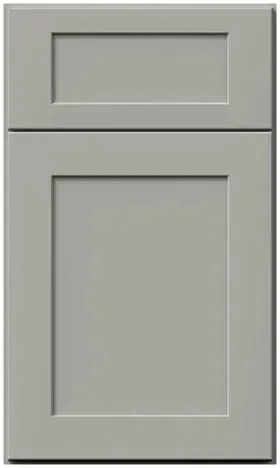
Look at any door in this line and the paint is doing its work across five pieces: two stiles, two rails, a recessed centre, and the shadow line between them. That geometry is forgiving. It breaks reflections up, it gives the eye somewhere to land, and it hides a great deal of what light does to a painted surface.
A fridge panel has none of it. GN REP1296 is eight square feet of unbroken flat face; the 24-inch sheet beside a deeper appliance is sixteen. There is no frame, no field, no shadow — just one rectangle of paint standing vertically at the exact height and angle where a window or a downlight will rake across it. On a mid-tone that is the single most honest surface in the kitchen, and two practical rules follow from it. Order the panel in the same batch as the doors, because a variance that hides on a five-piece face does not hide on a flat one. And treat touch-up here as a last resort rather than a plan, since a repair on an unbroken plane is visible from across the room where the same repair on a door edge is not.
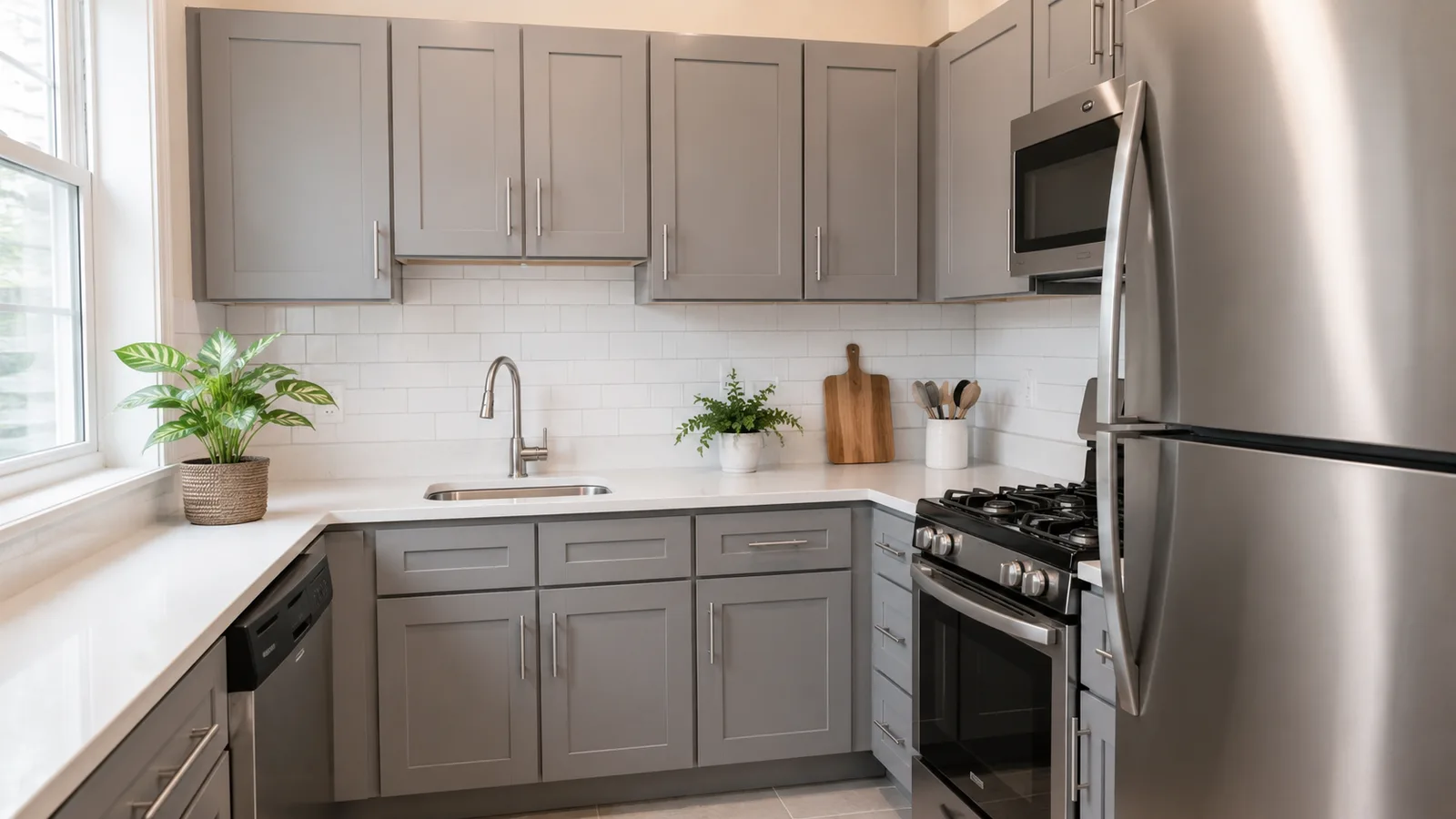
None of that is an argument against the colour, and it is not an argument for a smaller panel. It is an argument for ordering the whole bay — box, panel, end cap and filler — as one line at one time. How this finish behaves under different light is covered in finding the right shade of grey, and if you want to see it against your floor first, a door sample costs very little.
Ordering the bay as one item
Send us the appliance make and model, the four numbers above, and an elevation. The model number is the fastest route, because the installation sheet carries the real depth, the hinge-cap height and the clearance the manufacturer wants, and those three are what the panel is cut to.
Order the panel, the end cap, the cabinet above and the filler beside it together. They are one assembly and they arrive as one delivery on the collection’s normal seven days to three weeks, pre-assembled, KCMA certified, AWI Premium Grade, with the Fabuwood limited lifetime warranty. Split across two orders and the install waits for the cheapest part in it.
The panels are here, the deep boxes that go above the appliance are on the wall cabinet page, the tall run either side is on the tall cabinet page, and everything else that finishes a kitchen is on the decorative accessories page.
Common questions
- What size refrigerator end panel do I need?
- The panel’s width is the depth of the bay, and its height comes off the appliance plus the clearance the manufacturer asks for. GN REP1296 is the 12 by 96 inch part at $224.25; a 24-inch-deep bay is usually served by the 24 by 96 sheet, GN REP2496 at $295.75, which is catalogued under refacing panels. Take the numbers off the installation sheet rather than the plan.
- Do I need a panel on both sides of the fridge?
- Only where a side is exposed. Against a wall or a tall cabinet, one panel. In an open run with circulation on both sides, two — and that is the count most often got wrong on a plan, because it doubles the cost of the bay.
- What do GN REP1-1/2 and GN REP3 do?
- They build the face out, for a bay where the appliance sits forward of the cabinet line and a flush panel would leave a step. They are $250.25 and $325.00. The live list does not publish face dimensions for either, so send the elevation and we will confirm the finished size before the order is released.
- Does a counter-depth refrigerator need a different panel?
- Usually a simpler one. A counter-depth machine sits roughly flush with a 24-inch run once the doors are on, so the panel runs the depth of the surrounding cabinetry with no build-out. A standard-depth fridge is eight to twelve inches deeper and either gets recessed into the wall or needs the panel to cover that extra depth.
- What is the refrigerator side panel end cap for?
- GN RFPEC at $97.50 closes the front edge of the panel so no cut core shows. It is the cheapest part in the bay and the most exposed one — at hand height, on the edge people brush past — and it is left off more orders than anything else in the assembly.
- Why does the finish matter more on a fridge panel than on a door?
- Because there is no joinery in it. A door breaks the paint across two stiles, two rails and a recessed centre, and that geometry hides a lot. A panel is one unbroken flat rectangle standing where light rakes across it, so order it in the same batch as the doors and treat touch-up on it as a last resort.
Keep reading
The guides behind the numbers on this page.
- Important Kitchen Dimensions Before Buying Cabinets
The appliance-first measurements this page depends on.
- End Panels, Scribe Molding and Fillers Explained
Where a panel ends and a filler begins at an appliance bay.
- Wall and Tall Cabinet Sizes
The deep box above the fridge and the towers either side of it.
- Gray Kitchen Cabinets: Finding the Right Shade
How this mid-tone reads on a large unbroken plane.
- Matte Cabinet Finishes: Pros, Cons and Care
Sheen behaviour on a flat surface, and what shows on it.
- How to Clean and Care for Kitchen Cabinets
Keeping a large flat panel looking like the doors beside it.
- Fabuwood Cabinet Sizes and Specs
The cabinet depths a fridge bay has to agree with.
- Free 3D Kitchen Design
Getting the bay drawn with the real appliance in it.


