

The cheapest part on the order, and the one that saves the install: quarter round at the floor and wall line
Reviewed September 2026 · Captivating Cabinets
Every cabinet leaving the factory is square, flat and true, and every room it goes into is none of those things. A floor that falls half an inch across a ten-foot run is a normal floor. A wall that bows three-eighths of an inch between studs is a normal wall. When a square box meets a not-square room the difference appears as a tapering gap, and a tapering gap is the single most common thing that makes a new kitchen look badly fitted. Quarter round is $62.40, it is the smallest line on most orders, and it is what closes that gap in the two places where the gap is unavoidable.
Where the gaps appear, and why they are nobody’s fault

Base cabinets are levelled, not laid. An installer shims the run until the counter line is level end to end, which is the correct thing to do and means that where the floor drops away, the cabinet does not follow it down. A quarter-inch fall over a run of bases produces a quarter-inch gap at one end and nothing at the other. Nobody did anything wrong; the alternative — following the floor — puts a visible slope in the counter and the door reveals.
Walls do something similar in the horizontal plane. A finished end panel pressed against a bowed wall touches at the high point and leaves daylight either side of it, and that daylight varies along its length. Tall cabinets get it worst because they are the longest vertical surface in the room, and a bow that is invisible on a drawing is very visible against ninety-six inches of straight panel edge.
And ceilings do it at the top. A crown line scribed to a ceiling that dips in the middle of a run is the same problem again, which is why the parts that close these joints show up in three different places on a takeoff.
Which small part closes which gap
There are four answers and they are not interchangeable. The table is the point of this page: find the row that describes your gap, and the part is decided.
| Where the gap is | Size | The part | Price |
|---|---|---|---|
| Toe kick to a sloping floor | Up to ~1/2″, tapering | GN QRM quarter round | $62.40 |
| End panel to a bowed wall | Up to ~1/2″, varying | GN SM8-S or SM8-D scribe | $39.00 / $41.60 |
| Cabinet to wall, constant gap | 1″ and up, even | GN BF3 base filler | $26.00 |
| Counter to backsplash | Hairline | Flexible sealant, not a moulding | — |
| Cabinet to ceiling | Varying, at the crown line | Scribe, or the crown assembly itself | from $39.00 |
Read the second and third rows together, because they are the ones that get confused. A gap that is the same size all the way along is a filler problem — something is simply narrower than the space, and a flat piece closes it. A gap that changes size along its length is a scribe or quarter round problem, because no straight-sided piece will ever fit it. That distinction decides the part more reliably than measuring does, and it is set out at more length in the end panels, scribe moulding and fillers guide.
Scribe or quarter round: the two are not the same trick
Both close a tapering gap and they do it by opposite methods, which is why substituting one for the other on site produces a visibly different result.
A scribe is cut to the gap. The piece is offered up, the profile of the wall or floor is transferred onto it with dividers, and the waste is removed so the trim follows the irregular surface exactly. Done well it disappears, because there is no gap left to see. It takes a competent installer twenty minutes a piece.
A quarter round is laid over the gap. It is a constant section that bridges the joint, touching the cabinet on one face and the floor on the other, and its curve absorbs a varying gap because the point of contact simply slides along the radius. It takes five minutes and requires no skill beyond a mitre cut. What it does not do is disappear: there is now a visible rounded moulding at the floor line where before there was a shadow.
Which is why the honest rule is: scribe where the joint is at eye level and quarter round where it is at the floor. Nobody examines the base of a run from eighteen inches away. Everybody sees the joint beside a tall cabinet at chest height. Spending the installer’s twenty minutes in the right place is the whole decision. The scribe moulding page covers the technique in detail.
What it cannot hide
A quarter round covers a gap up to about its own radius, and past that the geometry stops working — the moulding starts to sit away from one surface or the other and the shadow behind it becomes more obvious than the gap ever was. As a working number, if the gap is bigger than half an inch anywhere along the run, this is the wrong part.
The second limit is variation rather than size. A gap that runs from nothing to three-eighths and back to nothing across a single eight-foot stick means the moulding has to rock along its length, and it will only be tight where it was nailed. Two shorter pieces, or a scribed piece, will look better than one long one fighting the floor.
Third, it cannot fix a level problem. If the counter line is visibly out, no amount of trim at the floor addresses it, and adding trim makes the taper at the bottom more legible rather than less by drawing a line along it. That is a shimming conversation, not a moulding one.
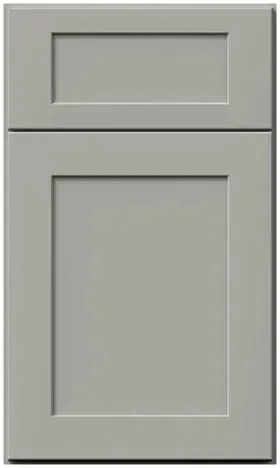
One finish-specific note. An unclosed shadow gap at the floor is less conspicuous under a mid-tone run than under a white one, where any dark line at the base is immediately obvious. That makes the temptation to skip the part stronger here — and it is still the wrong call at the floor line, because that gap is where mop water, crumbs and dust go, and it is the one place in the room where an open joint turns into a maintenance problem rather than just a visual one.
The floating floor case, which has a rule of its own
Laminate and engineered floors laid as floating systems need an expansion gap at every fixed obstruction, and a run of base cabinets is a fixed obstruction. The floor is cut short of the kick by a quarter to half an inch deliberately, and that gap is not a defect — it is what stops the floor buckling in August.
Quarter round is the standard way to cover it, and there is one rule that goes with it: the moulding is fastened to the cabinet or the toe kick, never to the floor. Pin it to the floor and you have fixed the floating floor in place at that point, which defeats the expansion gap you just left. Installers who fit floors know this instinctively; installers who fit cabinets sometimes do not, and it is worth saying out loud before anybody picks up a nail gun.
Sequence matters too. If the floor is going in after the cabinets — which is common, and which changes the kick height as well — the quarter round is the last thing fitted, after the floor, and it should be ordered at the start and left in the box until then. The toe kick page covers the height interaction, and everything here is priced on the quarter round page.
Common questions
- What is quarter round molding used for on cabinets?
- Covering a tapering gap where a cabinet or toe kick meets a floor or wall that is not true. GN QRM is $62.40. It bridges the joint rather than being cut to it, which makes it fast to fit and appropriate at the floor line, where nobody is inspecting the detail closely.
- What is the difference between scribe molding and quarter round?
- A scribe is cut to follow the irregular surface so the gap disappears; a quarter round lies over the gap and bridges it with a constant curve. Scribe where the joint is at eye level — beside a tall cabinet, at an end panel — and use quarter round at the floor.
- How big a gap can quarter round cover?
- Up to roughly its own radius, and as a working rule not more than about half an inch anywhere along the run. Beyond that the moulding lifts off one surface and the shadow behind it is more visible than the original gap. A bigger or constant gap is a filler or a scribe job.
- Why is there a gap between my new cabinets and the floor?
- Because the run was levelled rather than laid to the floor. An installer shims until the counter line is level end to end, which is correct, and where the floor falls away the cabinet does not follow it. The alternative puts a visible slope in the counter and the door reveals.
- Can I nail quarter round to a floating floor?
- No. Fasten it to the cabinet or the toe kick only. A floating laminate or engineered floor needs its expansion gap at the cabinets, and pinning the moulding through the floor fixes it at that point and defeats the gap.
- Do I need quarter round if the gap is barely visible?
- At the floor, usually yes. A shadow gap under a mid-tone run is less conspicuous than under a white one, which makes it tempting to leave — but that gap collects mop water, dust and crumbs, and an open joint at floor level becomes a maintenance problem rather than only a cosmetic one.
Keep reading
The guides behind the numbers on this page.
- Cabinet End Panels, Scribe Molding and Fillers Explained
The constant-gap versus varying-gap distinction, at length.
- Kitchen Cabinet Molding Types
The whole trim vocabulary in one place, with what each profile is for.
- Important Kitchen Dimensions Before Buying Cabinets
Level, plumb and square — and what a real room actually delivers.
- Pre-Assembled Kitchen Cabinets Buying Guide
Why a factory-square box has to be shimmed rather than laid to the floor.
- How to Clean and Care for Kitchen Cabinets
What an open joint at the floor line collects over a decade.
- How Long Do Kitchen Cabinets Last
Water at the base of a run is the thing that shortens the answer.
- Cabinet Terminology: Parts and Abbreviations
QRM, SM8 and BF3 decoded on a quote.


